
The Pediatric Boom: Why Specialized Home Care is 2026's Hottest M&A Segment
The pediatric home care market is exploding in 2026 with a 50 percent rise in deal volume. Specialized agencies are now commanding 7x+ EBITDA multipliers due to reimbursement stability and high-acuity demand. Learn why Senate Healthcare LLC is prioritizing these acquisitions and how you can capitalize on this "Golden Window" before valuations normalize.
3/2/20265 min read


Quick-Scan Summary
The pediatric home health sector has transitioned from a niche specialty to a primary driver of healthcare M&A activity. As we move through 2026, the data shows a clear preference among buyers for high-acuity pediatric services over traditional adult home health.
Who this is for:
Owner-operators of pediatric home health or hospice agencies.
General home health owners looking to diversify into specialized niches.
Healthcare executives planning an exit strategy within the next 12 to 18 months.
Key Takeaways:
Deal volume for pediatric in-home care spiked by 50 percent in 2025 and early 2026.
Reimbursement stability in pediatric Medicaid is currently outperforming Medicare home health.
Valuation multiples for specialized pediatric agencies are reaching 7x EBITDA and higher.
Senate Healthcare LLC is actively seeking to partner with and acquire agencies in this space to build regional density.
The Shift from Generalist to Specialist
For years, the "bigger is better" mantra dominated the home health or hospice landscape. Large platforms focused on broad adult populations to capture volume. However, 2026 has brought a sharp correction. The market now rewards specialization. According to recent Home Health Care News reports, the pediatric segment saw a 50 percent increase in deal volume over the last year. This isn't just a fluke; it is a strategic move by buyers to find "reimbursement moats" that protect against the volatility of adult home health regulations.
At Senate Healthcare LLC, we see this trend firsthand. While adult home health faces constant CMS payment rule changes, the pediatric sector benefits from a more stable, though complex, Medicaid environment. This stability makes your agency more predictable, and in the world of M&A, predictability equals a higher sale price.


Why Pediatric Valuations are Skyrocketing
There are three primary reasons why pediatric home health or hospice agencies are seeing higher multipliers than their adult-focused counterparts right now.
1. High-Acuity Necessity
Pediatric care often involves "technology-dependent" children who require ventilators, tracheostomy care, or complex feeding tubes. This is not elective care. It is high-acuity, life-sustaining medical necessity. Buyers like Senate Healthcare LLC look for this because it ensures long-term patient retention and a recurring revenue stream that is less sensitive to economic downturns.
2. The Medicaid Stability Factor
While adult home health is heavily tied to Medicare Advantage and its tightening margins, pediatric care is primarily funded through state Medicaid programs. In 2026, many states have recognized the "existential crisis" facing pediatric inpatient units and have increased home care rates to keep children out of expensive hospital settings. This makes pediatric agencies a safer bet for buyers looking to diversify away from Medicare's "Federal Funding Chaos." You can learn more about these budget shifts in our guide on federal funding chaos and Medicare budget prep.
3. Scarcity of Specialized Assets
There simply aren't that many high-quality pediatric agencies with clean clinical records and strong staffing. When demand is high and supply is low, multipliers move. We are seeing premium pediatric shops command 7x to 8x EBITDA, whereas a standard adult home health agency might only see 5x or 6x in the same market.
Valuation Scenario: The Multiplier Math
Let's look at a concrete example of how this specialization impacts your pocketbook at the closing table.
Imagine two agencies, both generating $1,000,000 in EBITDA (Earnings Before Interest, Taxes, Depreciation, and Amortization).
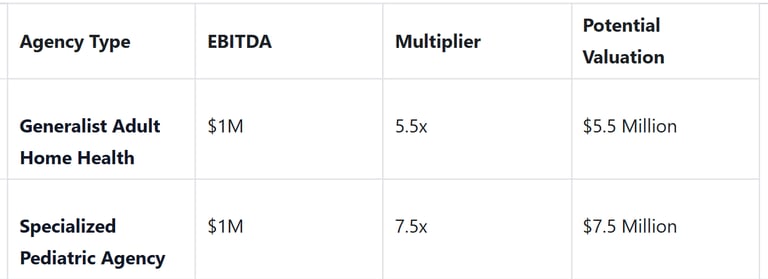
By specializing in the pediatric niche, the owner captures an additional $2 Million in value for the exact same amount of bottom-line profit. This is why we tell owners that their valuation drivers are the most important metric to track in 2026.


Staffing: The New Gold in Pediatrics
The biggest hurdle in the pediatric boom is not a lack of patients; it is the scarcity of specialized nurses (LPNs and RNs). In 2026, buyers are ignoring your census if your turnover is over 20 percent. If you have a stable, loyal clinical team, your agency is worth significantly more.
We have found that agencies investing in nurse training and "high-tech" pediatric certifications are the ones winning the M&A game. Retention is no longer just an HR metric; it is your strongest valuation multiplier. If you are struggling with this, read our report on why staffing is the new gold.
Plain-Language Glossary
EBITDA: A measure of a company's overall financial performance, used as a proxy for cash flow.
Multiplier: The number used to multiply EBITDA to determine the total purchase price.
High-Acuity: Patients who require a high level of medical care and monitoring, often involving specialized equipment.
Due Diligence: The process where a buyer like Senate Healthcare LLC verifies all your financial, clinical, and legal records before closing a deal
The Role of Technology and AI
In 2026, the pediatric sector is leading the way in technology integration. From AI-driven scheduling to remote patient monitoring, these tools are becoming "must-haves" for due diligence. For example, Connecticut Children’s recently used AI to improve forecasting and emergency efficiency. Buyers are looking for agencies that use these tools to lower their overhead and improve patient outcomes. Check out our insights on how AI is changing home health operations to see how you can apply this to your pediatric shop.
So what should you do now?
If you are an owner in the pediatric or specialized home care space, the "Golden Window" for a high-value exit is open. Here is how to prepare:
Audit your Medicaid rates: Ensure you are maximized on current state reimbursements to show the highest possible EBITDA.
Clean up your clinical files: High-acuity means high scrutiny. Ensure your documentation can withstand a rigorous audit. Our documentation sprint guide can help you get started.
Quantify your referral pipeline: Show buyers where your cases come from and why those relationships are "sticky."
Explore a partnership: You don't have to navigate this alone. Senate Healthcare LLC is actively looking for pediatric agencies to bring into our portfolio.
Partner with Senate Healthcare LLC
The pediatric boom is not going to last forever. As more private equity capital enters the space, the "scarcity premium" will eventually stabilize. At Senate Healthcare LLC, we are looking for high-quality home health or hospice agencies that want to grow or transition to a buyer that understands the complexity of specialized care.
We are not brokers. We are the ones who acquire, invest in, and scale healthcare businesses. If you are considering a sale or want to know what your agency is worth in the current 2026 market, let's talk.
Unlock Your 30-Minute Agency Succession Review
Maybe you're ready to expand your reach, or perhaps it's time to consider your legacy and the future of your business. Either way, it all begins with a conversation. Schedule a confidential, no-obligation call to explore what the future might hold for you and your business.
Complete the form, and we'll reach out for a chat...


© 2025 SENATE HEALTHCARE LLC.
ALL RIGHTS RESERVED