
The Documentation Sprint: Why Your 2026 Exit Depends on Your Files Today
Is your agency’s paperwork standing in the way of a multi-million dollar exit? In 2026, buyers are scrutinizing clinical and HR files more than ever, and missing signatures can lead to massive valuation haircuts. This guide explains how to execute a 90 day "Documentation Sprint" to clean up your records, boost your EBITDA multiple, and ensure your deal closes on time.
2/26/20266 min read


The window for a high-value exit in 2026 is officially open, but the rules of engagement have changed. Buyers are no longer just looking at your census; they are digging deep into the digital and physical filing cabinets of your clinical and HR departments. This article breaks down how a focused 90 day documentation sprint can protect your valuation and ensure a smooth transition when you decide to partner with an acquirer like Senate Healthcare.
Quick-Scan Summary
Who this is for:
Owner-operators of home health or hospice agencies with $2M to $10M in annual revenue.
Founders planning an exit within the next 6 to 12 months.
Administrators who want to reduce the stress of future due diligence.
Key Takeaways:
Clinical file errors are the number one cause of "deal fatigue" and price retrading in Q1 2026.
A 90 day sprint based on accelerated sale roadmaps can fix years of "documentation debt."
Organized HR files can increase buyer confidence and lead to higher EBITDA multiples.
Senate Healthcare looks for agencies that prioritize compliance, even if the files are not perfect yet.
The 2026 M&A Landscape: Scrutiny is the New Standard
As we move through the first quarter of 2026, the M&A environment for home health or hospice services is experiencing a flight to quality. While interest rates have stabilized, buyers have become much more surgical in their approach. According to recent insights from Ion Analytics on M&A best practices, transparency is the primary currency of a successful deal. If a buyer cannot verify your clinical outcomes or employee compliance through clean documentation, they will either walk away or lower their offer to account for the perceived risk.
At Senate Healthcare, we are actively evaluating acquisitions in the home health and hospice space. We see firsthand how a lack of organized records creates a "diligence death spiral." This happens when a buyer asks for a sample of 50 patient charts and finds missing signatures or late certifications in 10 of them. Suddenly, the buyer wonders if the other 500 charts are also non-compliant. This leads to deeper audits, longer timelines, and often, a lower final sale price.


The Story of Jim: A Lesson in HR Documentation
Consider the story of Jim, a hospice owner we recently spoke with. Jim had a fantastic agency with a loyal staff and a great reputation in his community. He was ready to retire and move on to his next chapter. However, during a preliminary review, it became clear that his HR files were a mess. Background checks were missing for three employees hired during a busy stretch two years ago. Professional licenses for several per-diem nurses had expired and been renewed without a paper trail of the gap.
Even though Jim’s care was excellent, the "documentation debt" made the business look risky. Jim had to spend three months pausing the sale process to reconstruct those files. If he had started a documentation sprint six months earlier, he would have been ready to close his deal on schedule. This is why we emphasize legacy planning secrets that focus on the boring but essential work of record-keeping.
Why a "Documentation Sprint" is Your Highest-ROI Move
Stoneridge Partners often highlights the importance of an accelerated sale roadmap. A documentation sprint is a concentrated effort to clean up your files before you ever sign a Letter of Intent (LOI). By treating this like a 90 day project, you can identify and fix gaps while you still have total control.
1. The Clinical Deep Dive
Buyers in 2026 are looking for "program integrity." They want to see that your hospice or home health agency follows every CMS guideline to the letter. Focus on:
Face to face encounter documentation.
Timely physician signatures.
Clear links between the plan of care and the actual services provided.
Evidence of regular QAPI (Quality Assessment and Performance Improvement) meetings.
2. The HR Audit
Your staff is your greatest asset, but they can also be a liability if their files are incomplete. Ensure every file includes:
Up to date I-9 forms.
Verified background checks and OIG exclusions.
Current professional licenses.
Documented annual performance reviews.
We have found that agencies with retention rates above 80% usually have the best documentation. If you are struggling with turnover, check out our thoughts on why staffing is the new gold and how it affects your valuation.
The Math: How Documentation Affects Your Multiplier
Let’s look at a concrete valuation scenario. Imagine two hospice agencies, both generating $1M in EBITDA (Earnings Before Interest, Taxes, Depreciation, and Amortization).
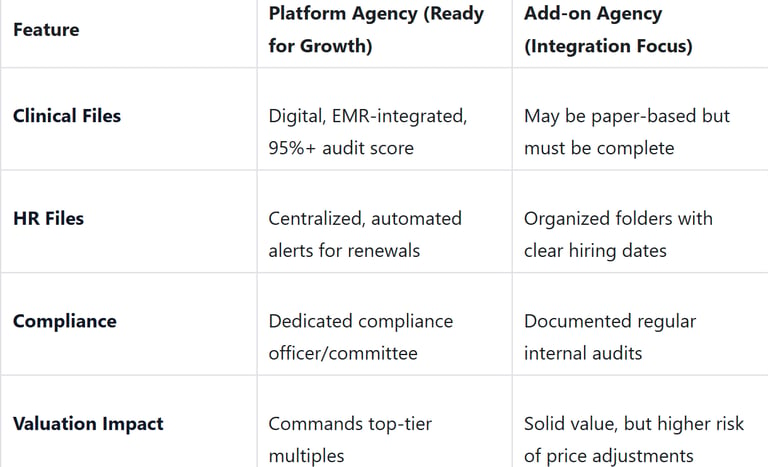
Agency A: Has a clean 90 day documentation sprint completed. Files are digital, searchable, and 98% compliant. A buyer might offer a 6x multiple. Valuation: $6,000,000.
Agency B: Has messy paper files, missing physician signatures, and inconsistent HR records. A buyer sees high audit risk and offers a 4.5x multiple to cover potential future CMS "clawbacks." Valuation: $4,500,000.
That is a $1.5 million difference simply based on the quality of the paperwork. In the current market, documentation is not just a clerical task; it is a direct driver of your retirement fund.


Beyond the Census: The Hidden Value of Systems
Many owners focus entirely on their daily census. While growth is important, a high census with poor documentation is like a house built on sand. When we look at 10 valuation drivers buyers actually care about, systems and processes are always near the top.
The goal of your sprint is to prove that your agency can survive an audit today, tomorrow, and three years after the sale. Buyers want to sleep well at night knowing they won't inherit a federal investigation. This is particularly true in 2026 as CMS continues to crack down on hospice fraud in specific regions. Staying ahead of these trends is vital for anyone considering selling their home health agency.
Plain-Language Glossary
EBITDA: A measure of a company's overall financial performance. Think of it as your "take home" profit before the accountants get fancy with taxes and interest.
Due Diligence: The "inspection" period where a buyer like Senate Healthcare verifies everything you have said about your business.
LOI (Letter of Intent): A non-binding document that outlines the price and terms a buyer is willing to offer.
Retrading: When a buyer lowers the price after the LOI because they found "surprises" (like bad documentation) during due diligence.
Clawback: When Medicare or an insurance company takes back money they already paid you because an audit found the documentation was insufficient.
So what should you do now?
If you are thinking about a 2026 exit, do not wait for a buyer to ask for your files. Take these steps today:
Run a "Mock Audit": Pull 20 random patient charts and 10 employee files. If you find even one missing signature, assume there are more.
Digitize Where Possible: If you are still 100% paper-based, start scanning your "active" files. Digital records are much easier for buyers to review and increase the speed of the deal.
Assign a "Sprint Leader": Give your best administrator or clinical director the authority to spend 5 hours a week solely on file cleanup for the next 90 days.
Reach Out Early: You do not need perfect files to start a conversation. At Senate Healthcare, we can help you understand what a buyer will look for so you can focus your sprint on the areas that matter most.
Partnering with Senate Healthcare
Senate Healthcare is an acquiring entity looking for high quality home health or hospice agencies to join our portfolio. We are not brokers or advisors; we are strategic partners who understand the daily grind of healthcare operations. We know that running an agency is hard, and sometimes documentation falls behind care.
Our goal is to work with owners who have built something special and want to ensure their legacy is protected. Whether your files are pristine or need a bit of work, we are interested in hearing your story. Let’s explore how we can reduce your risk and help you achieve the exit you have worked so hard for.


Unlock Your 30-Minute Agency Succession Review
Maybe you're ready to expand your reach, or perhaps it's time to consider your legacy and the future of your business. Either way, it all begins with a conversation. Schedule a confidential, no-obligation call to explore what the future might hold for you and your business.
Complete the form, and we'll reach out for a chat...


© 2025 SENATE HEALTHCARE LLC.
ALL RIGHTS RESERVED