
Rock River Just Closed Its Doors : Why Independent Hospices Are Under Siege in 2026
The sudden closure of Rock River Hospice & Home highlights the growing dangers for independent agencies in 2026. This post explores how CMS moratoria and aggressive fraud crackdowns are blocking exits and slashing valuations for home health or hospice owners. Learn why a strategic partnership with an acquirer like Senate Healthcare may be the only way to protect your legacy in an increasingly hostile regulatory market.
7/23/20265 min read


This post examines the sudden closure of Rock River Hospice & Home as a symptom of a much larger regulatory and economic crisis facing independent agency owners today. We break down how nationwide CMS moratoria and aggressive fraud crackdowns are fundamentally shifting the landscape for home health or hospice acquisitions.
Quick-Scan Summary
Who this is for:
Hospice and home health agency owners with $2M to $10M in annual revenue.
Operators considering a sale or partnership but wary of the current regulatory environment.
Entrepreneurs concerned about how shifting Medicare policies impact their agency valuation.
Key takeaways:
Even established, high-quality agencies like Rock River are closing due to rising costs and reimbursement hurdles.
The current nationwide CMS moratorium on new certifications is effectively blocking simple license transfers.
Buyer underwriting has become significantly more rigorous, focusing heavily on regulatory risk and "dragnet" exposure.
Successful exits in 2026 require navigating the 36-month rule and enhanced oversight states with a strategic buyer.
The Rock River Cautionary Tale: 44 Years Ended in an Instant
For over four decades, Rock River Hospice & Home in Sterling, Illinois, served as a pillar of its community. On August 1, 2026, that history officially ends. According to reports from Shaw Local and KWQC, the agency cited a perfect storm of unsustainable operating costs, changes in healthcare reimbursement, and mounting economic pressures.
The most jarring aspect of this story is not just the closure itself, but the failed rescue attempt. CGH Medical Center expressed a clear interest in purchasing the property and resuming services to ensure community continuity. However, they hit a bureaucratic wall. Because of the nationwide CMS moratorium on new Medicare hospice certifications, CGH cannot simply step in and take over the license. They must wait until the moratorium is lifted, currently expected late in 2026, just to apply for certification.
For an owner-operator, this is a nightmare scenario: having a willing buyer but being legally barred from completing a transition that saves the business.


Caught in the "Fraud Dragnet"
While agencies like Rock River struggle with costs, others are being paralyzed by aggressive federal oversight. In May 2026, CMS took the unprecedented step of suspending payments for 773 hospices and 23 home health agencies tied to approximately $70 million in suspected fraud. As reported by Hospice News, these actions are part of a massive program integrity initiative.
The problem for legitimate providers is the "dragnet" effect. When CMS freezes payments or implements nationwide enrollment moratoria, as seen on the CMS Provider Enrollment Moratoria page, it creates a chilling effect across the entire market. Even if your agency has a perfect compliance record, the broader regulatory environment makes buyers more cautious and lenders more hesitant.
The M&A Reality: Fewer Deals, Higher Stakes
The data reflects this tension. The Home Health Care News Q2 M&A report titled "Fewer Deals, Big Checks" reveals that only 16 home-based care deals closed last quarter. Regulatory complexity is the primary driver of this slowdown. Buyers are no longer looking for just any agency; they are looking for "clean" platforms that can withstand the scrutiny of the 36-month rule and enhanced oversight state requirements.
For owners in the $2M to $10M revenue band, this means your exit readiness is no longer just about your patient census. It is about your ability to prove your agency can survive a CMS audit and that your license is transferable under current moratoria.


Valuation Math: The Cost of Regulatory Risk
When we evaluate an acquisition at Senate Healthcare, we look at the risk-adjusted EBITDA. Regulatory uncertainty acts as a direct haircut to your valuation multiple.
Consider two identical hospice agencies, each with $5 million in revenue and $750,000 in EBITDA.
Agency A: Located in a low-scrutiny state with a clean 5-year audit history and documented compliance with the hospice election addendum. It might command a 6.0x multiple, resulting in a $4.5 million valuation.
Agency B: Operates in an "enhanced oversight" state, lacks a robust due diligence checklist, and has high key-person dependence. A buyer might only offer a 4.5x multiple, dropping the valuation to $3.375 million.
That single difference in regulatory positioning costs the owner over $1.1 million at the closing table.
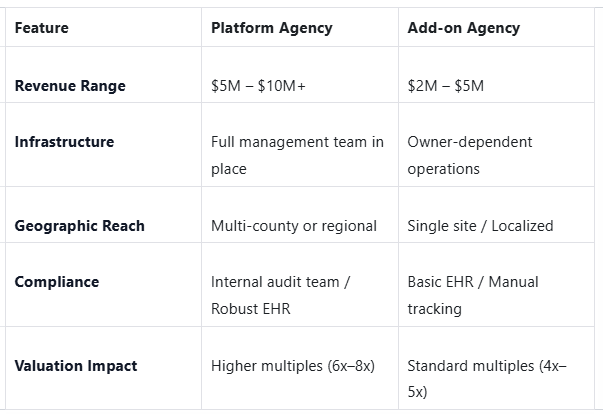
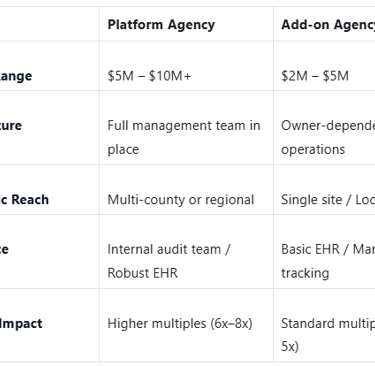
Understanding Your Position: Platform vs. Add-on
To maximize your sale price, you must understand how a buyer like Senate Healthcare categorizes your agency.
The Regulatory Wall: Why Timing Matters
The nationwide moratorium implemented on May 13, 2026, has changed the "wait and see" strategy for many owners. If you wait until you are burnt out or facing a financial crisis to sell, you may find that the regulatory window has slammed shut, much like it did for Rock River.
Transitioning your legacy requires a partner who understands how to navigate these moratoriums. At Senate Healthcare, we evaluate acquisitions based on long-term strategic fit, not just short-term cash flow. We are the buyer, and our goal is to maintain the quality of care you have built while absorbing the regulatory risks that are currently crushing independent operators


Plain-Language Glossary
EBITDA: Earnings Before Interest, Taxes, Depreciation, and Amortization. Essentially, a measure of your agency's operational profitability used to calculate its sale price.
CMS Moratorium: A temporary freeze by the government on new Medicare provider enrollments or certain ownership changes to prevent fraud.
36-Month Rule: A regulation that can prevent the sale of a home health agency if it has been Medicare-certified for less than 36 months, forcing a new certification process instead of a simple transfer.
Clawback: When a payer, like Medicare, demands the return of money previously paid to a provider, often following an audit or fraud investigation.
Underwriting: The process a buyer uses to assess the risk and value of an agency before making an offer.
So what should you do now?
If you are an owner watching the Rock River closure with concern, consider these immediate steps to protect your equity:
Audit Your Enrollment Status: Confirm your agency is not in a high-risk geographic zone for the current moratorium and that your billing privileges are fully secure.
De-risk the Owner Role: Transition daily operational decisions to a clinical manager or administrator. Buyers pay more for businesses that can run without the owner's constant presence.
Review Your Payer Mix: Diversify your reliance on traditional Medicare by optimizing your Medicare Advantage strategy.
Engage with a Strategic Buyer: Start a confidential conversation with us at Senate Healthcare. We can help you understand your current market value and how we handle regulatory complexities in an acquisition.


The closure of Rock River Hospice & Home is a stark reminder that staying independent is becoming more dangerous every month. The regulatory environment is designed to favor scale and sophisticated compliance infrastructure. By partnering with Senate Healthcare, you can secure your legacy, protect your staff, and ensure your patients continue to receive care: all while achieving a valuation that reflects the lifetime of work you have put into your agency.
Don't wait for the next moratorium to limit your options. Let's discuss how we can work together to navigate this landscape.
Unlock Your 30-Minute Agency Succession Review
Maybe you're ready to expand your reach, or perhaps it's time to consider your legacy and the future of your business. Either way, it all begins with a conversation. Schedule a confidential, no-obligation call to explore what the future might hold for you and your business.
Complete the form, and we'll reach out for a chat...


© 2025 SENATE HEALTHCARE LLC.
ALL RIGHTS RESERVED