
Is Your Agency "Due Diligence Ready"? The 10-Point Checklist for a 2026 Audit
Is your home health or hospice agency truly ready for the scrutiny of a 2026 buyer? In today’s "Market Reset," sophisticated acquirers are using AI and deep data dives to find even the smallest documentation gaps, which can lead to massive valuation haircuts. This post provides a 10 point checklist to help you audit your own clinical files, financials, and operations before you hit the market. Learn how to protect your legacy and maximize your final sale price by thinking like a buyer.
6/11/20267 min read


This article outlines a 10 point checklist to help home health and hospice owners prepare for the sophisticated due diligence standards of 2026. We cover exactly how to protect your valuation from common pitfalls like clinical documentation gaps and unrecorded liabilities.
Quick-Scan Summary
Who this is for:
Home health or hospice owners in the $2M to $10M revenue range.
Operators considering an exit in the next 12 to 24 months.
Entrepreneurs wanting to maximize their sale price by reducing buyer risk.
Key Takeaways:
Buyers in 2026 use AI-assisted tools to catch clinical and billing errors faster than ever.
The "Market Reset" means buyers now tolerate fewer EBITDA add-backs, often capping them at 12% to 15%.
A "re-trade" (a price drop after the initial offer) is almost always triggered by poor documentation or hidden liabilities.
Preparing for an audit now can increase your final check by 20% or more.
The 2026 Market Reset: Why Diligence is Different Now
The home health and hospice M&A landscape has officially shifted. If 2021 was the era of "growth at all costs," 2026 is the era of "disciplined underwriting." According to recent data from Stoneridge Partners, buyers are no longer just looking at your top-line revenue. They are digging deep into the durability of your cash flow and the integrity of your clinical files.
At Senate Healthcare, we evaluate acquisitions with a focus on long-term stability. As a buyer, we see that sophisticated acquirers are now using data analytics and even AI-assisted auditing to scan thousands of pages of clinical charts in hours. This means that a few missing signatures or vague "face-to-face" encounter notes are no longer hidden. They are quantified as financial risks that lead directly to a lower sale price.
The JD Supra 2026 Market Reset report notes that the gap between high-quality agencies and average ones is widening. Premium assets are still trading at strong multiples, but the "average" agency is facing intense scrutiny. If you want to be in that premium category, you must be "Due Diligence Ready" before you even sign a Letter of Intent (LOI).
The 10-Point Checklist for a 2026 Audit


1. Clinical Chart Sampling (Face-to-Face & Eligibility)
This is where most deals face their first major hurdle. Buyers will pull a random sample of 50 to 100 patient charts. They are looking for clear evidence that the patient is eligible for home health or hospice services. In home health, that means the "Face-to-Face" encounter is perfectly documented. In hospice, it means the terminal illness narrative is supported by specific clinical data, not just generic statements.
2. PEPPER and CASPER Analysis
Your Program for Evaluating Payment Patterns Electronic Report (PEPPER) and Certification and Survey Provider Enhanced Reports (CASPER) are the first things an acquirer like us will ask for. We look for outliers. Are your hospice live discharge rates significantly higher than the national average? Is your home health therapy utilization spiking? If you have outliers, you need a data-backed explanation to prevent a valuation haircut.
3. ADR and Audit History Transparency
Do not hide your Additional Documentation Requests (ADRs) or past Unified Program Integrity Contractor (UPIC) audits. A buyer will find them. Transparency is key. If you had an audit in the past, show the results and, more importantly, the "Plan of Correction" you implemented. Showing that you learned and improved can actually build trust with a buyer.
4. Payer Mix Verification
The "gold standard" remains Medicare Fee-for-Service. However, as Medicare Advantage (MA) penetration grows, buyers are looking at how well you manage those lower-reimbursement contracts. We’ve discussed in our previous post how payer mix diversification is a key lever for your exit. If 80% of your patients are on a low-paying MA plan, your EBITDA multiple will likely be lower than an agency with more traditional Medicare or high-quality commercial contracts.
5. EMR and Tech Maturity
If your clinical documentation is still partially on paper or your Electronic Medical Record (EMR) is outdated, you are signaling to the buyer that their "integration cost" will be high. Modern buyers want clean, digital data that can be easily ported into their systems. High tech maturity reduces the buyer’s post-close risk and makes your agency more attractive.
6. Financial Hygiene (QoE Readiness)
A "Quality of Earnings" (QoE) report is a deep dive into your numbers to ensure they aren't just "accounting magic." In 2026, buyers are less tolerant of aggressive add-backs. If you are adding back your personal luxury car lease or a family member's "ghost" salary, be prepared for the buyer to reject those. Keeping clean, accrual-basis financials for at least 24 months is non-negotiable.
7. Referral Source Diversification
If 40% of your patients come from a single physician or one hospital system, you have a "concentration risk." If that doctor retires or that hospital starts its own agency, your revenue disappears. Buyers look for a broad base of referral sources to ensure the business won't collapse after the owner leaves.
8. Staffing and Retention KPIs
Your nurses and therapists are your most valuable assets. Buyers will scrutinize your turnover rates and your reliance on expensive "contract labor" or staffing agencies. High turnover signals a culture problem or poor management, both of which are red flags during diligence.
9. Survey History and POC Resolution
A clean state survey or accreditation report (CHAP/ACHC) is worth its weight in gold. If your last survey had "Condition-Level Deficiencies," we want to see that you resolved them immediately. Unresolved survey issues are a fast track to a "deal-killer" status.
10. Succession and Key-Person Dependencies
Does the agency run if you, the owner, take a month-long vacation? If you are the primary relationship holder for every major referral source, the business has high "key-person dependence." To get a top-tier multiple, you need a management layer that can operate without you.
The Math of the "Haircut": Why Preparation Pays Off


Let's look at a concrete example. Suppose your home health or hospice agency has an EBITDA of $1 million. In a perfect world, you might receive a 6x multiple, resulting in a $6 million valuation.
However, during due diligence, the buyer finds that 15% of the clinical charts sampled have eligibility documentation gaps. The buyer’s underwriters will assume that 15% of your revenue is "at risk" for Medicare recoupment. They might apply a "valuation haircut" to account for this risk.
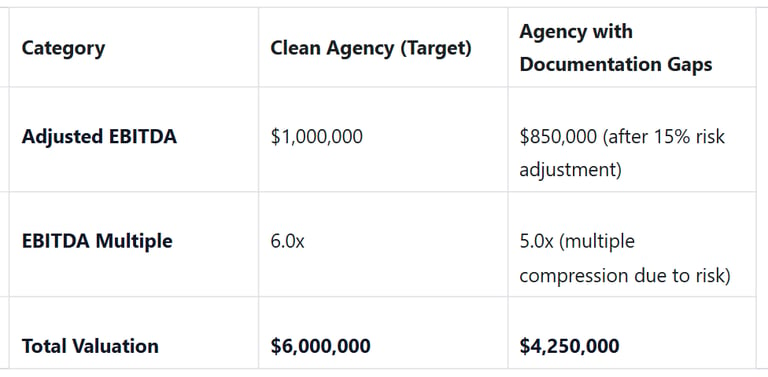
In this scenario, poor preparation cost the owner $1.75 million. This is what the industry calls a "re-trade." By cleaning up your charts and financials before going to market, you are essentially "insuring" that extra $1.75 million at the closing table.
How to Identify Your Agency's Position
Different agencies face different diligence hurdles. Use the table below to see where you likely stand in the eyes of a buyer.
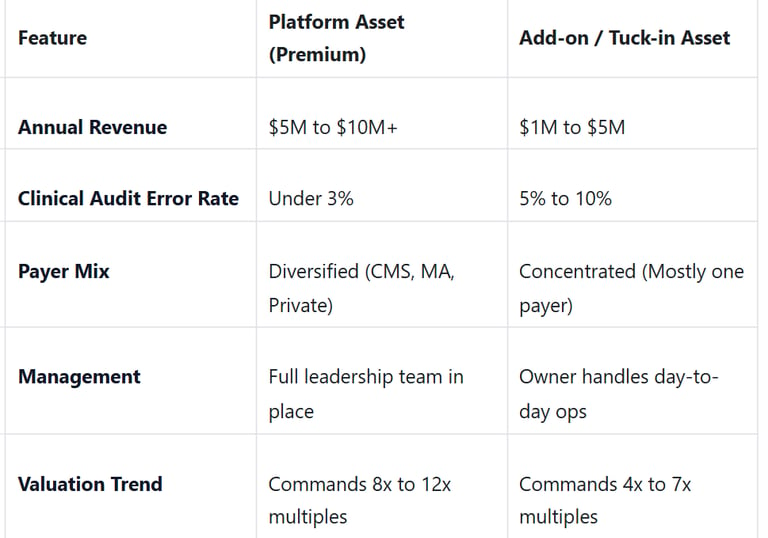
As noted by Mertz Taggart in their Q1 2026 report, hospice remains a highly sought after sub-sector, but even these "hot" assets are facing more rigorous billing reviews than they were two years ago.
The Medicare Advantage Influence in 2026
We cannot talk about due diligence without mentioning Medicare Advantage. In 2026, the "MA Squeeze" is real. Buyers are looking at your ability to manage authorizations and your "days to collect" on MA claims. If your team is struggling to get paid by private insurers, a buyer will view your agency as inefficient.
Reviewing your regulatory updates is a good first step to understanding how these national shifts impact your local agency's value.
So what should you do now?
If you are thinking about a sale or partnership, don't wait for a buyer to find your flaws. Here are the first four steps an operator should take:
Run a "Shadow Audit": Hire a third party to pull 30 random charts and grade them exactly how a Medicare auditor would. Fix the systemic errors immediately.
Clean Up Your P&L: Eliminate personal expenses from your business accounts at least 12 months before a sale. It makes the "add-back" conversation much easier.
Diversify One Referral Source: If you have one massive referral partner, spend the next six months building out two more to reduce your concentration risk.
Test Your EMR Reports: Ensure you can pull a "Real-time AR Aging Report" and "Census by Payer" report at a moment's notice.
Partnering with Senate Healthcare


At Senate Healthcare, we aren't brokers or advisors who list your business and hope for the best. We are the buyer. We are actively evaluating acquisitions in the home health and hospice space to grow our national portfolio of high-quality agencies.
When you partner with us, you are dealing directly with the decision-makers. We understand the blood, sweat, and tears you’ve put into your agency, and we know that no business is perfect. Our goal is to work with owners to navigate the 2026 market realities, identify growth opportunities, and ensure your legacy of care continues.
If you are ready to explore what a sale or strategic partnership could look like, let’s have a confidential conversation. We can help you understand where your agency sits in today’s market and how we can work together to achieve a successful transition.
Plain-Language Glossary
EBITDA: "Earnings Before Interest, Taxes, Depreciation, and Amortization." Essentially, it is a measure of your business's cash profit.
Multiple: The number a buyer multiplies your EBITDA by to determine the purchase price (e.g., $1M EBITDA at a 5x multiple = $5M price).
Add-back: An expense that "goes away" after a sale (like the owner's personal travel), which is added back to the profit to show a truer picture of earnings.
Re-trade: When a buyer lowers their offer price after finding negative information during the due diligence period.
Haircut: A slang term for a reduction in valuation or a price cut.
QoE (Quality of Earnings): An intense financial audit that verifies if the profits you reported are accurate and sustainable.
Unlock Your 30-Minute Agency Succession Review
Maybe you're ready to expand your reach, or perhaps it's time to consider your legacy and the future of your business. Either way, it all begins with a conversation. Schedule a confidential, no-obligation call to explore what the future might hold for you and your business.
Complete the form, and we'll reach out for a chat...


© 2025 SENATE HEALTHCARE LLC.
ALL RIGHTS RESERVED