
The Hospice Election Addendum Just Went Mandatory: What It Means for Your Agency's Compliance Score
The CMS FY 2027 proposed rule turns the optional hospice election addendum into a mandatory billing requirement. This post explores the new Service and Spending Variation Index (SSVI) and how these transparency measures directly impact your agency's valuation. Learn why proactive compliance is the key to a successful exit or sale in the evolving hospice market.
7/16/20266 min read


This article details the transition of the hospice election statement addendum from an optional request to a mandatory requirement under the CMS FY 2027 proposed rule. We explore how these regulatory shifts impact your agency’s transparency scores and, ultimately, its valuation when you decide to pursue a sale or partnership.
Quick-Scan Summary
Who this is for:
Hospice agency owners with revenue between $2 million and $10 million.
Operators planning for a succession or exit within the next 12 to 24 months.
Clinical directors responsible for Medicare billing compliance and documentation.
Key takeaways:
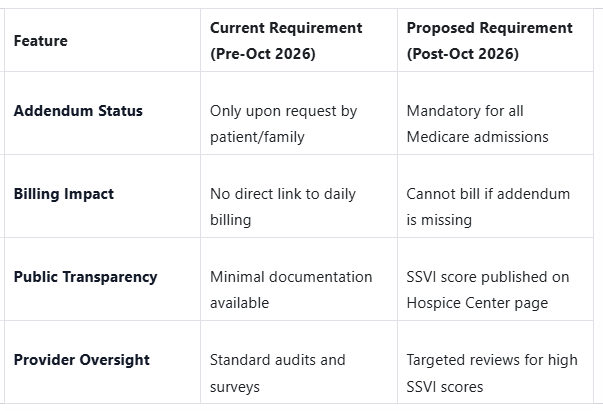
The election addendum becomes mandatory for all Medicare beneficiaries starting October 1, 2026.
CMS is introducing a new Service and Spending Variation Index (SSVI) to track outlier spending and utilization.
Failure to provide the addendum will result in a technical denial of payment for the entire election period.
Agencies with high SSVI scores may face lower valuation multiples during buyer underwriting.
Plain-Language Glossary
Election Statement Addendum: A document that tells a patient exactly which services and medications the hospice will not pay for because they are considered unrelated to the terminal illness.
Service and Spending Variation Index (SSVI): A new scoring system (0 to 16) that CMS uses to flag hospices that spend too much or too little compared to national averages.
EBITDA: Earnings Before Interest, Taxes, Depreciation, and Amortization. This is the standard measure of profit buyers use to determine your agency's price.
Valuation Multiple: The number (like 5x or 7x) that a buyer multiplies by your EBITDA to calculate your final sale price.
HQRP: The Hospice Quality Reporting Program, which tracks how well your agency performs on clinical and administrative quality metrics.
Market Context: Why CMS is Changing the Rules Now
The Centers for Medicare and Medicaid Services (CMS) released the FY 2027 Hospice Wage Index and Payment Rate Update proposed rule on April 2, 2026. While the headline news was a 2.4 percent payment update, which accounts for a 3.2 percent market basket increase minus a 0.8 percent productivity adjustment, the real story for owners lies in the compliance shifts. This update is expected to increase total payments by approximately $785 million across the industry.
However, CMS is concerned about non-hospice spending. In FY 2024, Medicare Parts A, B, and D spent over $2.8 billion on services for patients already enrolled in hospice. To curb this, CMS is moving the election statement addendum from a document provided "upon request" to a mandatory form required at the time of every election. If the proposal is finalized as written, this change will go into effect on October 1, 2026.


Owner Pain Points: The Burden of "Relatedness"
For an owner-operator in the $2 million to $10 million revenue band, this change represents a significant administrative hurdle. It is no longer enough to wait for a family to ask what is covered. Your clinical team must now proactively document every item, service, and drug determined to be unrelated to the terminal illness.
Consider the case of Sarah, an owner of a mid-sized hospice in the Midwest. Sarah’s team was excellent at care, but their documentation was often a secondary priority. Under the old rules, they rarely had to produce an addendum because their patients were satisfied. Under the new FY 2027 mandate, if Sarah’s team misses even one addendum during the admission process, the agency cannot bill Medicare for that entire election period. This creates a massive cash flow risk and an even larger risk during buyer diligence.
When we evaluate an acquisition at Senate Healthcare, we look for "clean" files. If a buyer sees that your agency has been billing without the mandatory addendum, they will likely "haircut" your valuation to account for the risk of a future CMS audit or clawback.
The Valuation Math: How SSVI Affects Your Sale Price
CMS is also introducing the Service and Spending Variation Index (SSVI). This is a 9-metric scoring system that ranges from 0 to 16. It looks at factors such as:
Average minutes of skilled care per day.
Non-hospice spending for enrolled beneficiaries.
The percentage of live discharges where patients return to the same hospice within seven days.
Weekend visit frequency.
A high SSVI score is a red flag for buyers. In the current market, a "clean" hospice with a low SSVI score and perfect addendum compliance might trade at a 6x to 7x EBITDA multiple. An agency with a high SSVI score (indicating potential over-utilization or poor documentation of unrelatedness) might see its multiple drop to 4x or 5x.
For an agency with $1 million in EBITDA, that is a $2 million difference in your pocket at closing. Compliance is no longer just a clinical goal; it is a direct driver of your legacy’s value.
Operational Flexibility: A Small Win for Staffing
One positive note in the FY 2027 proposal is the increased flexibility for patient discharges. CMS has proposed that a physician designee or a member of the Interdisciplinary Group (IDG) can handle the discharge process, rather than exclusively requiring the medical director. This could help alleviate some of the administrative bottlenecks that hospice owners face when trying to manage a mobile workforce.
Additionally, CMS has issued a Request for Information (RFI) regarding community-based palliative care and a potential hospice-specific wage index. While these are not yet policy, they signal that the regulatory environment is shifting toward more specialized oversight for hospice providers. If you are considering selling your agency, staying ahead of these trends is vital for maintaining your position as a high-value "platform" acquisition rather than a risky "add-on."


Exit Timing: Why 2026 is a Critical Year
If you are an owner-operator thinking about an exit, the window before October 1, 2026, is critical. Once the new addendum mandate and the SSVI scoring become active, a "paper trail" begins. For the first 12 months of the new rule, buyers will be looking for agencies that transitioned smoothly without a dip in billing or an increase in audit risk.
Selling your hospice agency before these scores become a matter of public record on Care Compare could prevent "valuation erosion." Buyers like Senate Healthcare are looking for agencies that are either already compliant or have the clinical leadership in place to handle the transition. We focus on helping owners who have built strong businesses but are tired of the constant "regulatory treadmill" that CMS continues to speed up.
So what should you do now?
Audit your current addendum process: Even though it is currently optional, start treating it as mandatory today to train your clinical staff on the "relatedness" documentation.
Calculate your internal SSVI score: Use your claims data to see where you land on the 0-16 scale. Focus on reducing non-hospice spending and increasing weekend visit frequency.
Evaluate your discharge workflow: Look at how the new physician designee rules can free up your medical director's time for higher-value activities.
Contact a strategic buyer: If the administrative burden of the FY 2027 rule feels like the "final straw," reach out to Senate Healthcare to discuss a confidential valuation and acquisition opportunity.


Partner With Senate Healthcare
As the hospice industry faces tighter transparency and mandatory documentation requirements, the gap between low-value and high-value agencies is widening. At Senate Healthcare, we are not brokers or advisors; we are strategic buyers pursuing the acquisition of quality home health or hospice agencies. We understand the unique challenges of the $2M to $10M revenue band because we operate in this space every day.
If you are ready to explore a sale or partnership that preserves your clinical legacy while maximizing your exit valuation, we are ready to listen. We acquire agencies based on their potential and their commitment to quality care, even if your documentation isn't perfect today. Let us help you navigate the complexities of the FY 2027 rules and turn your years of hard work into a successful transition.
Contact Senate Healthcare today to schedule a confidential consultation.
Unlock Your 30-Minute Agency Succession Review
Maybe you're ready to expand your reach, or perhaps it's time to consider your legacy and the future of your business. Either way, it all begins with a conversation. Schedule a confidential, no-obligation call to explore what the future might hold for you and your business.
Complete the form, and we'll reach out for a chat...


© 2025 SENATE HEALTHCARE LLC.
ALL RIGHTS RESERVED