
The SDOH Advantage: Transforming Home Health Agencies into Premium M&A Assets in 2026
This blog post explains how integrating Social Determinants of Health (SDOH) can significantly increase the M&A valuation of home health and hospice agencies in 2026, providing concrete examples and valuation scenarios for owners looking to exit.
3/9/20265 min read


Quick-Scan Summary
Who this is for:
Home health or hospice owners with $2M to $10M in annual revenue.
Operators looking to exit in the next 12 to 24 months.
Agencies feeling the squeeze of the 2026 CMS reimbursement rates.
Key takeaways:
SDOH data is now a mandatory requirement for Medicare programs in 2026.
Agencies that track and intervene in "social" issues (food, housing, isolation) are commanding 1.0x to 1.5x higher EBITDA multiples.
Major players like Choice Health at Home are setting the blueprint by acquiring non-clinical "social care" assets to boost their clinical value.
Senate Healthcare is actively seeking to acquire agencies that have started this transition.
The 2026 Market Shift: From Clinical Vendor to Strategic Platform
If you have been keeping an eye on the news this March, you probably saw that CMS finalized a net 1.3 percent payment reduction for 2026. While that is much better than the 6.4 percent cut we were all worried about last year, it still means that the "business as usual" model is under pressure. For an owner looking to maximize their exit value, simply providing great clinical care is no longer the finish line.
In the current M&A landscape, buyers are looking for "platform" potential. We aren't just looking for an agency that follows a doctor's orders. We are looking for agencies that solve the problems that keep hospital CEOs awake at night: readmissions caused by things that have nothing to do with medicine.
This is where Social Determinants of Health (SDOH) come in. In 2026, CMS has transitioned SDOH screening from voluntary to mandatory. Whether it is a home health or hospice patient, clinicians are now required to document barriers like food instability, lack of transportation, or unsafe housing. At Senate Healthcare, when we evaluate a potential acquisition, we look at how well an agency captures this data. Why? Because that data is the key to winning in high-margin Value-Based Care (VBC) contracts.


The "Choice Health" Blueprint: Why Social Care is the New Gold
Look at what Choice Health at Home has been doing lately. They recently acquired companies like Senior Nannies and Alliant, which focus heavily on the "social" side of care. They aren't just doing this to be nice. They are doing it because they know that if they control the social care (the "nanny" or companion) and the clinical care (the nurse), they can prevent the $20,000 hospital stay that happens when a senior forgets to eat or trips over a loose rug.
For an owner in the $2M to $10M revenue range, this is your secret weapon. If you can show a buyer that your staff is already identifying these risks and, better yet, coordinating with community resources to fix them, you have moved your agency from a "commodity" to a "strategic asset."
When we look at 10 valuation drivers buyers actually care about, being able to prove you are lowering the "total cost of care" through social intervention is near the top of the list.
Valuation Math: The SDOH Multiple Bump
Let’s talk about the actual dollars. In the $2M to $10M revenue band, a standard home health or hospice agency might see an EBITDA multiple of 4.5x to 5.5x. However, if that same agency can demonstrate a robust SDOH integration, that multiple can easily jump.
Scenario A: The Traditional Agency
EBITDA: $1,000,000
Operations: Purely clinical, high staff turnover, no SDOH tracking.
Multiple: 5.0x
Sale Price: $5,000,000
Scenario B: The SDOH-Integrated Platform
EBITDA: $1,000,000
Operations: Mandatory SDOH screening, low readmission rates, community partnerships.
Multiple: 6.5x
Sale Price: $6,500,000
That is a $1.5 million difference for the exact same bottom line. This is why we tell owners that their exit strategy starts with their operations today. You can read more about how to position yourself for these premium deals in our guide to value-based care partnerships.
Identifying Your Agency's Position
Are you an "add-on" or a "platform"? Most owners think they are a platform, but buyers often see them as add-ons. The difference usually comes down to data and infrastructure.
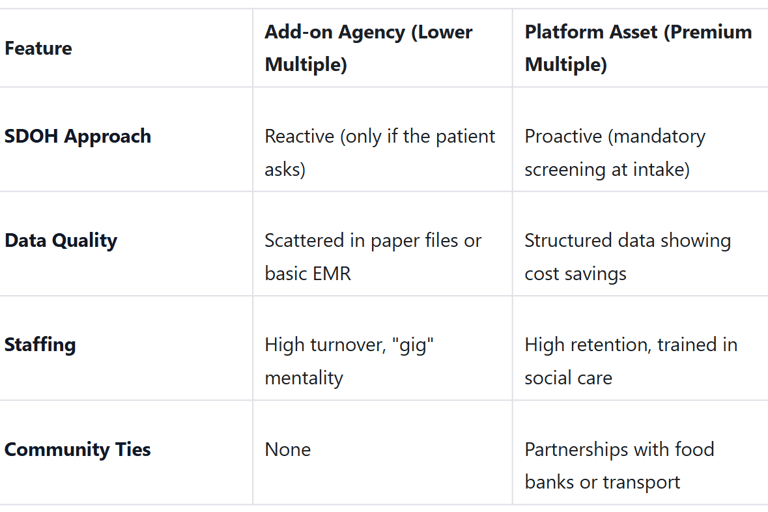
If you find yourself on the left side of this table, do not panic. Senate Healthcare often partners with agencies that have the "bones" of a great business but need the resources of a larger partner to bridge the gap to the right side. We understand the labor shortage crisis makes it hard to focus on these "extras," but these are exactly the things that make your agency attractive to us as an acquirer.
Anonymized Owner Vignette: The "Social" Turnaround
Take the example of "Sarah," who owned a $4M revenue hospice agency in the Midwest. She was exhausted by the federal funding chaos and felt her valuation was stagnant. We looked at her books and realized she was already doing a lot of "social" work, her social workers were incredibly active, but she wasn't tracking it as a clinical outcome.
By simply formalizing her SDOH screening process and linking it to her low 30-day hospital readmission rates, she was able to show she was saving the healthcare system hundreds of thousands of dollars. When she eventually decided to explore a sale, that data allowed her to command a multiple that was significantly higher than the local average.


Why Senate Healthcare is Looking for SDOH-Ready Agencies
As a strategic buyer, we are not just looking for "units" of care. We are looking for partners who understand where the 2026 market is going. We want to acquire agencies where the owner has built a culture of "whole-person" care.
Even if you aren't perfectly positioned today, starting the transition to SDOH-focused care reduces your "risk profile" in the eyes of a buyer. It shows you are forward-thinking and that your agency won't be obsolete the next time CMS changes the rules. If you are worried about legacy planning, focusing on social care is one of the best ways to ensure your agency thrives long after you have handed over the keys.
Plain-Language Glossary
SDOH (Social Determinants of Health): Non-medical factors like where people live, eat, and work that affect their health outcomes.
EBITDA Multiple: A common way to value a business. It’s your Earnings Before Interest, Taxes, Depreciation, and Amortization multiplied by a number (like 5x) to get your sale price.
VBC (Value-Based Care): A payment model where providers are paid based on patient health outcomes rather than just the number of visits.
Platform Asset: A business that has the systems, data, and leadership in place to serve as a foundation for a buyer to grow and acquire other smaller businesses.
So what should you do now?
If you are an owner looking to maximize your value in 2026, here are your next steps:
Review your intake process: Ensure your team is using the new mandatory 2026 SDOH screening tools.
Track the "why" behind hospitalizations: If a patient goes back to the hospital, was it a clinical failure, or did they run out of food? This data is gold.
Audit your staff retention: Buyers pay more for stable teams. Check out our thoughts on why staffing is the new gold.
Reach out for a confidential conversation: Even if you aren't ready to sell today, we can help you understand how your current SDOH efforts translate into a future valuation.
At Senate Healthcare LLC, we aren't just looking for numbers on a spreadsheet. We are looking for the next generation of home health and hospice leaders. Let’s talk about how your agency’s "social" focus can lead to a premium exit.
Resources:
Unlock Your 30-Minute Agency Succession Review
Maybe you're ready to expand your reach, or perhaps it's time to consider your legacy and the future of your business. Either way, it all begins with a conversation. Schedule a confidential, no-obligation call to explore what the future might hold for you and your business.
Complete the form, and we'll reach out for a chat...


© 2025 SENATE HEALTHCARE LLC.
ALL RIGHTS RESERVED