
The Great Hospital Spinoff: Why Health Systems are Offloading Home Health in 2026
As hospital systems across the country offload their home health and hospice divisions in 2026, a massive opportunity is opening for independent agency owners. This post breaks down why systems like ECU Health are divesting and how the 1.3 percent CMS rate cut is reshaping market valuations. Learn how to position your $2M to $10M agency as a high-value platform for strategic buyers like Senate Healthcare LLC.
3/12/20266 min read


Quick-Scan Summary
Who this is for
Owner-operators of home health or hospice agencies with annual revenues between $2M and $10M.
Founders feeling the pressure of the 2026 Medicare reimbursement cuts.
Agency owners looking for a strategic exit or partnership with a buyer that understands the clinical mission.
Key Takeaways
Health systems like ECU Health are offloading home health and hospice assets to Liberty Home Care and Hospice to simplify their balance sheets.
The 1.3 percent CMS payment reduction for 2026 is driving "non-core" operators out of the market.
Independent agencies can command higher multiples right now by proving operational efficiency that large, bloated hospital systems lack.
Senate Healthcare LLC is actively seeking to acquire well-run agencies to expand our portfolio during this transition period.
The healthcare landscape in March 2026 is defined by a massive "return to core." For the last decade, the trend was vertical integration, where hospitals tried to own every part of the patient journey from the ER to the living room. But the tide has turned. Just this month, we saw ECU Health finalize the divestiture of its home health and hospice division to Liberty Home Care and Hospice. This is not an isolated incident. It is part of a broader exodus as health systems realize that managing home-based care is a specialized, high-intensity business that does not always mesh with the high-overhead model of a traditional hospital.
For the independent owner of a home health or hospice agency, this is a pivotal moment. When the local "Goliath" hospital system exits the home care space, it leaves behind a vacuum of market share and a pool of talented clinicians. More importantly, it signals that the value of specialized home-based care is rising. As a buyer, Senate Healthcare LLC is watching these spinoffs closely, because they highlight exactly why nimble, independent agencies are the most valuable assets in the 2026 market.


The 1.3 Percent Squeeze and the Search for Focus
Why are these billion-dollar health systems selling now? The primary driver is a combination of reimbursement pressure and operational complexity. The CMS final rule for 2026 included a 1.3 percent overall payment reduction for home health services. While that might sound small to a layman, for a massive hospital system with thousands of employees and significant administrative bloat, that 1.3 percent cut can be the difference between a profitable division and a massive liability.
Hospitals are built for acute care. They excel at high-tech surgeries and emergency stabilization. However, the labor-intensive, geographically dispersed nature of home health or hospice care requires a different DNA. When CMS tightens the belt, hospitals often decide that the headache of managing remote nurses and complex home-based billing is no longer worth the thinning margins. They are choosing to offload these assets to focus on their "core" inpatient services.
This creates a "Golden Window" for independent owners. While the hospital is distracted by its divestiture, you have the chance to tighten your operations and prove that your agency can remain profitable even under the new rates. Buyers like Senate Healthcare are not looking for the biggest agency; we are looking for the most resilient ones. You can learn more about why this quarter is the peak time to consider a transition in our guide on The 2026 Golden Window.
Anonymized Owner Vignette: The "Health System" Victim
Consider the case of "Sarah," an owner of a mid-sized hospice agency in the Southeast. For years, she struggled to compete with the local university hospital's home health arm. They had the branding and the built-in referrals. However, in early 2026, the hospital announced it was selling its home health and hospice units to a national conglomerate. Suddenly, the local clinical staff felt like just another number in a giant database.
Sarah saw an opportunity. She doubled down on her "community-first" approach and picked up three of the hospital’s top-performing nurses who were unhappy with the corporate transition. By the time Sarah approached us at Senate Healthcare to discuss a potential sale, her agency’s valuation had jumped because her staffing retention rates were the best in her county. She turned the hospital’s retreat into her own professional victory.


Valuation Math: How Spinoffs Affect Your Multiple
When a hospital system exits your market, the "scarcity value" of your agency goes up. Strategic buyers like Senate Healthcare LLC look at EBITDA (Earnings Before Interest, Taxes, Depreciation, and Amortization) as a baseline, but the "multiple" we apply to that EBITDA depends on your market position.
Let’s look at a concrete example. Imagine a home health agency with $5 million in revenue and $750,000 in EBITDA.
Scenario A (Market Crowded by Hospital): If the local hospital system is aggressively taking all the referrals, your agency might be viewed as an "add-on" with a multiple of 4x to 5x. Valuation: $3M to $3.75M.
Scenario B (Hospital Divests): If the hospital exits and you become the dominant local provider with a strong referral network, your agency could be viewed as a "platform" asset. This can push the multiple to 6x or even 7x for the right buyer. Valuation: $4.5M to $5.25M.
The difference of $1.5 million in your pocket at closing comes down to how you position your agency during these market shifts. We focus on 10 specific valuation drivers that help owners move the needle on their multiplier, especially when the local competition is in flux.
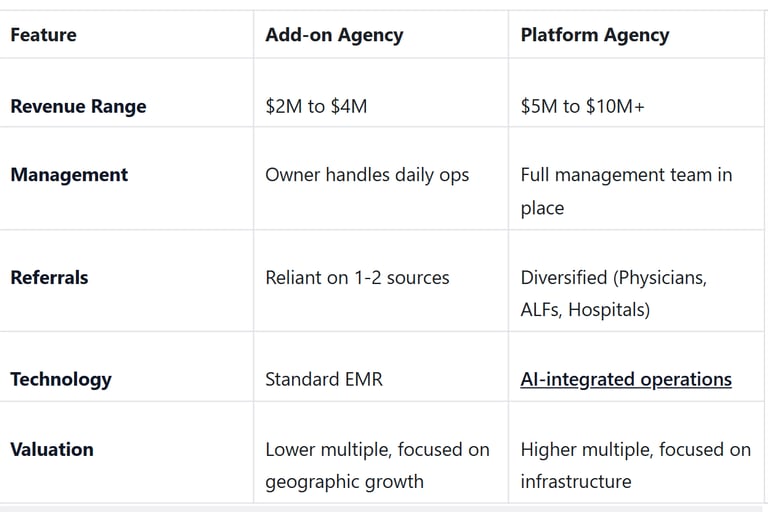
Platform vs. Add-on: Where Do You Fit?
As we evaluate acquisitions for our portfolio, we categorize agencies to determine the best path forward.


The Role of Senate Healthcare LLC as Your Buyer
It is important to clarify that Senate Healthcare LLC is a direct buyer. We are not brokers or advisors who list your business and wait for a bite. We are the ones doing the underwriting and providing the capital. We are specifically looking for home health or hospice owners who are tired of the "corporate squeeze" but want to see their legacy protected.
When a hospital system sells out, the clinical mission often gets lost in the shuffle. We take a different approach. We look for agencies that have deep roots in their community. We want to partner with owners who have built something special and are now looking for a clean exit that rewards them for their years of hard work. Whether you are ready to sell today or are just starting to think about your legacy planning, we provide a straightforward path to a deal without the games.
So what should you do now?
Audit your referral sources: If the local hospital system is divesting, find out where those referrals will go next and position your agency to catch them.
Focus on clinician retention: As large systems transition, their staff will be nervous. This is your time to recruit the best talent in the market to boost your agency's value.
Review your EMR and data: Ensure your documentation is audit-proof before the 2026 CMS cuts fully take effect.
Start a conversation: Even if you aren't ready to sign a Letter of Intent today, knowing what a buyer like Senate Healthcare is looking for will help you build a more valuable asset for the future.
Plain-Language Glossary
Divestiture: When a company sells off a business unit or a specific division.
EBITDA: A measure of a company's overall financial performance, often used as a baseline for valuation.
Multiple: The number that a buyer multiplies your EBITDA by to determine the purchase price.
Underwriting: The process a buyer uses to assess the risk and value of an agency before making an offer.
Acute Care: Active but short-term treatment for a severe injury or episode of illness, usually taking place in a hospital.
The spinoff trend is just beginning. As more health systems like ECU Health decide to leave the home health and hospice space, the opportunity for independent owners grows. If you’re ready to see how your agency fits into our acquisition strategy, let’s talk.


Explore a Partnership with Senate Healthcare LLC
We are actively seeking acquisitions in the home health or hospice space. If you are an owner looking to reduce your operational risk or explore a full exit, we invite you to reach out for a Healthcare Partnership Consultation. We are not here to list your business; we are here to buy it. Let’s discuss how we can build on the legacy you’ve created.
Unlock Your 30-Minute Agency Succession Review
Maybe you're ready to expand your reach, or perhaps it's time to consider your legacy and the future of your business. Either way, it all begins with a conversation. Schedule a confidential, no-obligation call to explore what the future might hold for you and your business.
Complete the form, and we'll reach out for a chat...


© 2025 SENATE HEALTHCARE LLC.
ALL RIGHTS RESERVED