
Hospice Patients Were Left Out of the Medicaid Work Requirement Rule : Here's the Problem
New Medicaid work requirements are set to disrupt the hospice sector by January 2027, yet hospice patients remain missing from the explicit exemption lists. This oversight creates significant "census risk" that can drastically lower your agency's valuation during a sale. Learn how to protect your EBITDA and navigate the regulatory burden through strategic partnership with Senate Healthcare LLC.
7/27/20265 min read


This post examines the oversight in the latest Medicaid work requirement rule that fails to explicitly exempt hospice and palliative care patients. We discuss how this regulatory gap creates significant census risk and administrative burdens that can ultimately impact your agency's valuation during a sale.
Quick-Scan Summary
Who this is for:
Hospice agency owners with a high volume of dual-eligible (Medicare and Medicaid) patients.
Healthcare operators in the $2M to $10M revenue band planning for an exit within the next 24 months.
Owners concerned about regulatory compliance and census stability under new CMS mandates.
Key takeaways:
CMS Interim Final Rule CMS-2454-IFC mandates 80 hours of work or community engagement per month for most Medicaid adults starting January 1, 2027.
Hospice and palliative care patients are currently missing from the explicit exemption list, creating a "compliance trap" for agencies.
Unresolved regulatory risk can lead to valuation "haircuts" where buyers reduce offer prices to account for potential census volatility.
Proactive documentation and strategic partnerships are necessary to maintain your agency’s exit readiness.
The New Medicaid Landscape: Rule CMS-2454-IFC
On June 1, 2026, the Centers for Medicare & Medicaid Services (CMS) issued an Interim Final Rule known as CMS-2454-IFC. This rule implements new Medicaid work requirements derived from the 2025 reconciliation law. Starting January 1, 2027, non-disabled adults aged 19 to 64 in 43 states and the District of Columbia must document 80 hours per month of work, school, or community service to maintain their Medicaid eligibility.
While the rule provides exemptions for those who are pregnant, blind, or have specific developmental disabilities, it contains a glaring omission. Hospice and palliative care patients are not specifically named as an exempt category. This lack of clarity has sounded alarms across the industry, particularly for agencies serving dual-eligible populations.
The Administrative Gap and Census Risk
The National Partnership for Healthcare and Hospice Innovation (NPHI) has taken a firm stand on this issue. In a comment letter submitted on July 23, 2026, NPHI CEO Tom Koutsoumpas urged CMS to explicitly exempt these vulnerable populations. Without this explicit label, patients at the end of life may be technically required to "work" to keep their health coverage, or at the very least, their providers will face a mountain of paperwork to prove "medical frailty."
For a hospice owner, this is not just a policy debate. It is a direct threat to your census stability. If a patient loses Medicaid coverage due to a reporting error or a failed "frailty" determination, your agency may face uncompensated care or be forced to discharge. From a buyer's perspective, this introduces a variable known as "succession risk" or "policy-driven attrition." When we evaluate acquisitions, we look for stable, predictable patient flows. A census heavily weighted toward dual-eligibles who are suddenly at risk of losing coverage creates a significant red flag in underwriting.


Valuation Math: Quantifying the Risk
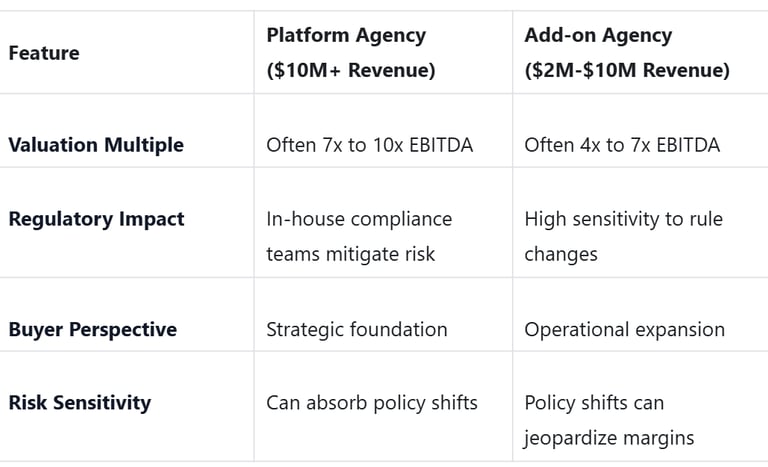
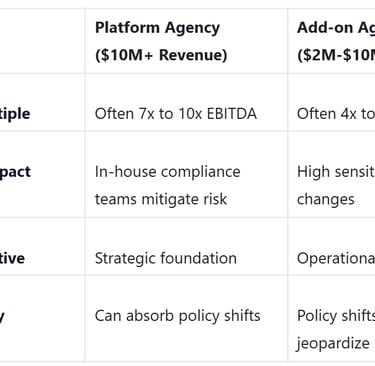
In the current market, hospice agencies in the $2M to $10M revenue range typically trade at EBITDA multiples between 4x and 7x, depending on scale and quality. However, regulatory uncertainty acts as a multiplier reducer.
Consider an agency with $1,000,000 in EBITDA. At a 6x multiple, the enterprise value is $6,000,000. If a buyer identifies that 40 percent of your census is at risk due to Medicaid work requirement confusion, they may apply a "valuation haircut." A reduction in the multiple to 5x: to account for the risk of census drop-off: erases $1,000,000 in value overnight.
The "Medical Frailty" Trap
A recent analysis by KFF (formerly the Kaiser Family Foundation) on June 23, 2026, highlighted that states must use claims data from the preceding 12 months to verify frailty. However, a diagnosis alone is often insufficient. To qualify for a medical frailty exemption, a patient must demonstrate that their condition significantly impairs their ability to meet the 80-hour work requirement.
Ethan McChesney of NPHI points out that states should proactively identify these patients using existing encounter data. Yet, until CMS provides nationwide guidance, the burden falls on the operator. If you are considering selling your home health or hospice agency, you must be able to prove during due diligence that your census is protected and that your "medical frailty" documentation is ironclad.
Medicare Advantage and the Shift in Payer Mix
This Medicaid rule change comes at a time when Medicare Advantage is already reshaping the landscape. As payers become more aggressive in managing costs, any administrative friction in Medicaid can push dual-eligible patients into more restrictive managed care models.
Buyers are currently looking for agencies that have successfully navigated these payer mix shifts. If you can show that your agency has a diversified payer base and a robust system for tracking patient eligibility, you move from being an "add-on" to a highly desirable "strategic partner.

Timing Your Exit: Why the Window Is Narrowing
With the Medicaid work requirements set to take effect in January 2027, the remainder of 2026 represents a critical window. Many owners are realizing that the regulatory burden of the late 2020s will be significantly higher than in previous decades. Between the FY 2026 payment rule updates and these new work mandates, the complexity of staying compliant is reaching a tipping point.
At Senate Healthcare LLC, we are actively evaluating acquisitions in the hospice sector. We look for agencies where the owner has built a solid foundation but may be feeling the weight of these increasing mandates. Partnering with a buyer like Senate Healthcare allows you to secure your legacy while the market still offers strong multiples, rather than waiting for the full weight of the 2027 mandates to hit your bottom line.
So what should you do now?
If you are an operator in the $2M to $10M range, take these steps to protect your valuation:
Audit Your Census: Identify exactly how many patients fall into the non-disabled adult Medicaid category (ages 19-64) and would be subject to the 80-hour rule.
Strengthen Documentation: Ensure every hospice patient’s record clearly details the specific physical or mental impairments that prevent them from working, using the "medical frailty" framework provided by KFF.
Review Your Multiplier: Use our guide on valuation drivers to see if regulatory risk is dragging down your potential sale price.
Consult a Buyer Directly: Instead of waiting for a broker to list your business, speak with a strategic buyer who understands these nuances and can offer a streamlined transition.
Partnering for the Future
The regulatory environment is becoming more hostile to small and mid-sized operators. Senate Healthcare LLC is the buyer and strategic partner you need to navigate these transitions. We specialize in acquiring home health and hospice agencies, providing owners with a confidential and professional exit strategy that preserves the quality of care they have worked so hard to build. By joining our portfolio, your agency gains the operational backing required to handle mandates like CMS-2454-IFC without sacrificing patient service.


Plain-Language Glossary
CMS-2454-IFC: A federal rule that requires certain Medicaid recipients to work or volunteer for 80 hours a month to keep their insurance.
EBITDA Multiple: A number (like 5x or 6x) that a buyer multiplies by your company's profit to determine the purchase price.
Dual-Eligible: A patient who qualifies for both Medicare (federal) and Medicaid (state) coverage.
Medical Frailty: A designation that allows a patient to be exempt from work requirements if their health condition makes working impossible.
Underwriting: The process a buyer (like Senate Healthcare) uses to evaluate the financial and regulatory risks of a business before buying it.
Unlock Your 30-Minute Agency Succession Review
Maybe you're ready to expand your reach, or perhaps it's time to consider your legacy and the future of your business. Either way, it all begins with a conversation. Schedule a confidential, no-obligation call to explore what the future might hold for you and your business.
Complete the form, and we'll reach out for a chat...


© 2025 SENATE HEALTHCARE LLC.
ALL RIGHTS RESERVED