
From Automation to AI Agents: Solving the 2026 Staffing Crisis
This article examines the transition from basic automation to "Agentic AI" in the home health and hospice industry as of March 2026. It highlights how these new tools are solving the staffing crisis by increasing clinician capacity and reducing burnout. Finally, it explains how adopting this technology directly increases an agency's valuation for owners looking to sell.
3/16/20266 min read


For years, the "staffing crisis" was something home health and hospice owners just had to endure. We all tried the same tactics: signing bonuses, recruitment agencies, and basic software to "automate" simple tasks. But in March 2026, the game has changed. We are no longer talking about simple automation that follows a "if this, then that" logic. We have entered the era of Agentic AI: reasoning agents that can handle end to end tasks, from referral management to documentation, with minimal human oversight.
At Senate Healthcare LLC, we are tracking this shift closely. As a buyer looking to acquire and partner with high performing agencies, we no longer just look at your current census or geographic footprint. We look at your tech stack. In today’s market, an agency that uses AI agents to solve the staffing crisis is worth significantly more than one that relies on traditional manual labor.
Automation vs. AI Agents: The 2026 Distinction
If you were running an agency in 2024, "automation" probably meant a system that sent an automated text to a nurse when a new referral came in. That was helpful, but it still required the nurse to read the referral, check the schedule, and reply.
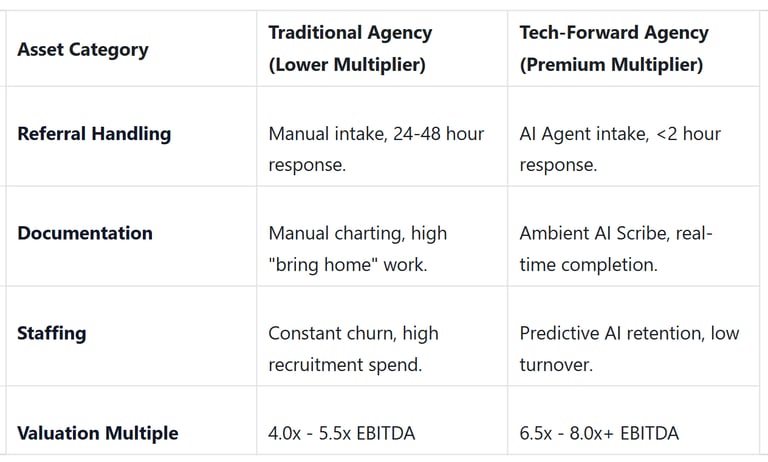
By March 2026, we have moved to AI Agents. These are "reasoning" entities. An AI Referral Agent doesn't just notify a clinician; it reads the 50 page hospital discharge packet, extracts the pertinent clinical data, checks it against your current staffing capacity, and prepares the admission paperwork before a human even touches it. This allows agencies to process referrals in under two hours, a metric that was nearly impossible just two years ago.
This isn't just a marginal improvement. It is a fundamental shift in how home health and hospice agencies operate. According to recent industry data, the US staffing market in 2026 has stabilized into a "low hire, low fire" environment. This means you can't just hire your way out of a growth problem anymore. You have to optimize the clinicians you already have.
The ROI of the Digital Clinician
When we evaluate an agency for acquisition, we look at the "revenue per clinician." In the old model, a nurse might cap out at 5 or 6 visits a day because they spent two hours every night finishing documentation.
With the launch of tools like Homecare Homebase (HCHB) Curate: Scribe and AlayaCare’s autonomous care plan generation, that burden is disappearing. Ambient listening technology now allows a clinician to focus entirely on the patient while the AI agent creates the note in real time. What used to be a 45 minute charting session is now a 5 minute review and sign off.
The math for owners is clear:
Increased Capacity: Clinicians can safely perform 2 to 3 more visits per day without feeling the "burnout" of late night paperwork.
Revenue Growth: If each clinician generates an additional $300,000 in annual value through increased capacity, a 10 person clinical team just added $3M to your top line without adding a single person to the payroll.
Retention: Our research shows that staffing is the new gold. Agencies that use AI to reduce administrative load have 40% lower turnover rates.


Real World Examples from March 2026
We aren't talking about science fiction. The industry leaders are already deploying these agents at scale. Cera recently launched 1,000 AI agents specifically designed as Care Coordinators and Retention Agents. These agents don't just wait for a problem; they identify "at risk" clinicians by analyzing patterns in their visit logs and communication, allowing management to intervene before the clinician quits.
Furthermore, AlayaCare has moved into autonomous visit verification. By using AI to handle the back end compliance and care plan adjustments, they have removed the "middle man" in the office, allowing the agency to remain lean even as it scales. You can read more about how AI is changing operations to see how these real world results are impacting the bottom line.
Why CMS is Pushing the AI Agenda
As of March 2026, even the regulatory environment has shifted. CMS is now actively advocating for "agentic AI" solutions for Medicare members. They recognize that the aging population is growing faster than the nursing workforce. To maintain quality of care, AI must fill the gap.
For agency owners, this means that adopting AI is no longer a "nice to have" feature; it is a compliance and survival strategy. Agencies that lag behind on this will face "valuation haircuts" because their business model relies on a labor force that is increasingly expensive and hard to find. We discuss these trends in our breakdown of the CMS FY 2026 hospice payment rule.
The Impact on Your Agency’s Valuation
If you are considering a sale or a succession plan, you need to understand how buyers like Senate Healthcare view your business. In 2024, we bought your EBITDA (Earnings Before Interest, Taxes, Depreciation, and Amortization). In 2026, we are buying your "systems."

Think about an owner we'll call "Jim." Jim owns a $5M hospice agency. He’s tired. He spends half his time trying to find nurses to replace the ones who just left for "easier" hospital jobs. When we look at Jim's agency, we see a "key-person dependence" risk. If Jim stops grinding, the agency stops growing.
Now compare that to an agency that has integrated AI agents. The workflow is standardized, the clinicians are happy because they don't have "homework," and the data is clean. That agency is a "platform" we can scale. That is the agency we want to acquire at a premium. Check out the 10 valuation drivers buyers actually care about to see where you stand.


So what should you do now?
The "staffing crisis" isn't going away, but the tools to defeat it are finally here. If you want to position your agency for a high value exit or simply want to stop the 24/7 fire fighting, here are your next steps:
Audit your documentation time: If your clinicians are spending more than 15% of their day on paperwork, you are losing money and risking turnover.
Investigate AI Scribes: Look into HCHB Curate: Scribe or similar ambient listening tools. This is the single biggest "quality of life" improvement you can give your staff.
Modernize your intake: Ensure your referral process is digital and can be augmented by AI agents to beat your competitors to the punch.
Evaluate your exit timing: The market for tech-enabled agencies is hot right now. Knowing your exit strategy early can help you build the right infrastructure today.
Partner with Senate Healthcare LLC
We aren't here to give you generic advice. We are active buyers looking for home health or hospice agencies that are ready for their next chapter. Whether you have already integrated AI or you are looking for a partner who can provide the resources and scale to help your agency thrive in this new landscape, we want to talk.
At Senate Healthcare, we focus on helping owners reduce their personal risk and realize the full value of the "gold" they have built. We acquire agencies in the $2M to $10M range and work to preserve the legacy you have created while bringing the technological edge needed for 2026 and beyond.
Plain-Language Glossary
Agentic AI: AI that can plan and execute complex tasks on its own, rather than just following simple instructions.
EBITDA: A measure of a company's overall financial performance, used as a shortcut to estimate the cash flow available to the owner.
Multiple: The number used to multiply your annual profit to determine the sale price (e.g., a 5x multiple on $1M profit equals a $5M valuation).
Ambient Listening: Technology that listens to a conversation and automatically creates a clinical note, similar to a digital scribe.
Unlock Your 30-Minute Agency Succession Review
Maybe you're ready to expand your reach, or perhaps it's time to consider your legacy and the future of your business. Either way, it all begins with a conversation. Schedule a confidential, no-obligation call to explore what the future might hold for you and your business.
Complete the form, and we'll reach out for a chat...


© 2025 SENATE HEALTHCARE LLC.
ALL RIGHTS RESERVED