
The FY2027 Hospice Final Rule Is Dropping in August : What to Expect
The FY2027 Hospice Final Rule is entering its final stage of review at the OMB, with a public release expected in early August 2026. This article breaks down the proposed 2.4 percent payment update, the new mandatory election addendum, and the OIG’s fresh focus on nursing home hospice rates. Discover how these regulatory shifts directly impact agency valuations and what owner-operators must do now to remain competitive for an acquisition.
7/20/20266 min read


This post examines the critical updates coming in the FY2027 Hospice Final Rule and how these regulatory changes directly impact your agency's valuation. We provide actionable steps for owner-operators to prepare for the October 1 implementation while maximizing their exit potential.
Quick-Scan Summary
Who this is for:
Hospice agency owners with annual revenues between $2 million and $10 million.
Operators considering a sale or partnership within the next 12 to 24 months.
Executive teams managing compliance and Medicare reimbursement strategy.
Key takeaways:
The final rule was sent to the Office of Management and Budget on July 10, 2026, with publication expected in early August.
A proposed 2.4 percent payment update is on the table, alongside a mandatory election statement addendum and new telehealth reporting requirements.
A new Office of Inspector General (OIG) project targeting fixed daily rates for nursing home hospice care adds fresh scrutiny to agencies with high facility concentrations.
Compliance with these rules is no longer just an operational hurdle: it is a primary driver of buyer underwriting and sale price.
The Countdown to October 1: What We Know
The regulatory window is closing. On July 10, 2026, the Centers for Medicare & Medicaid Services (CMS) transmitted the FY2027 Hospice Wage Index and Payment Rate Update Final Rule to the Office of Management and Budget (OMB). This is the final procedural step before the public release of the rule, which is anticipated in the first few weeks of August.
According to the LeadingAge Nebraska July 17 newsletter, this timeline leaves operators with less than 60 days to adjust their operations before the October 1, 2026, effective date. For owners who are evaluating acquisitions or considering their legacy, this period is critical. When we evaluate an agency for purchase, we look closely at how quickly a team responds to these shifts. Lagging behind on compliance can lead to significant valuation haircuts during due diligence.
Key Provisions in the Proposed Rule
The proposed rule, released on April 2, 2026, set the stage for what we expect to see finalized. The 2.4 percent payment update, estimated at 785 million dollars, is designed to reflect market basket increases minus productivity adjustments. However, the operational requirements are where the real risk lies.
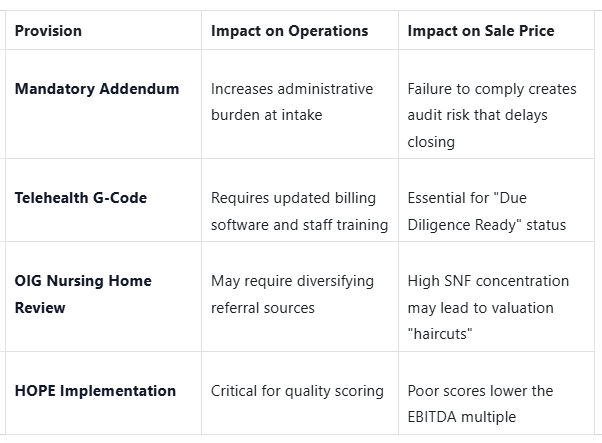
Mandatory Election Addendum: CMS proposes making the hospice election statement addendum mandatory for all Medicare beneficiaries at the time of election. Previously, this was only required upon request.
New Telehealth G-Code: Starting January 1, 2027, a new G-code (G0679) will be required for hospice face-to-face visits conducted via telehealth. This will require granular line-item detail on claims.
HOPE Assessment Status: CMS continues to prioritize the Hospice Outcomes and Patient Evaluation (HOPE) assessment, treating all 2025 submissions as timely to facilitate the transition.
Care Compare Transparency: A new icon on the Care Compare website will flag agencies that fail to meet quality reporting requirements, publicly marking them for both patients and prospective buyers.
Why Your Nursing Home Payer Mix Just Became a Valuation Risk
On July 15, 2026, the OIG launched a new project titled "Savings in Medicare Hospice Payments for Care Provided in Nursing Homes." This project examines whether the fixed daily Routine Home Care (RHC) rates are inefficient for patients residing in nursing facilities.
If you are an owner with a high concentration of patients in skilled nursing facilities (SNFs), your agency is now under a microscope. Buyers, including our team at Senate Healthcare, are closely monitoring the OIG Work Plan to see if this leads to site-specific payment reductions. If Medicare moves toward differential payments for nursing home patients, agencies that have not diversified their referral sources may see their EBITDA multiples compress from 8.5x down to 5.5x or lower.
Valuation Math: Quantifying the Impact of the Final Rule
Regulatory changes are the primary driver of buyer underwriting in 2026. When we acquire a hospice agency, we do not just look at the current EBITDA: we look at "Clean EBITDA." This means earnings that are not at risk of being clawed back by audits or reduced by new payment caps.
Consider an agency with 2 million dollars in EBITDA. In a stable environment, a quality multi-market agency might trade at an 8x multiple, resulting in a 16 million dollar valuation. However, if that agency lacks a process for the new mandatory election addendum or has an unaddressed OIG risk profile, a buyer may adjust the multiple to 6x. That is a 4 million dollar loss in value due to preventable compliance gaps.
Owner Vignette: The Cost of Waiting
We recently spoke with "David," an owner-operator of a 5 million dollar revenue hospice in the Midwest. David has a strong local reputation but has been slow to implement the new telehealth reporting requirements and the HOPE assessment framework. He believed he could wait until the final rule was published to start making changes.
During a preliminary evaluation, the lack of a structured response to the FY2027 proposals was flagged as a "key-person dependence" and compliance risk. Because David is the only one who understands the regulatory landscape, the agency's value was estimated significantly lower than his peers who had already delegated these transitions to a clinical director. By partnering with a buyer like Senate Healthcare, owners like David can offload this regulatory burden while securing their legacy at a peak valuation.

Plain-Language Glossary
EBITDA Multiple: A number used to determine a company's value by multiplying its earnings before interest, taxes, depreciation, and amortization.
Final Rule: The definitive version of a federal regulation that has been reviewed and is ready to be enforced.
Hospice Cap: The maximum amount Medicare will pay a hospice agency per patient, per year, on average.
OMB (Office of Management and Budget): The federal office that reviews significant regulations before they are published in the Federal Register.
Underwriting: The process a buyer uses to assess the risk and potential of a business before making an offer.
So what should you do now?
Audit your intake process: Ensure your clinical team is prepared to make the hospice election statement addendum mandatory for all patients starting October 1.
Analyze your referral mix: If more than 50 percent of your census is in nursing homes, begin diversifying your referral sources to mitigate the risk of the OIG's "fixed daily rate" investigation.
Update your billing systems: Verify that your software can accommodate the new telehealth G-code (G0679) before the January 1, 2027, requirement.
Prepare for exit: Ensure your agency is due diligence ready by documenting your response to these new CMS mandates.
Strategic Growth through Partnership
The complexity of the FY2027 Hospice Final Rule illustrates why many independent owners are choosing to transition their agencies. Staying compliant requires constant vigilance and significant overhead. At Senate Healthcare, we acquire hospice agencies and transform them into a trusted national brand. We are actively evaluating acquisitions in the 2 million to 10 million dollar revenue band.
When you partner with us, we take on the regulatory headaches and the pressure of buyer underwriting, allowing you to realize the value of the business you have built. Our commitment to quality care and operational excellence ensures that your legacy is preserved while your agency continues to grow.


If you are considering a sale or want to explore how a partnership with Senate Healthcare can protect your agency from regulatory volatility, we are here to talk. We focus on streamlining the acquisition process so you can focus on what matters most.
Unlock Your 30-Minute Agency Succession Review
Maybe you're ready to expand your reach, or perhaps it's time to consider your legacy and the future of your business. Either way, it all begins with a conversation. Schedule a confidential, no-obligation call to explore what the future might hold for you and your business.
Complete the form, and we'll reach out for a chat...


© 2025 SENATE HEALTHCARE LLC.
ALL RIGHTS RESERVED