
Quality is the New Scale: Why Your Census Isn't the Only Number That Matters in 2026
This article breaks down why clinical quality and documentation have replaced census size as the primary driver of agency valuations in 2026. It provides a comparative look at how "quality" agencies out-earn "volume" agencies during an acquisition. The post also offers a practical guide for home health and hospice owners to prepare for a successful sale by focusing on outcomes and compliance. Alt Text Descriptions:
3/23/20266 min read


Quick-Scan Summary
Who this is for: Owners of home health or hospice agencies with $2 million to $10 million in revenue who are considering a sale or seeking a strategic partner.
Key takeaways:
Buyers are no longer chasing "growth at all costs." They want clean charts and high clinical scores.
Poor quality metrics can lead to "valuation haircuts" of 20 percent or more during due diligence.
Staffing stability and low hospital readmission rates are the two biggest value drivers in the current market.
High-quality operations command premium multiples even with a smaller census.
The Great Shift: From 2021 Volume to 2026 Value
A few years ago, the math for selling a home health or hospice agency was simple. If you had a large census and decent top-line revenue, you could practically name your price. Private equity firms and large strategic buyers were in a "land grab" phase. They wanted scale, and they wanted it fast. They were willing to overlook a few messy clinical files or a high turnover rate if the volume was there.
That world is gone.
In 2026, the market has matured. We have entered an era where quality is the foundation for any sustainable scaling strategy. Buyers, including our team here at Senate Healthcare LLC, are looking past the "vanity metrics" of a large patient list. We are looking at what that list actually represents. Is it a stable group of patients receiving high-level care? Or is it a revolving door of high-risk admissions with poor documentation?
When we evaluate acquisitions, we see a clear trend: agencies that focus on being "better" instead of just "bigger" are the ones walking away with the highest checks. This shift is driven by a tighter regulatory environment and the CMS finalizes FY 2026 hospice payment rule, which places more emphasis on outcomes than ever before.
Why Quality Conversions Trump Raw Volume
It is tempting to think that more patients always equals more value. However, the data for 2026 shows that high-quality conversions are worth significantly more than raw volume. A "quality conversion" in the world of home health or hospice means a patient who stays on service for the appropriate length of stay, has zero unplanned hospitalizations, and provides high marks on satisfaction surveys.
When an agency focuses on quality, its costs actually go down. Research shows that companies in the top 25th percentile of quality culture see their "costs of poor quality" fall by at least 16 percent over three years. For a home health or hospice owner, this translates to less money spent on "rework" like fixing clinical notes, dealing with ADRs (Additional Documentation Requests), or training new staff to replace those who quit due to burnout.


The "Valuation Haircut" and Messy Paperwork
Nothing kills a deal faster than a clinical audit that comes back messy. We have seen owners build incredible businesses with $8 million in revenue, only to see their valuation tank during due diligence because their OASIS or HIS documentation was inconsistent.
In 2026, buyers treat quality as a "guardrail." If your bug frequency (in the form of charting errors) or your incident volume (readmissions) is high, it signals a lack of operational control. To a buyer, this looks like a massive risk. If we are going to integrate your agency into our portfolio, we need to know the foundation is solid.
If your paperwork is in shambles, a buyer might offer a 4x multiple instead of a 6x multiple. On a $1 million EBITDA business, that is a $2 million mistake. You can find more about these specific triggers in our guide on 10 valuation drivers buyers actually care about.
Staffing Stability as a Quality Metric
You cannot have high-quality care without a stable team. In the current market, your retention rate is perhaps the most honest indicator of your agency's quality. High turnover leads to "visit fatigue" and clinical errors, which eventually show up in your outcomes data.
At Senate Healthcare LLC, we often say that staffing is the new gold. When we see an agency with a clinician turnover rate below 15 percent, we know we are looking at a premium asset. It tells us that the culture is healthy and the patients are getting consistent care.
Many owners are now using technology to protect this quality. We are seeing a surge in how AI scribes are adding millions to agency valuations by reducing the charting burden on nurses. This is a perfect example of using "quality" tools to drive "scale" value.
Comparing Two Agencies: A Valuation Scenario
Let’s look at how this plays out in a real-world negotiation.
Imagine two hospice agencies in the same market. Agency A has focused entirely on census growth. They take every referral, even if they don't have the staff to cover it properly. Agency B has stayed smaller but has focused on perfect compliance and elite staffing.
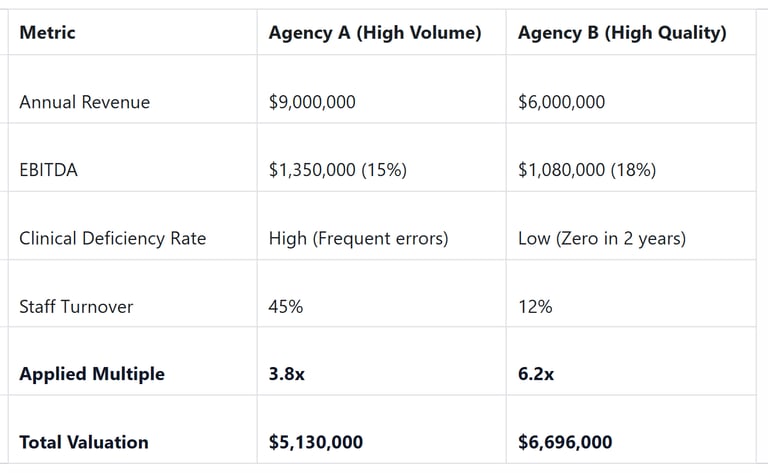
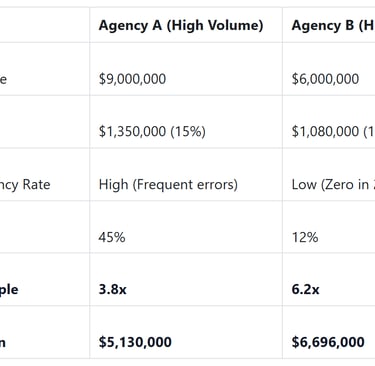
Even though Agency A has 50 percent more revenue, Agency B is worth $1.5 million more. Why? Because Agency B is a "turnkey" asset. A buyer like Senate Healthcare can scale Agency B easily. Scaling Agency A, however, would require a total operational overhaul, which adds risk and lowers the price we are willing to pay.


Positioning for Value-Based Care
The shift toward quality is also a preparation for the value-based care takeover. Payors are increasingly looking to partner with agencies that can prove they keep patients out of the hospital. If you can show a history of low readmissions, you aren't just a provider anymore: you are a strategic partner.
This is especially critical for those considering an exit in the 2026 golden window. With interest rates stabilizing, more capital is flowing into the market, but it is moving toward agencies that can survive in a value-based world.
A Plain-Language Glossary for Owners
EBITDA: Your profit before interest, taxes, depreciation, and amortization. It is the baseline number buyers use to value your agency.
Multiple: The number we multiply your EBITDA by to get the purchase price. Quality metrics are what push this number from a 3x to a 7x.
Clinical Compliance: The act of following all federal and state regulations. In M&A, this is usually verified through a "chart audit" of your patient files.
Recapture Rate: The percentage of patients who stay within your care network instead of going back to the hospital. High recapture equals high valuation.
So what should you do now?
If you are an owner looking to maximize your value for a 2026 or 2027 exit, here is your playbook:
Perform a "Mock Audit": Hire a third party to look at 20 percent of your charts. Fix the systemic errors now so they don't appear during our due diligence.
Audit Your Stars: If your Medicare Star Rating or CAHPS scores are lagging, create a 90-day "Quality Sprint" to move the needle.
Benchmark Your Turnover: If your turnover is above 25 percent, find out why. Fixing your culture is the fastest way to increase your multiple.
Focus on Documentation: Ensure your clinicians understand that "if it isn't documented correctly, it didn't happen." This protects you from future audits and clawbacks.
At Senate Healthcare LLC, we are actively looking to acquire home health or hospice agencies that prioritize these quality markers. We aren't looking for the biggest agency on the block; we are looking for the best-run agency. If you have built something with a strong clinical foundation and are ready to explore a sale, we would love to talk about how we can help you secure your legacy.
You can learn more about our approach on our about us page or check out our FAQs for owners considering a sale.
Resources:
https://homehealthcarenews.com/2026/02/inside-the-trends-shaping-at-home-care-ma-in-2026/
https://hospicenews.com/2026/01/08/the-pendulum-swings-hospices-2026-ma-outlook/
https://www.wolterskluwer.com/en/expert-insights/2026-healthcare-ai-trends-insights-from-experts
https://senatehealthcare.com/cms-finalizes-fy-2026-hospice-payment-rule-what-agencies-need-to-know
Unlock Your 30-Minute Agency Succession Review
Maybe you're ready to expand your reach, or perhaps it's time to consider your legacy and the future of your business. Either way, it all begins with a conversation. Schedule a confidential, no-obligation call to explore what the future might hold for you and your business.
Complete the form, and we'll reach out for a chat...


© 2025 SENATE HEALTHCARE LLC.
ALL RIGHTS RESERVED