
OASIS-E2 is Live: The 3 Data Points That Will Decide Your Agency's Value This Quarter
This article explores the critical impact of the April 2026 OASIS-E2 rollout on home health agency valuations. We break down the three specific data points that sophisticated buyers like Senate Healthcare use to determine your agency's market multiple. Learn how to avoid costly valuation "haircuts" by ensuring your clinical documentation reflects the new focus on social determinants and functional outcomes.
4/2/20266 min read


As of yesterday, April 1, 2026, the home health landscape officially moved into the OASIS-E2 era. While many operators see this as just another regulatory hurdle or a documentation headache, sophisticated buyers see it as a truth machine. At Senate Healthcare, we are actively looking for home health or hospice agencies that have stayed ahead of this curve. When we evaluate an agency for acquisition, the way you handle these new data points tells us everything we need to know about your clinical integrity and your future profitability under Value Based Purchasing.
The era of COVID-19 specific questions is behind us. CMS has shifted the focus toward long term sustainability, resource management, and a deeper understanding of the patient’s environment. If your documentation is sloppy or your clinicians are still adjusting to these changes, it could lead to a significant valuation haircut during the due diligence process. On the other hand, clean data in these three specific areas can push your exit multiple to the top of the market range.
Quick-Scan Summary
Who this is for: Home health or hospice owners in the $2M to $10M revenue range who are considering a sale or seeking a strategic partner in 2026.
Key takeaways:
OASIS-E2 marks a definitive shift away from pandemic era reporting toward functional outcomes and social risk factors.
Buyers use specific data points like A1255 (Transportation) and expanded sensory assessments to gauge your agency's operational efficiency.
Clean data prevents valuation "haircuts" where buyers lower the offer price due to compliance risks found during due diligence.
Maximizing your EBITDA multiple requires a clinical team that understands how documentation drives the financial value of the business.
The Shift from Compliance to Valuation
In years past, OASIS was seen primarily as a billing requirement. As long as the forms were submitted, the revenue flowed. However, in the current 2026 market, data is the currency of M&A. We are currently in a unique period often called The 2026 Golden Window because interest rates have stabilized and CMS has provided a clearer runway for the next few years.
When a buyer like Senate Healthcare looks at your agency, we aren't just looking at your current revenue. We are looking at how "buyable" your data is. If your OASIS-E2 entries are inconsistent, it signals to us that your team might be struggling with the transition, which represents a post-acquisition risk. To avoid this, you need to focus on three specific data categories that are currently driving buyer underwriting.


1. Functional Improvement and Sensory Accuracy (The Quality Proxy)
OASIS-E2 has expanded sensory assessments, particularly hearing, vision, and language, to the Resumption of Care (ROC) time point. This might seem like a minor clinical change, but it is a massive data point for buyers. Why? Because it demonstrates your agency’s ability to capture patient acuity accurately from the start.
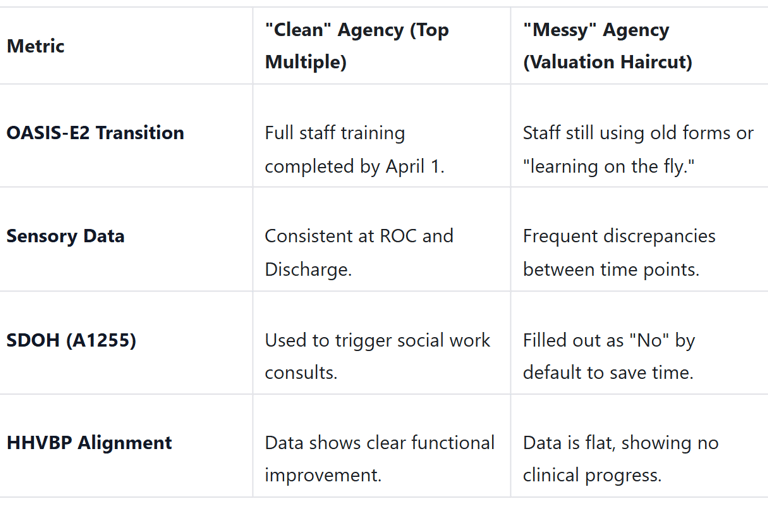
If your clinicians are marking "no impairment" for sensory items at the start of care but then documenting complex needs later, it creates a discrepancy. Sophisticated buyers look for "clean" sensory data because it is a leading indicator for Home Health Value Based Purchasing (HHVBP) scores. High HHVBP scores lead to higher reimbursement bonuses, which directly increases your EBITDA. If we see that your sensory assessments are consistently accurate, we view your agency as a high-quality clinical engine that is worth a premium multiple. You can learn more about how these drivers move the needle in our guide on 10 valuation drivers buyers actually care about.
2. Resource Efficiency and the New Transportation Metric (A1255)
One of the most notable changes in OASIS-E2 is the refinement of transportation tracking. Item A1255 has been streamlined to identify if a patient’s lack of transportation has kept them from getting medical care. From a buyer’s perspective, this is a resource efficiency metric.
If a high percentage of your census struggles with transportation, it suggests your staff may be spending more time on coordination and social work than on direct clinical care. While this is necessary for the patient, an agency that doesn't track this accurately is often "bleeding" labor costs without realizing it. We evaluate how you use this data to trigger referrals to community partners or social services. An agency that manages these Social Determinants of Health (SDOH) efficiently is more profitable and less dependent on the owner’s constant oversight. This is a key part of moving away from key person dependence.
3. Social Determinants of Health (SDOH) and Risk Adjustment
The shift away from COVID-19 questions has left a vacuum that CMS filled with SDOH metrics. This includes the new A0810 (Patient Sex) field and more nuanced assessments of living situations. To a buyer, these are risk adjustment tools.
If you are operating in a high oversight state like California or Texas, your ability to document these social risks correctly protects your agency from audits. During due diligence, if we find that your patient population is high risk but your documentation doesn't reflect the complexity of their social needs, we have to assume your agency is at risk for "upcoding" or technical denials. This leads to a valuation haircut. For example, if we initially value your agency at a 6x multiple but find "dirty" SDOH data, we might drop that to a 5x multiple to account for the risk of future CMS clawbacks.
Valuation Math: The Cost of "Dirty" Data
Let's look at a concrete scenario. Imagine your home health agency has an EBITDA of $1,000,000. In the current 2026 market, a clean, well-run agency might command a 6x multiple, resulting in a $6,000,000 valuation.
However, if your OASIS-E2 data is inconsistent, a buyer will see risk. They might apply a "haircut" of 1.0x to the multiple to cover potential audit exposure and the cost of retraining your staff post-acquisition.
Clean Data Valuation: $1,000,000 EBITDA x 6.0 = $6,000,000
Dirty Data Valuation: $1,000,000 EBITDA x 5.0 = $5,000,000
The "Data Tax": $1,000,000 loss in exit value.
Documentation isn't just about compliance; it is about protecting millions of dollars in personal wealth when you decide to exit.


Comparing Data Profiles: What Buyers See
The "April 1" Effect on Your Exit Strategy
If you are planning to sell your agency in late 2026 or 2027, the data you are collecting right now is what we will be auditing during due diligence. We don't just look at the last month of data; we look at trends. If your agency shows a "dip" in quality scores or an increase in documentation errors starting in April 2026, it tells us that your leadership team struggles with change management.
Many owners are feeling the pressure of these constant changes. We see burnout rising as Medicare Advantage plans squeeze margins and CMS updates documentation requirements. If you feel that staying on top of OASIS-E2 is becoming a burden, it might be the right time to explore a partnership with a larger entity that has the back office infrastructure to handle these complexities. Our portfolio is designed to absorb these administrative burdens so that clinicians can focus on patients. You can see how others are positioning themselves in this environment by checking out the M&A surge secrets for 2026.
Plain-Language Glossary
EBITDA: Your agency's profit before paying for things like interest, taxes, or non-cash accounting items. It is the primary number buyers use to value your business.
Multiple: The number (e.g., 5x or 6x) that a buyer multiplies your EBITDA by to get your total purchase price.
OASIS-E2: The newest version of the assessment tool required by CMS for all home health patients, effective April 1, 2026.
Due Diligence: The "home inspection" phase of a business sale where the buyer verifies your clinical and financial records.
Valuation Haircut: When a buyer reduces their initial offer price because they found risks or problems during their review.
So what should you do now?
Audit your ROC files: Review the first batch of OASIS-E2 submissions from this week. Specifically, check the sensory and transportation fields for accuracy.
Quantify your "Data Risk": Ask your clinical director if they feel confident in the new SDOH requirements. If they are hesitant, it is time for immediate retraining.
Evaluate your exit timeline: If the thought of another two years of OASIS updates feels exhausting, consider whether you want to capture your agency's value at the peak of the 2026 market.
Contact Senate Healthcare: We are evaluating home health and hospice acquisitions right now. We can help you understand how your current data stacks up against buyer expectations.
The transition to OASIS-E2 is more than a clinical update; it is a valuation event. By focusing on functional improvement, resource efficiency, and clean SDOH data, you can ensure that when it comes time to sell, you aren't leaving money on the table. Senate Healthcare is here to be that strategic partner, helping you transition your legacy while maximizing the value you have built.
Resources:
https://oasisanswers.com/update-april-2025-oasis-qas-what-you-need-to-know/
https://www.carevoyant.com/home-health-blog/oasis-e2-2026-guide
https://www.medbridge.com/blog/free-oasis-e2-cheat-sheet-download
https://www.cms.gov/medicare/quality/home-health/oasis-data-sets
https://www.cms.gov/files/document/oasis-e2-draft-508-11-14-25.pdf
Unlock Your 30-Minute Agency Succession Review
Maybe you're ready to expand your reach, or perhaps it's time to consider your legacy and the future of your business. Either way, it all begins with a conversation. Schedule a confidential, no-obligation call to explore what the future might hold for you and your business.
Complete the form, and we'll reach out for a chat...


© 2025 SENATE HEALTHCARE LLC.
ALL RIGHTS RESERVED