
The “VBP” Survival Guide: Why Your 2026 Home Health Margins Depend on These 4 Metrics
Is your agency ready for the 2026 VBP shift? This guide explores the four key metrics that now dictate home health margins and agency valuations. Learn why clinical outcomes like functional gain and hospitalization rates are the new drivers of sale prices in the M&A market.
4/9/20266 min read


For the home health or hospice owner, the landscape of 2026 is no longer about just providing good care. It is about proving that care through a very specific set of numbers. The Home Health Value-Based Purchasing (HHVBP) model has moved past its pilot phase and is now the primary lever CMS uses to reward efficiency and punish clinical stagnation.
If you are an owner thinking about a sale in the next twenty-four months, these metrics are not just operational goals. They are the primary variables in a buyer’s underwriting spreadsheet. At Senate Healthcare LLC, when we evaluate an acquisition, we look directly at how an agency is performing against the Total Performance Score (TPS). A high score suggests a stable, premium asset. A low score suggests a "fixer-upper" that carries significant reimbursement risk.
Quick-Scan Summary
Who this is for:
Home health or hospice owners with $2M to $10M in annual revenue.
Operators looking to exit or partner with a larger entity by 2027.
Agency directors struggling to align clinical staff with VBP goals.
Key Takeaways:
The Two-Year Lag: Your 2026 performance determines your 2028 cash flow.
Clinical is Financial: Metrics like "Potentially Preventable Hospitalization" now carry the same weight as traditional financial KPIs.
Valuation Impact: Poor VBP scores can lead to a "haircut" on your EBITDA multiple during a sale.
Strategic Focus: Shifting staff focus to functional improvement and cost efficiency is non-negotiable.
The New Reality of HHVBP in 2026
The rules have changed. In previous years, patient satisfaction (HHCAHPS) held a massive chunk of the scoring. While the patient experience still matters, CMS has pivoted toward hard clinical outcomes and cost-efficiency. This shift signals a move away from "how the patient felt" to "how much the patient improved" and "how much did it cost the system."
For an agency owner, this means your clinical team needs to be as disciplined with their documentation as your biller is with claims. The 2026 recalibrations have redistributed the weights of the Total Performance Score, making it harder to hide poor clinical performance behind high patient satisfaction scores.


The Core Four: Metrics That Move the Needle
To protect your margins and ensure your agency remains an attractive acquisition target, you must master these four specific areas.
1. The 1800-Series OASIS Functional Items
CMS has doubled down on the Discharge Function Score. This is now a cornerstone of the VBP model. It measures how well your clinicians help patients regain independence in daily activities. Specifically, the focus is on the 1800-series items like Bathing, Upper-Body Dressing, and Lower-Body Dressing.
Buyers look for "functional gain" trends. If your staff is under-reporting functional limitations at admission or failing to show progress at discharge, your TPS will suffer. From an M&A perspective, an agency that cannot demonstrate functional improvement is seen as a liability. It suggests a lack of clinical oversight or a staff that is simply "going through the motions."
2. Medicare Spending Per Beneficiary (MSPB)
This is the "new kid on the block" for many owners. The MSPB metric tracks the total cost of care during an episode and for thirty days after discharge. It is a measure of your agency’s cost-efficiency.
Are you over-utilizing therapy when it is not clinically indicated? Are your patients ending up back in the ER for things that could have been handled at home? CMS is watching the total spend. High-cost agencies will see their margins squeezed by negative payment adjustments. When we at Senate Healthcare LLC look at a potential partnership, we analyze MSPB to see if the agency is lean and efficient or if it is bloated with unnecessary costs that will be trimmed by CMS in the coming years.
3. Potentially Preventable Hospitalization (PPH)
This is perhaps the most critical clinical metric for valuation. PPH tracks unplanned hospitalizations that could have been avoided with better home care management. It is a claims-based measure, meaning there is no way to "fudge" the numbers through documentation.
A high PPH rate is a massive red flag for a buyer. It indicates poor clinical protocols, weak communication between nurses and physicians, and a lack of after-hours support for patients. In a sale scenario, a high PPH rate can directly lower the multiple a buyer is willing to pay because it represents a high risk of future Medicare penalties.
4. Streamlined HHCAHPS (Patient Experience)
While the weight has shifted, the patient experience still matters. The 2026 model uses a more streamlined version of the HHCAHPS survey. It focuses on communication, care of the home, and whether the patient would recommend the agency.
The key here is consistency. A buyer wants to see that your agency is well-regarded in the community. High satisfaction scores are a "soft asset" that supports a higher valuation multiple, as they often correlate with strong referral patterns and a stable workforce.
The Math of a Sale: How VBP Performance Dictates Your Exit Multiple
Let’s look at a concrete valuation scenario. Consider a home health agency with $5 million in annual revenue and $1 million in EBITDA. In a standard market, this agency might trade at a 5x multiple, resulting in a $5 million valuation.
Scenario A: The High Performer
This agency has a high TPS, strong functional improvement scores, and low PPH. A buyer like Senate Healthcare LLC sees this as a low-risk, high-reward asset. We might offer a 5.5x multiple because we know the 2028 reimbursement will likely include a 2% bonus.
Valuation: $5.5 million.
Scenario B: The Underperformer
This agency has lagging functional scores and a high PPH rate. The buyer knows that a 2% payment penalty is looming in 2028. This risk is "priced in" by dropping the multiple to 4.5x.
Valuation: $4.5 million.
In this example, the owner's failure to manage VBP metrics cost them $1 million at the closing table. This is why we tell owners that clinical quality is the strongest driver of financial value.
Platform vs. Add-on: How Buyers Categorize You
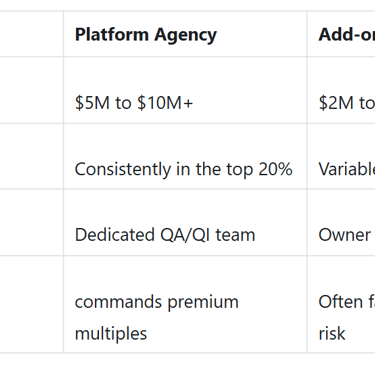
When we evaluate acquisitions, we generally categorize agencies into two groups based on their operational and VBP readiness.
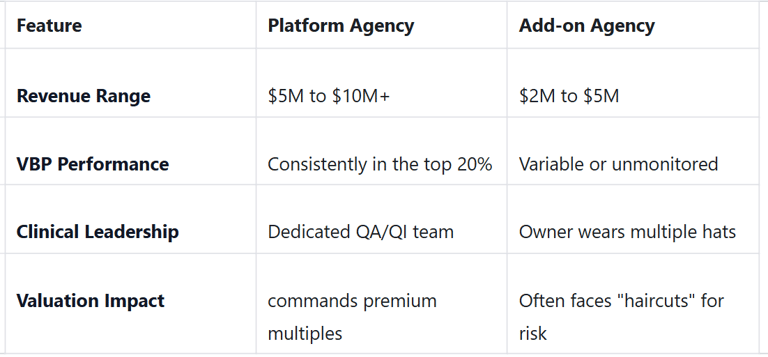


Why Buyers Care More About Your 2026 Data Than Your 2025 Data
Because VBP payment adjustments apply prospectively two years after the performance year, your 2026 data is the most relevant information for a buyer looking at your agency today. If we are negotiating a deal in late 2026 or early 2027, your 2026 scores tell us exactly what your revenue will look like in 2028.
As a buyer, Senate Healthcare LLC is looking for agencies that have already done the hard work of clinical alignment. We want to partner with owners who understand that the "old way" of home health or hospice: focused purely on volume: is over. The new way is focused on value.
So what should you do now?
If you are an owner-operator in the $2M to $10M range, your focus for the remainder of 2026 should be clear:
Audit Your OASIS Accuracy: Specifically, bring in an outside set of eyes to review your 1800-series scoring. Ensure your staff is not under-representing patient needs at start of care.
Review Your PPH Data Monthly: Do not wait for the quarterly reports from CMS. Use your internal EMR data to track which patients are going back to the hospital and why.
Train Staff on MSPB: Educate your clinical managers on the cost of care. Show them how efficient scheduling and proper supply management affect the agency’s overall score.
Assess Your Exit Readiness: Reach out to a buyer like Senate Healthcare LLC for a confidential conversation. Even if you are not ready to sell today, knowing how a buyer views your current metrics can help you course-correct before it is too late.
Partner With Senate Healthcare LLC
Senate Healthcare LLC is a dedicated buyer of home health or hospice agencies. We are not brokers or advisors; we are strategic partners looking to acquire and grow high-quality healthcare businesses. We understand the pressure that VBP recalibrations put on independent owners.
Our goal is to help owners reduce their operational risk and achieve a transition that reflects the true value of the care they provide. Whether you are facing succession challenges or simply want to take some "chips off the table" while valuations are strong, we are here to evaluate your agency for a potential acquisition.
Plain-Language Glossary
EBITDA: Earnings Before Interest, Taxes, Depreciation, and Amortization. A common measure of a company's healthy cash flow.
Multiple: The number used to multiply EBITDA to determine the total sale price of a business.
Total Performance Score (TPS): The final score CMS gives a home health agency based on various quality and cost metrics.
Due Diligence: The period during an acquisition when a buyer (like Senate Healthcare) verifies the financial and clinical records of the seller.
Underwriting: The process a buyer uses to assess the risk and potential return of an acquisition.
Unlock Your 30-Minute Agency Succession Review
Maybe you're ready to expand your reach, or perhaps it's time to consider your legacy and the future of your business. Either way, it all begins with a conversation. Schedule a confidential, no-obligation call to explore what the future might hold for you and your business.
Complete the form, and we'll reach out for a chat...


© 2025 SENATE HEALTHCARE LLC.
ALL RIGHTS RESERVED