
The Sophisticated Buyer Era: Why Your Census is No Longer the Star of the Show
The era of valuing home health or hospice agencies solely on patient census is officially over. Today’s sophisticated buyers are diving deep into "holistic KPIs" like caregiver retention and clinical compliance to determine true value. This post breaks down why operational excellence leads to higher EBITDA multiples and how owners can prepare for a more rigorous due diligence process. If you want to maximize your sale price in 2026, you need to understand what modern acquirers are actually looking for.
3/30/20266 min read


Quick-Scan Summary
Who this is for
Owners of home health or hospice agencies in the $2M to $10M revenue range who are considering a future exit or partnership.
Key takeaways
Census is a vanity metric that no longer guarantees a premium valuation.
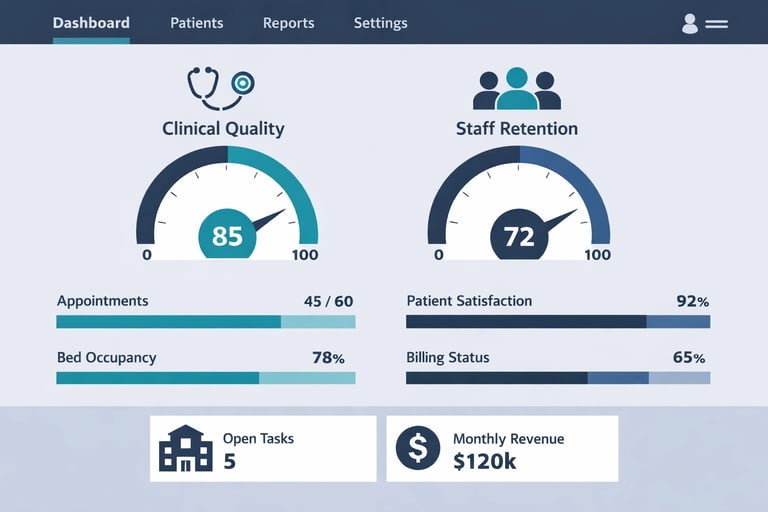
Sophisticated buyers prioritize "holistic KPIs" like caregiver retention and clinical compliance.
Operational efficiency can increase your EBITDA multiple by 2x or more compared to peers with messy books.
Reducing risk is just as important as increasing revenue when preparing for a sale
The "Growth at All Costs" Era is Over
There was a time when selling a home health or hospice agency was simple. If you had a large census and a decent geographic footprint, buyers would come knocking with big checks. The math was basic: more patients equaled more value. This created a "growth at all costs" mentality where owners focused entirely on marketing and referrals while letting the back office and culture sit on the back burner.
The market has changed. We are now in the era of the sophisticated buyer.
In 2026, the buyers we see in the market are no longer just looking at the top line. They have become smarter, more clinical, and much more focused on risk. They understand that a high census means nothing if the agency is one clinical audit away from a total shutdown. They know that if your turnover rate is 50 percent, the cost to replace those clinicians will eat the profit margins they are buying.
When we evaluate acquisitions at Senate Healthcare, we look past the surface level numbers. We look for agencies that are built to last, not just agencies that look big on paper.
Why Your Census is a Vanity Metric
A large census is impressive, but it can be a "hollow" number. If your census is 150 patients but your staffing levels only support 100, you are operating in a danger zone. Sophisticated buyers see this as a liability. They see potential burnout, low quality of care, and future regulatory "red flags."
Buyers today are looking for "sustainable margins." They want to see that your growth is supported by a solid operational foundation. If you are a home health or hospice owner, you need to stop asking "How many patients do we have?" and start asking "How healthy is our operation?"


The Three Pillars of Sophisticated Value
If census is not the star of the show anymore, what is? Sophisticated buyers are now looking at three specific pillars to determine what your agency is actually worth.
1. Caregiver Retention
Staffing has officially become the new gold in healthcare. We have discussed before why your retention rate is a major valuation multiplier. A buyer is not just buying your patient list; they are buying your workforce. In a labor shortage, a stable team of nurses and therapists is the most valuable asset you own. If your turnover is low, your valuation goes up. It shows the buyer that your culture is strong and the business can survive the transition.
2. Billable Hour Efficiency
How much does it cost you to deliver a unit of care? Sophisticated buyers look at the "unit economics" of your agency. They want to see that you have mastered your scheduling and that your clinicians are not wasting hours on administrative bloat. High billable hour efficiency suggests that the agency is using modern tools, perhaps even AI scribes to reduce documentation time, which adds millions to the bottom line in the eyes of a buyer.
3. Clinical Compliance
This is the "silent killer" of deals. A sophisticated buyer will perform deep due diligence on your charts. They want to know if you are following the latest CMS payment rules. If your documentation is sloppy, a buyer will apply a "haircut" to your valuation to account for the risk of future audits or clawbacks. On the flip side, an agency with "clean" clinical records is viewed as a premium asset.
An Owner’s Tale: The Difference Between $4M and $6M
Let's look at two hypothetical hospice owners in the $2M to $10M revenue band.
Owner A: The Volume Chaser
Sarah ran a hospice with a census of 120. She spent all her time on referral relationships. Her revenue was high, but her staff was constantly quitting. Her EBITDA was $1M. Because of the high turnover and some shaky clinical documentation, buyers viewed her as high risk. We might offer a 4x multiple for a business like this.
Valuation: $4,000,000.
Owner B: The Operational Expert
Mark ran a hospice with a census of 85. His revenue was lower than Sarah’s, but his staff had been with him for years. His clinical charts were perfect, and he used technology to keep overhead low. His EBITDA was also $1M. Because his business was "turnkey" and low risk, he attracted premium interest.
Valuation: 6x multiple = $6,000,000.
Despite having the same profit, Mark walked away with $2M more because he focused on the things sophisticated buyers actually care about.


Plain-Language Glossary
EBITDA: Earnings Before Interest, Taxes, Depreciation, and Amortization. This is essentially your "normalized" profit and is the number most buyers use to value your business.
Multiple: The number that your EBITDA is multiplied by to reach the purchase price. For example, a $1M EBITDA at a 5x multiple equals a $5M valuation.
Due Diligence: The "investigation" phase of a sale where the buyer looks at your financial, clinical, and legal records to make sure everything is as you claimed.
Haircut: A reduction in the offer price usually caused by risks found during due diligence.
The Shift Toward "Market Sophistication"
Our research shows that as the market matures, buyers are becoming "solution-aware." They are no longer responding to simple marketing claims about "quality care." They are evaluating the value and merits of their purchases based on hard data. They plan ahead and compare options.
For an owner, this means you cannot hide behind a big census anymore. You must be able to prove your value through your data. You need to show that your agency is not just a collection of patients, but a well-oiled clinical machine. This is especially true for those looking at legacy planning and succession.
So what should you do now?
If you are an owner thinking about a sale or a partnership, your priority list needs to shift. Here are the steps to take today:
Audit your turnover: Calculate your annual staff retention rate. If it is below 70 percent, identify why your people are leaving and fix it before you go to market.
Clean your charts: Conduct an internal clinical audit. Make sure your documentation supports your billing to avoid "valuation haircuts" later.
Look at your efficiency: Evaluate your "back office" costs. Are you still doing things manually that could be automated?
Know your math: Understand your EBITDA today so you can set a target for what you want it to be when you are ready to partner with a buyer.
Preparing for the Next Step
The sophisticated buyer era is not something to fear. It is actually a great opportunity for high-quality operators. When the "noise" of raw growth is stripped away, the agencies that are truly well-run stand out and command much higher prices.
At Senate Healthcare, we aren't brokers looking to list your business. We are the acquirers. We are looking for home health or hospice agencies that have spent time building a real foundation. If you have focused on your team and your clinical quality, we want to talk.
Whether you are ready to move on today or just want to see how your current metrics stack up against what we are looking for, a conversation can help you clarify your path. We look for partnerships where we can take what you have built and give it the resources to grow even further.


Let's Talk About Your Exit Strategy
Don't wait until you are burned out to think about your valuation. Let's look at your numbers together and see how we can position your agency for a successful transition.
Consult with Senate Healthcare
Unlock Your 30-Minute Agency Succession Review
Maybe you're ready to expand your reach, or perhaps it's time to consider your legacy and the future of your business. Either way, it all begins with a conversation. Schedule a confidential, no-obligation call to explore what the future might hold for you and your business.
Complete the form, and we'll reach out for a chat...


© 2025 SENATE HEALTHCARE LLC.
ALL RIGHTS RESERVED