
The Simple Strategy to Protect Your Margins Under the 2026 Medicare Final Rule
The 2026 Medicare Final Rule introduces complex net cuts for home health and specific caps for hospice that can significantly erode your agency's bottom line. This article outlines a practical strategy focused on OASIS accuracy and LUPA management to protect your margins and maximize your valuation. Learn how to prevent "valuation haircuts" and prepare your agency for a successful sale to a strategic buyer.
5/5/20266 min read


This post breaks down the specific documentation and operational shifts required to maintain profitability under the 2026 Medicare Final Rule. We explore how these changes directly impact your agency valuation and provide a roadmap for owner-operators to protect their bottom line during a potential sale.
Quick-Scan Summary
Who this is for:
Owner-operators of home health or hospice agencies in the $2M to $10M revenue range.
Founders considering an exit within the next 12 to 24 months.
Clinical directors tasked with maintaining compliance and margin in a tightening regulatory environment.
Key Takeaways:
Understand the "Net Cut" reality: While headline rates are up, behavioral adjustments are the real margin killers.
Master the OASIS: Functional measures like bathing and dressing are now the primary drivers of your HHRG (Home Health Resource Group) accuracy.
Manage LUPAs aggressively: Thresholds have shifted for many clinical groupings, making one extra visit the difference between profit and loss.
Valuation protection: Every dollar of margin lost to poor documentation results in a 4x to 6x hit to your final sale price.
The 2026 Reality: When a Rate Increase is Actually a Cut
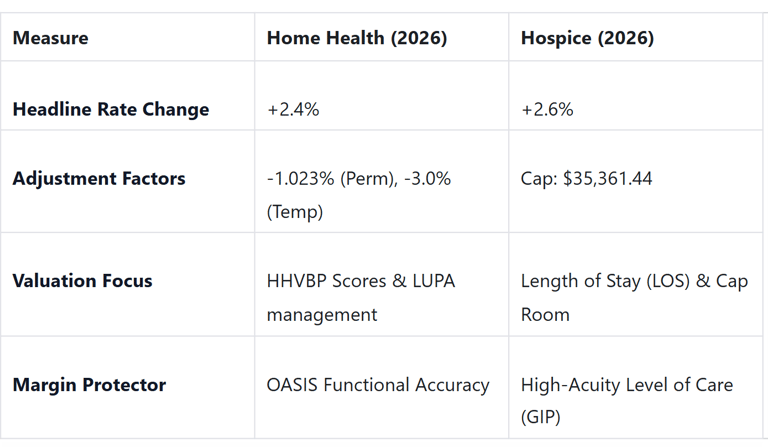
If you have been operating a home health or hospice agency for any length of time, you know that the headlines from CMS rarely tell the full story. For 2026, the news cycle might highlight a 2.4 percent rate increase for home health. On the surface, that sounds like a win. However, once you factor in the permanent behavioral adjustments of minus 1.023 percent and the temporary clawback adjustments of minus 3.0 percent, most agencies are looking at a net decrease in reimbursement of about 1.3 percent.
In the hospice world, the outlook is slightly more stable with a 2.6 percent rate increase, but the cap has been set at $35,361.44. While these numbers might seem like minor fluctuations, for an agency doing $5 million in annual revenue, a 1.3 percent drop is $65,000 straight off the bottom line.
When we evaluate an acquisition at Senate Healthcare LLC, we look at the trailing twelve months of EBITDA (Earnings Before Interest, Taxes, Depreciation, and Amortization). If that $65,000 disappears because of poor preparation for the 2026 rules, and your agency is trading at a 5x multiple, you just lost $325,000 in enterprise value. Protecting your margin is not just about monthly cash flow. It is about protecting the legacy and the wealth you have built in your business.


The Pain of the "Valuation Haircut"
Many owners we speak with are feeling the pressure of "valuation haircuts." This happens when a buyer looks at your books and sees that your margins are tightening. They assume the trend will continue and offer a lower multiple. The 2026 Final Rule provides a perfect storm for these haircuts if you are not proactive.
Consider an owner-operator named "Sarah." Sarah runs a high-quality home health agency with a $6 million census. In 2025, her EBITDA was $900,000 (a healthy 15 percent margin). As the 2026 rules kicked in, Sarah did not adjust her OASIS training or her LUPA (Low Utilization Payment Adjustment) tracking. Her margin slipped to 13.5 percent. That 1.5 percent slide reduced her EBITDA to $810,000.
When Sarah approached us to discuss a sale, the $90,000 drop in profit translated to a $450,000 reduction in our offer price. This is why "The Simple Strategy" is so vital. It bridges the gap between clinical documentation and financial exit readiness.
The Strategy: Precision Documentation and Threshold Management
The most effective way to combat these cuts is not by hiring fewer people or providing less care. It is by ensuring your documentation reflects the actual complexity of the patients you are already seeing.
1. The OASIS Functional Focus
Under the 2026 adjustments, functional measures have a higher weight in determining your reimbursement levels. Specifically, how your clinicians document "Bathing" and "Dressing" can drastically change the HHRG. If a nurse marks a patient as independent in bathing because they "can" do it, but they ignore the fact that the patient requires a seated bench and significant setup, your agency is being underpaid for the actual resource intensity required.
We recommend a "Double-Look" process on every OASIS start-of-care for the first 90 days of the 2026 rule. This ensures that the functional impairment levels are captured accurately before the claim is submitted.
2. LUPA Threshold Management
The 2026 rules have shifted the visit thresholds for several clinical groupings. A LUPA occurs when the number of visits in a 30-day period falls below a specific threshold, causing you to be paid a per-visit rate rather than a full episode rate.
In some 2026 groupings, the threshold might have moved from 2 visits to 3. If your team continues to follow "the way we have always done it" and only schedules 2 visits, you are losing thousands of dollars per patient. You must update your EMR (Electronic Medical Record) alerts to reflect the new 2026 LUPA thresholds immediately.
3. Leveraging F2F Flexibility
Face-to-Face (F2F) documentation remains a primary reason for claim denials and revenue clawbacks. The 2026 guidance allows for more flexibility in how the primary diagnosis is linked to the F2F encounter. By ensuring the physician’s notes explicitly state how the home health or hospice needs relate to the primary reason for the encounter, you reduce the risk of future audits that can wreck your valuation during a buyer's due diligence process.


HHVBP: The 10-Point Swing
The Home Health Value-Based Purchasing (HHVBP) model is no longer a pilot. It is the law of the land. In 2026, the reweighting of these measures means that your agency faces a potential 10 percent swing in reimbursement. You will either get a 5 percent bonus or a 5 percent penalty based on your performance relative to your peers.
For an agency looking to sell, being in the "bonus" category is a massive green flag for a buyer like Senate Healthcare LLC. It proves that you have a high-performing clinical team and a standardized process. Conversely, if you are in the "penalty" zone, a buyer will likely price in the risk of further revenue erosion, leading to a lower multiple.
Comparing the Impact: Home Health vs. Hospice
While the rules differ, the strategy remains the same: accuracy over volume.
Plain-Language Glossary
EBITDA: A measure of a company's overall financial performance, often used as a proxy for cash flow. This is the number we use to calculate your agency's value.
Multiple: The number multiplied by your EBITDA to determine the total sale price (e.g., $1M EBITDA x 5 Multiple = $5M Valuation).
LUPA: Low Utilization Payment Adjustment. A "penalty" rate paid when too few visits are made in a period.
OASIS: Outcome and Assessment Information Set. The standard data set used by home health agencies to track patient outcomes and determine payment.
PDGM: Patient-Driven Groupings Model. The payment system Medicare uses for home health.
The Strategic Partnership Approach
At Senate Healthcare LLC, we aren't here to act as brokers or advisors who list your business and walk away. We are the buyers. We are actively seeking to acquire home health or hospice agencies where the owner is ready for the next chapter.
We understand that the 2026 Medicare Final Rule is a lot to handle. Many owners feel burnt out by the constant "goalpost shifting" from CMS. If you are tired of chasing the latest documentation requirements and want to secure your legacy while the market multiples are still strong, we should talk. We evaluate acquisitions based on the strength of your local reputation and the potential of your team, even if your 2026 prep isn't perfect yet.


So what should you do now?
Audit your top 20 claims: Look specifically at your functional OASIS scores. Are they reflecting the true difficulty of the care provided?
Review your LUPA alerts: Ensure your scheduling team knows the updated 2026 thresholds for every clinical grouping.
Calculate your "Valuation Gap": Use your current EBITDA and a 5x multiple. Now, subtract 1.3 percent from your revenue and see how much your "exit check" shrinks.
Start a conversation: You don't need to have every box checked to explore a sale. Reach out to us to see how we can help you transition out of the daily regulatory grind.
We are looking for partners who have built something special. Whether you are ready to retire or just want to take some chips off the table and stay on as a leader, Senate Healthcare LLC is the strategic partner to help you navigate what comes next.
Resources:
Unlock Your 30-Minute Agency Succession Review
Maybe you're ready to expand your reach, or perhaps it's time to consider your legacy and the future of your business. Either way, it all begins with a conversation. Schedule a confidential, no-obligation call to explore what the future might hold for you and your business.
Complete the form, and we'll reach out for a chat...


© 2025 SENATE HEALTHCARE LLC.
ALL RIGHTS RESERVED