
The Owner’s Guide to Surviving the Hospice Fraud Crackdown in 2026
As the 2026 hospice fraud crackdown intensifies with new nationwide moratoriums and payment suspensions, agency owners face unprecedented risks to their business stability. This guide explores the "red flags" CMS is targeting, including live discharge rates and the new FY 2027 Hospice Scoring System. Learn how these regulatory shifts impact your agency's valuation and discover practical steps to protect your legacy before a potential sale or partnership.
6/18/20266 min read


This post provides a strategic roadmap for hospice owners navigating the aggressive 2026 CMS enforcement landscape and the new FY 2027 Scoring System. We break down the impact of current nationwide moratoriums and offer actionable steps to protect your agency’s valuation during this period of intense regulatory scrutiny.
Quick-Scan Summary
Who this is for
Owners and operators of home health or hospice agencies with $2M to $10M in annual revenue.
Sellers preparing for an exit or partnership within the next 12 to 24 months.
Operators in hotspot states like California, Texas, Arizona, Nevada, Georgia, and Ohio.
Key Takeaways
The Moratorium is Real: CMS launched a six-month nationwide pause on new hospice enrollments in May 2026 to curb rapid industry expansion.
Payment Suspensions are the New Norm: Targeted holds are being used more frequently than full decertification to freeze operations during audits.
Valuation is Tied to Data: Your live discharge rates and SSVI scores are now the first things a buyer like Senate Healthcare will look at during underwriting.
Compliance is the Best Defense: Proactive internal audits of documentation and "long stay" patients are mandatory for anyone seeking a premium sale price.
The 2026 Regulatory Storm: Moratoriums and Suspensions
The hospice industry is currently facing one of its most challenging regulatory environments in decades. In May 2026, the Centers for Medicare & Medicaid Services (CMS) took the unprecedented step of implementing a six-month nationwide moratorium on new Medicare hospice enrollments. While this primarily affects new entrants, the message to existing operators is clear: the era of unchecked growth is over.
For established owners, the bigger threat is the surge in payment suspensions. CMS and its Unified Program Integrity Contractors (UPIC) have identified specific hotspots where growth has outpaced clinical logic. If your agency is located in California, Arizona, Texas, Nevada, Georgia, or Ohio, you are already in the crosshairs. These suspensions are being used as a primary enforcement tool, often triggered by billing anomalies or rapid census growth that looks like "license flipping" to federal regulators.
When we evaluate an acquisition at Senate Healthcare, we aren't just looking at your clinical outcomes. We are looking at how vulnerable you are to a sudden payment hold. A suspension of just 30 to 60 days can be a death sentence for a mid-sized agency with $2M to $5M in revenue. Protecting your cash flow means ensuring your documentation is beyond reproach before the UPIC knock comes.
Red Flags: The Metrics That Trigger Audits
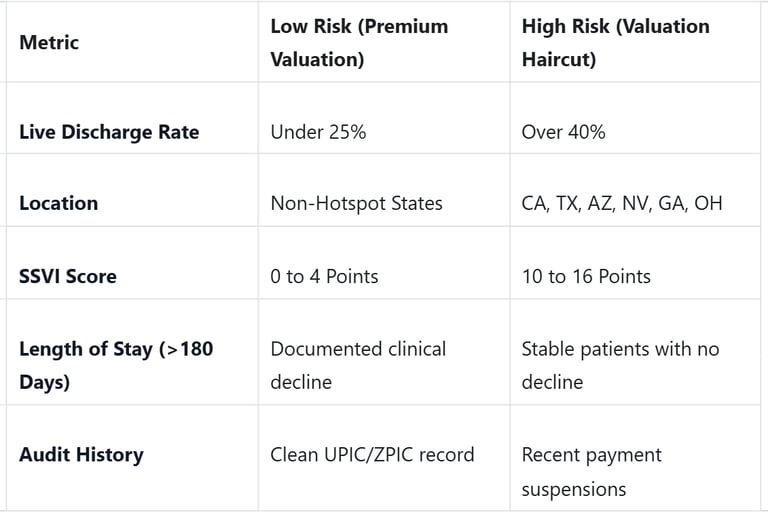
In the past, many owners viewed live discharge rates as a secondary quality metric. Today, it is a primary fraud indicator. The national average for live discharges typically sits between 17% and 21%. However, the new benchmarks for 2026 indicate that any agency with a live discharge rate exceeding 40% will likely trigger an automatic audit or a PPEO (Provider Period of Enhanced Oversight) review.
CMS is also focused on what they call "unreasonable lengths of stay." If a significant portion of your census has been on service for more than 180 days and is eventually discharged alive, it signals to regulators that those patients might never have been eligible for the hospice benefit in the first place.
The FY 2027 Hospice Scoring System (SSVI)
Starting in late 2026, CMS is introducing the Service and Spending Variation Index (SSVI). This is a 0 to 16-point scoring system designed to rank your agency's risk profile. Points are assigned based on metrics like:
Overall Live Discharge Rate: Points are given if you are in the top 25% of the country (currently over 47.5%).
Rapid Return to Hospice: High rates of patients being discharged and then readmitted within seven days.
Non-Hospice Spending: When your patients are still billing Medicare for expensive treatments outside of your care plan.
End-of-Life Visit Intensity: A lack of skilled nursing visits in the final two days of a patient's life.


Why This Matters for Your Valuation
If you are an owner-operator in the $2M to $10M revenue band, your agency’s value is directly tied to its "cleanliness." In a buyer's market, risk is the ultimate multiple-killer. When Senate Healthcare evaluates a potential acquisition, we underwrite for compliance risk before we ever look at growth potential.
Let’s look at the math. Imagine two hospice agencies, both generating $1,000,000 in EBITDA.
Agency A (Clean): Has a live discharge rate of 19%, a low SSVI score, and impeccable physician narratives. This agency might command a 6x multiple, resulting in a $6,000,000 valuation.
Agency B (High Risk): Has a live discharge rate of 42%, is located in a California hotspot, and has several "long stay" patients without clear clinical decline documentation. This agency might only get a 3.5x multiple because of the risk of future payment recaptures or suspensions. That’s a $3,500,000 valuation.
The difference is $2.5 million. That is the price of poor compliance in 2026. Buyers are increasingly using "holdbacks" or "earn-outs" to protect themselves from these risks, meaning you might not see a large portion of your sale price for years if your data looks suspicious.
Operator Self-Assessment Table
Use this table to identify where your agency stands in the eyes of a potential acquirer.
The "Vignette" of the Burned-Out Owner
Consider "Sarah," an owner of a hospice agency in Nevada. Her census was healthy, and she was doing $5M in annual revenue. However, Sarah was exhausted by the constant regulatory shifts and the stress of a potential UPIC audit. She knew her live discharge rate had crept up to 38% because she struggled to discharge stable patients who had grown attached to her staff.
When she finally decided to explore a sale, she realized that her "kindness" in keeping those patients on service was actually a massive liability. By working with a strategic partner like Senate Healthcare, owners like Sarah can clean up these operational bottlenecks before they turn into permanent valuation hits. We specialize in identifying these pain points and helping operators transition their legacy into a larger, more stable platform.
Medicare Advantage and the Shift to Value
While fraud is the immediate concern, the broader market context involves the "carve-in" of hospice into Medicare Advantage. Payers are becoming just as selective as CMS. They want to partner with agencies that can prove their value through data, not just volume. If your agency is struggling to provide the data requested by MA plans, it’s another signal that you might be better off under the umbrella of a larger strategic partner who has the infrastructure to handle these demands.
Exit Timing: Why 2026 is a Pivot Point
Waiting for the "perfect" time to sell often leads to missing the window entirely. The 2026 moratorium and the upcoming FY 2027 Scoring System suggest that the regulatory pressure will only increase. For owners who are feeling the burnout of compliance management, now is the time to evaluate an exit.
Buyers are still actively looking for quality agencies, but they are being much more selective. They are looking for agencies that can serve as a "platform" for growth or as a strategic "add-on" in a specific geography. If you wait until you receive a payment suspension notice to start looking for a buyer, you will have lost all of your leverage.


So what should you do now?
Run your own SSVI report: Don't wait for CMS to publish your score. Calculate your live discharge rate and 180-day stay percentages today.
Audit your "Long Stay" charts: Ensure every patient over 180 days has a physician narrative that clearly articulates a six-month terminal prognosis.
Evaluate your geographic risk: If you are in a hotspot state, double down on documentation and consider whether you have the resources to survive a three-month payment suspension.
Reach out for a confidential consultation: We are evaluating acquisitions in the home health or hospice space and can help you understand what your agency is worth in the current market.
Plain-Language Glossary
EBITDA: Your profit before paying interest, taxes, and accounting for asset wear and tear. This is the base number used to value your business.
Multiple: The number your EBITDA is multiplied by to determine the sale price. Higher risk means a lower multiple.
UPIC (Unified Program Integrity Contractor): The federal investigators tasked with finding and stopping Medicare fraud.
Live Discharge: When a patient leaves hospice care alive, which can be a red flag if the rate is too high.
Payment Suspension: When CMS stops paying your claims while they investigate potential fraud, even if no formal charges have been filed.
SSVI (Service and Spending Variation Index): The new "credit score" for hospice agencies based on billing and discharge patterns.
Partner with Senate Healthcare
Senate Healthcare is an active acquirer of home health or hospice agencies. We are not brokers or advisors; we are strategic partners looking to grow our portfolio by acquiring well-run agencies from owners who are ready for their next chapter. If you are concerned about the 2026 fraud crackdown or the upcoming scoring system, let's talk about how we can help you secure your legacy and maximize your valuation before the regulatory environment tightens further.
Unlock Your 30-Minute Agency Succession Review
Maybe you're ready to expand your reach, or perhaps it's time to consider your legacy and the future of your business. Either way, it all begins with a conversation. Schedule a confidential, no-obligation call to explore what the future might hold for you and your business.
Complete the form, and we'll reach out for a chat...


© 2025 SENATE HEALTHCARE LLC.
ALL RIGHTS RESERVED