
The M&A Tidal Wave Is Here: Why the Moratorium Is Fueling a Hospice & Home Health Buying Spree
The May 2026 CMS moratorium has created a historic "buying spree" in the home health and hospice sectors. With de novo entries frozen, existing agencies are seeing record-high valuation multiples as large buyers scramble to secure provider numbers. Learn how this M&A tidal wave impacts your agency's value and why now might be the optimal time to explore a sale to a strategic partner like Senate Healthcare.
6/25/20265 min read


The recent CMS enrollment moratorium has shifted the landscape of healthcare acquisitions by making existing provider numbers more valuable than ever. This post explores why home health and hospice owners are seeing record valuation offers as de novo entry points remain frozen nationwide.
Quick-Scan Summary
Who this is for:
Home health and hospice owner-operators with $2M to $10M in annual revenue.
Healthcare entrepreneurs weighing an exit against the backdrop of increasing regulatory pressure.
Agencies looking to understand how the 2026 enrollment freeze affects their market value.
Key takeaways:
The May 13, 2026, nationwide enrollment moratorium has effectively stopped new competition from entering the market.
Consolidation is accelerating because buying an existing agency is now the primary way for large platforms to expand.
Valuation multiples remain strong: hospice at 11x to 13x and home health up to 12x in protected markets.
Private equity and large strategic buyers like Senate Healthcare are actively pursuing acquisitions to secure "clean" provider numbers.
The Great Enrollment Freeze
On May 13, 2026, the Centers for Medicare & Medicaid Services (CMS) dropped a regulatory hammer that changed the industry overnight. By implementing a nationwide six month moratorium on new Medicare enrollment for hospice and home health agencies, CMS intended to curb fraud. However, the unintended side effect is a massive consolidation wave.
When you freeze the ability to start a new "de novo" agency, you create an immediate scarcity of existing provider numbers. For regional and national operators, the only path to growth is now through acquisition. This has turned the home health and hospice market into a "buying spree" where existing, well-run agencies are the most sought-after assets in healthcare.


A Q2 2026 M&A Record
The data from the second quarter of 2026 shows that the market is not just active; it is hyperactive. We have tracked between 95 and 110 transactions in this period alone, with a disclosed deal value exceeding $4.2 billion. Private equity-backed buyers represent roughly 68 percent of this activity, signaling deep institutional confidence in the sector.
A prime example of this trend is the massive deal announced by Deacon Associates, Inc. (DAI). DAI agreed to acquire 31 agencies from HCA Healthcare, including 24 home health and 7 hospice locations across 8 states. This deal is set to close by September 2026, proving that large-scale buyers are "doubling down" on home-based care despite or perhaps because of the regulatory shifts.
Other notable moves include:
Kinderhook Industries: Completed a $1.1 billion take-private acquisition of Enhabit on May 15, 2026.
Lucent Health Group: Acquired Chambers Home Health & Hospice in Texas on June 10, 2026, showing that regional "add-on" deals are just as vital as the mega-mergers.
Why Owners Are Feeling the Pressure
If you are an owner-operator in the $2M to $10M revenue range, you are likely feeling a mix of opportunity and exhaustion. The current environment presents several specific pain points:
Succession Risk: Without a clear internal successor, many owners worry about their legacy and the long-term care of their patients.
Valuation Haircuts: Regulatory scrutiny means that any "compliance baggage" can lead to price reductions during the due diligence process.
Key-Person Dependence: Many agencies rely too heavily on the owner for daily operations, which buyers view as a significant risk factor.
Medicare Advantage Pressure: Negotiating with payers is becoming a scale game. Smaller agencies often lack the leverage to secure sustainable rates.
At Senate Healthcare, we evaluate acquisitions based on operational excellence. We look for agencies that have managed these pressures well and are ready to join a larger strategic portfolio.
The Math of the Multiples
Valuation in the current market is driven by "multiples" of EBITDA (Earnings Before Interest, Taxes, Depreciation, and Amortization). Because the moratorium has limited new supply, these multiples have remained remarkably resilient.
Hospice Valuations:
Add-on Acquisitions: Typically see 11x to 13x EBITDA.
Premium Platforms: Agencies with large geographic footprints can command multiples above 14x
Home Health Valuations:
Non-CON States: Usually range from 7x to 10x EBITDA.
CON-Protected Markets: In states with "Certificate of Need" laws, multiples jump to 9x to 12x because the barrier to entry is even higher.
Example Scenario:
Imagine a hospice agency with $1.5 million in EBITDA. In the current market, an "add-on" multiple of 12x would result in an $18 million valuation. If that same agency is positioned as a "platform" for a buyer to enter a new state, that valuation could climb toward $21 million or more.


Identifying Your Agency's Position
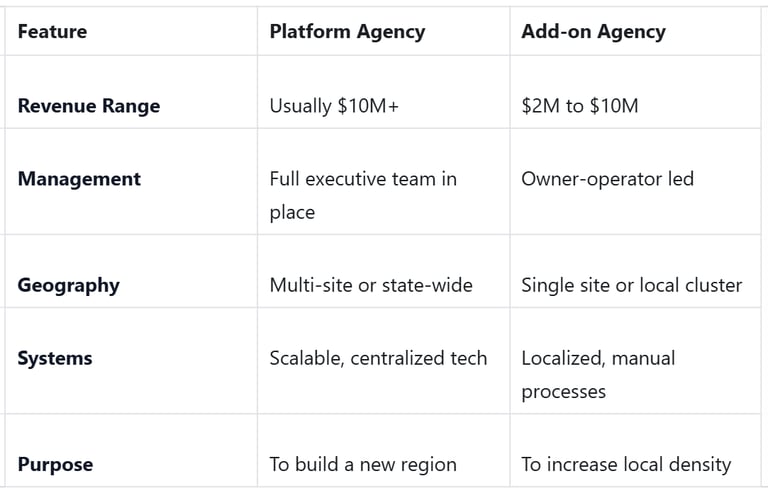
Buyers like Senate Healthcare categorize potential acquisitions into two main buckets: Platforms and Add-ons. Knowing where you fit helps you understand how a buyer will underwrite your deal.
Timing Your Exit
The "wait and see" approach is often the most dangerous strategy in a market this volatile. While multiples are high today, the moratorium is currently scheduled for six months. If CMS lifts the freeze or changes the rules, the "scarcity premium" currently attached to your provider number could shift.
Furthermore, buyer underwriting is becoming more rigorous. Buyers are looking for clean billing histories and strong clinical outcomes. If you have spent years building a reputable agency, your "exit readiness" is likely at a peak right now.


So what should you do now?
If you are considering a transition, here are the immediate steps to take:
Audit Your EBITDA: Ensure your financial statements are clean and "normalized" to show your true profitability to a buyer.
Clean Up Compliance: Review your charts and billing records now to avoid "valuation haircuts" during a due diligence phase.
Assess Your Role: Start delegating key decisions to your clinical or office managers to show that the business can run without you.
Explore a Partnership: Reach out to active buyers like Senate Healthcare to get a confidential valuation of your agency.
Partner With Senate Healthcare
Senate Healthcare is an active buyer and strategic partner pursuing home health or hospice agency acquisitions across the country. We are not brokers or advisors; we are the acquiring entity looking to grow our portfolio by partnering with high-quality operators. Our goal is to maintain the legacy of care you have built while providing the resources needed for sustainable growth in a complex regulatory environment.
If you are ready to explore a sale or want to understand how your agency fits into our current acquisition strategy, we invite you to contact us today. We help owners reduce risk and maximize the value of their life's work through a streamlined, confidential process.
Plain-Language Glossary
EBITDA: A measure of a company's overall financial performance, used as a proxy for cash flow.
Multiple: The number used to multiply EBITDA to determine the total value of a business.
Moratorium: A temporary freeze or "stop" on a specific activity, in this case, new Medicare enrollments.
De Novo: Starting a business from scratch rather than buying an existing one.
CIMO (Change in Majority Ownership): A regulatory term for when the majority of an agency's ownership changes hands.
CON (Certificate of Need): A legal requirement in some states that requires a "need" to be proven before a new healthcare facility can open.
Unlock Your 30-Minute Agency Succession Review
Maybe you're ready to expand your reach, or perhaps it's time to consider your legacy and the future of your business. Either way, it all begins with a conversation. Schedule a confidential, no-obligation call to explore what the future might hold for you and your business.
Complete the form, and we'll reach out for a chat...


© 2025 SENATE HEALTHCARE LLC.
ALL RIGHTS RESERVED