
The 2.6% Hospice Rate Win: Why We've Recalibrated Our Valuation Models Upward for Q1 2026
CMS just confirmed a 2.6% hospice rate increase for FY 2026, adding $750 million in federal spending and boosting per-diem reimbursement across all care levels. Senate Healthcare has adjusted our valuation models upward in Q1 because this regulatory stability improves EBITDA forecasts and reduces policy risk for hospice agencies we're acquiring. This post breaks down how the rate hike translates to higher acquisition offers, why rural and government-operated hospices saw even larger bumps (3.0% and 3.3%), and what owners should do now to capitalize on this valuation peak before market conditions shift.
2/12/20265 min read


CMS just handed hospice owners a regulatory gift that's changing how we value agencies this quarter. The 2.6% base rate increase for fiscal year 2026 translates to higher margins, stronger cash flow projections, and most importantly for you, higher acquisition offers from us at Senate Healthcare.
Quick-Scan Summary
Who this is for: Hospice agency owners in the $2M to $10M revenue range considering a sale or succession transition in 2026.
Key takeaways:
CMS locked in a 2.6% rate increase (higher than the 2.4% originally proposed), creating $750 million in additional federal spending for hospice providers
We've adjusted our valuation models upward in Q1 because this rate stability improves your EBITDA forecasts and reduces regulatory risk
Rural and government-operated hospices saw even larger increases (3.0% and 3.3%), making those segments especially attractive for acquisition right now
If your clinical documentation or operational "polish" isn't perfect, this rate bump creates enough margin cushion for us to acquire your agency and handle those upgrades post-close
Maria's Story: Waiting for the Right Signal
Maria runs a 65-patient hospice agency outside Columbus, Ohio. She's 61, and after 18 years of building relationships with local oncologists and senior communities, she's ready to step back. But she wasn't ready to sell in late 2025.
Why? Uncertainty. The proposed CMS rate adjustment was sitting at 2.4%, and Maria kept hearing conflicting predictions about whether Washington would trim payments due to budget pressures. She told us in December: "I'm not selling into a rate cut. I'll ride this out another two years if I have to."
Then the final rule dropped in January 2026. Not only did CMS confirm the increase, they went higher at 2.6%. Maria called us the same week. The regulatory green light changed everything. Within three weeks, we had her P&L modeled out, and she's now looking at a valuation nearly 0.8x EBITDA higher than what we would have offered six months ago. That regulatory stability made her agency significantly more attractive to us as a buyer.
Breaking Down the 2.6% Impact on Your Bottom Line
Let's get specific. The 2.6% increase flows directly into your revenue at every level of care. Here's what changed effective October 1, 2025 (the start of FY 2026):
Routine home care (days 1 to 60): Increased from $224.52 to $230.83 per day
Routine home care (days 61+): Increased from $177.32 to $182.47 per day
Continuous home care: Increased from $1,618.59 to $1,674.29 per day
Inpatient respite care: Increased from $528.24 to $543.35 per day
General inpatient care: Increased from $1,176.79 to $1,209.30 per day
For a hospice running 50 to 70 patients with a typical mix of routine and higher-acuity days, this translates to roughly $150,000 to $220,000 in additional annual revenue. If you're operating at a 15% to 20% EBITDA margin, that rate increase alone can add $30,000 to $44,000 to your bottom line this year.


Now apply a standard acquisition multiple of 5x to 7x EBITDA. That incremental $30,000 to $44,000 in earnings becomes $150,000 to $308,000 in additional enterprise value. This is not theoretical. We are adjusting our offer letters upward right now based on these revised cash flow models.
Why We Care About Regulatory Stability (And Why You Should, Too)
When we acquire a hospice agency, we're underwriting three to five years of forward performance. Regulatory uncertainty is one of the biggest discount factors in our models. If CMS signals rate volatility or threatens cuts, we have to build in risk premiums that lower what we can pay you today.
The 2.6% increase does two things for us as the buyer:
It confirms CMS is supporting hospice care as a budget priority, at least through FY 2026. That reduces our perceived policy risk.
It came in higher than the original proposal (2.4%), which signals that the federal appetite for hospice funding is stronger than expected.
Both of those factors allow us to tighten our discount assumptions and increase the multiples we're offering to sellers like Maria. In plain terms, your agency just became less risky to acquire, which makes it more valuable.
Geographic and Ownership Variations: Who Got the Biggest Bump?
Not all hospices benefited equally. CMS adjusted payments based on geography and ownership structure. Here's the breakdown:
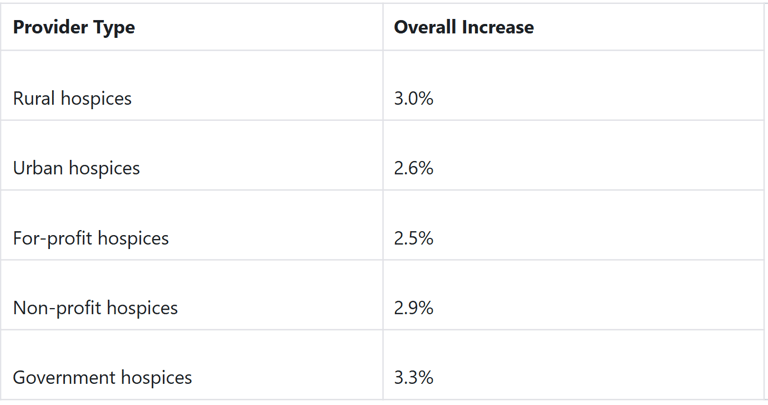
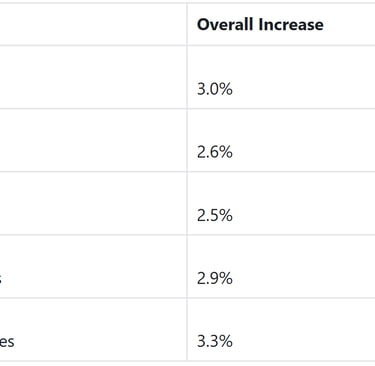
If you're operating a rural or government-affiliated hospice, you saw a disproportionately larger increase. For us, that makes those segments especially compelling targets right now. Rural agencies often struggle with workforce access and referral density, but the 3.0% rate bump gives us more margin to invest in staffing and community outreach post-acquisition. We're actively seeking rural hospice owners who want to exit while this rate advantage is fresh.


The Reassurance You Need to Hear
Let's be honest. You're probably reading this and thinking, "Sure, the rate increase is great, but my clinical documentation is a mess. My intake coordinator left in November, and I'm still using paper charts for half my patients. There's no way I'm 'acquisition ready.'"
Here's the reality: We don't need you to be perfect. This 2.6% rate increase creates enough financial breathing room for us to acquire your agency and handle those operational upgrades on our end. If your patient census is stable, your referral relationships are real, and your compliance footprint is manageable, we can work with the rest.
Maria's agency in Ohio? She was still using a legacy EHR from 2018 and had zero AI workflows. We didn't walk away. We modeled the cost of upgrading her systems post-close and still hit a valuation number that made sense for both sides. The rate stability gave us the confidence to absorb those transition costs.
Don't let operational polish stop you from exploring a sale. The regulatory tailwind we're seeing right now might not last into 2027, and waiting for your agency to be "perfect" could mean missing the valuation peak entirely.
So What Should You Do Now?
If you're a hospice owner sitting on the fence about selling, here are the next steps we recommend:
Pull your trailing twelve months (TTM) financials and calculate your adjusted EBITDA. Factor in the revenue lift from the 2.6% increase that started in October 2025.
Model out your 2026 cash flow with the new rates baked in. If your EBITDA is trending 10% to 15% higher than last year, your valuation just jumped.
Reach out to us directly before Q2. We're prioritizing hospice acquisitions in February and March while this rate clarity is still fresh. Waiting until summer could mean competing with other sellers who moved faster.
Don't overthink your operational gaps. If you've been avoiding a sale because your documentation isn't pristine or your EHR is outdated, the rate increase gives us room to bridge those gaps. Let us evaluate your agency as-is.


Unlock Your 30-Minute Agency Succession Review
Maybe you're ready to expand your reach, or perhaps it's time to consider your legacy and the future of your business. Either way, it all begins with a conversation. Schedule a confidential, no-obligation call to explore what the future might hold for you and your business.
Complete the form, and we'll reach out for a chat...


© 2025 SENATE HEALTHCARE LLC.
ALL RIGHTS RESERVED