
Scaling vs. Selling: Which Strategy Is Better For Your Agency in the 2026 Climate?
Is it time to grow your agency or time to cash out? In the complex 2026 landscape of Medicare Advantage pressure and AI integration, making the wrong choice can cost you millions in valuation. This post explores the current EBITDA multiples for home health and hospice and explains why selling to a strategic buyer like Senate Healthcare might be your most profitable move this year.
6/2/20266 min read


Choosing between expanding your footprint and seeking a strategic exit is the most consequential decision you will face as an agency owner this year. This guide breaks down the financial and operational realities of the 2026 market to help you determine which path maximizes your legacy and value.
Quick-Scan Summary
Who this is for:
Owner-operators of home health or hospice agencies with $2M to $10M in annual revenue.
Entrepreneurs facing burnout, succession concerns, or increasing regulatory pressure.
Strategic leaders weighing the costs of AI integration against the benefits of an immediate exit.
Key takeaways:
Market Reset: 2026 has seen a stabilization in valuation multiples, favoring agencies with high compliance standards and clean data.
Scaling Risks: Expansion in 2026 requires significant capital for AI-driven scheduling and clinical documentation tools to maintain margins.
Selling Upside: Buyers like Senate Healthcare are prioritizing agencies that offer operational stability over speculative growth potential.
The Multiplier Effect: A well-positioned hospice can still fetch a 10x to 15x EBITDA multiple, while home health platforms are clearing in the high-single digits.
The 2026 Landscape: Why the "Wait and See" Strategy Is Over
The home health and hospice sectors have reached a critical inflection point in 2026. After years of post-pandemic volatility and shifting reimbursement models, the market has finally settled into a new normal where data integrity and operational efficiency dictate everything. For owners in the $2M to $10M revenue range, the choice to scale or sell is no longer a luxury, it is a necessity for survival.
Industry data suggests the U.S. home care market will reach $173.6 billion this year. While the demand is staggering, the cost of doing business has risen alongside it. Staffing shortages continue to plague the industry, and the rise of Medicare Advantage (MA) penetration has introduced tighter utilization management and lower realized rates for many home health providers. If you are operating a "mom and pop" agency in the $2M to $10M revenue band without the benefit of centralized back-office scale, you are likely feeling the squeeze on your margins.


Owner Pain Points: The Hidden Costs of Staying Small
For many of the owners we speak with, the day-to-day grind is becoming unsustainable. Consider Sarah, an owner of a mid-sized hospice in the Midwest. She grew her agency from $1M to $5M in revenue over seven years, but her 2026 reality involves spending 40% of her time on compliance audits and another 30% on recruitment. She is experiencing what we call "scale-lock," where the agency is too big to be managed casually but too small to afford the high-level executive team needed to move meaningfully beyond the $2M to $10M band.
Sarah’s situation is common. Owners are facing:
Succession Risk: If you are the primary driver of referrals and the key decision-maker for every clinical issue, your agency has a "key-person" dependence that actually lowers your valuation.
Valuation Haircuts: Buyers in 2026 are deep-diving into documentation. If your hospice eligibility support or home health medical necessity records are not ironclad, buyers will apply significant "haircuts" to your asking price during underwriting.
M&A Pressure: Larger platforms are using AI to optimize their clinical routes and reduce administrative overhead. If you aren't scaling with these tools, your cost-per-visit will eventually make you uncompetitive.
The Valuation Math: Quantifying Your Exit
To decide whether to scale or sell, you have to look at the numbers. In 2026, buyers have moved away from the "growth at all costs" mindset of the early 2020s. We are now in an era of disciplined underwriting where verifiable cash flow is king.
For a hospice agency with $1.5M in EBITDA and perfect compliance scores, a 12x multiple is achievable, resulting in an $18M valuation. However, if that same agency has fragmented systems and high staff turnover, the multiple might drop to 9x, costing the owner $4.5M in the final sale price.
For a home health agency in the $2M to $10M revenue band, the math is just as practical. An agency generating $900K in EBITDA might attract an 8x multiple and a $7.2M valuation if its payor mix, documentation, and leadership coverage hold up in buyer underwriting. If those same records show referral concentration, weak MA performance, or owner-heavy operations, the multiple could fall to 6.5x, cutting value to $5.85M. That is a $1.35M difference tied directly to risk. If you choose to scale, you are betting that you can grow EBITDA fast enough to outpace the rising costs of labor and technology. If you sell to Senate Healthcare, you lock in value today without taking on the personal financial risk of further expansion.
Identifying Your Agency's Position
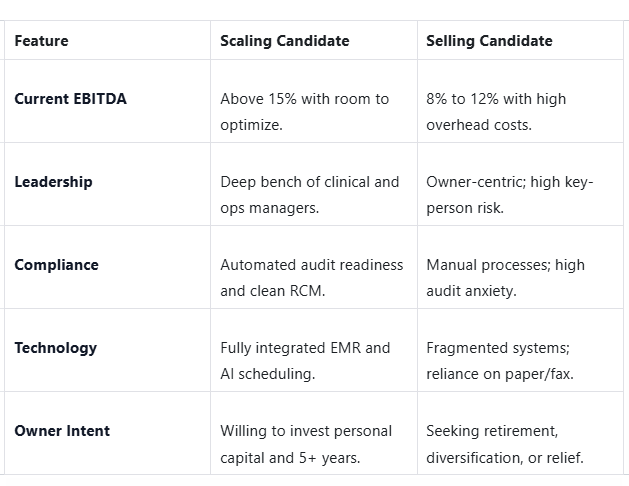
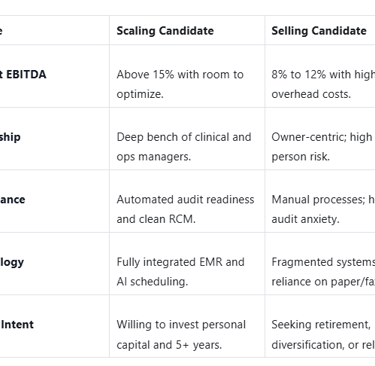
The Medicare Advantage Factor
By mid-2026, Medicare Advantage has become the dominant coverage for seniors in most urban markets. While this provides a steady stream of patients, it also presents a valuation challenge. MA plans are increasingly shifting toward value-based and risk-sharing models.
If your agency is "MA-heavy," your value in a sale depends on your ability to prove outcomes. Buyers are looking for agencies that can demonstrate lower readmission rates and high star ratings. If you cannot show this data, your revenue is viewed as "low-quality" or volatile, which reduces the multiple a buyer is willing to pay. As the buyer, Senate Healthcare evaluates agencies specifically for how they can integrate into our broader ecosystem, where scale can support stronger MA positioning than a standalone operator can typically achieve.
Exit Timing: Why 2026 is a Seller’s Window
While interest rates have stabilized compared to 2024, the credit markets remain disciplined. This means that while Senate Healthcare has capital to deploy as a buyer, we are selective. We evaluate acquisitions based on how well an agency fits into our long-term strategic vision for a national home health or hospice brand.
Waiting another three years to sell might seem like a way to "grow the pot," but you must factor in the "valuation reset" that has occurred. The peak multiples of 2021 are not returning anytime soon. Selling now allows you to capture a strong multiple while avoiding the next wave of regulatory changes or Medicare rate cuts that often come in late-year budget cycles.


Plain-Language Glossary
EBITDA: Earnings Before Interest, Taxes, Depreciation, and Amortization. This is the primary number buyers use to measure your agency’s profitability.
Multiple: The number (e.g., 10x) that a buyer multiplies your EBITDA by to determine the total purchase price.
Add-backs: Expenses that won't continue after a sale (like the owner's personal car or non-essential travel) that are added back to profit to show the "real" EBITDA.
Underwriting: The process where a buyer like Senate Healthcare scrutinizes your financials and clinical records to confirm the agency's value.
Census: The average number of patients your agency is caring for at any given time.
So what should you do now?
Audit Your Data: Before you decide to scale or sell, run a "mock audit" of your 2026 clinical records. Clean documentation is the difference between a premium multiple and a rejected offer.
Calculate Your "Walk-Away" Number: Determine the exact dollar amount you need from a sale to achieve your personal goals. If your current valuation meets that number, the risk of scaling further may not be worth the potential reward.
Assess Your Burnout: Be honest about whether you have the energy for another 36 to 60 months of high-stakes healthcare management.
Request a Confidential Consultation: Reach out to us at Senate Healthcare to understand how we value agencies in the current climate.
Partnering for the Next Chapter
At Senate Healthcare, we are not here to give you advice from the sidelines. We are the buyer. Our goal is to acquire and partner with high-quality home health or hospice agencies that are ready for their next chapter. We are actively building a national brand in this space, with a specific focus on operators in the $2M to $10M revenue band who want to reduce risk and protect value.
Whether you are looking for a complete exit to plan your legacy or a strategic partnership that allows you to remain involved while we handle the heavy lifting of back-office operations and compliance, we are ready to talk. We are evaluating acquisitions right now and looking for operators who take pride in their care but are ready for the financial security of a successful sale.


Resources:
https://www.jdsupra.com/legalnews/home-health-hospice-m-a-in-2026-why-the-1381791/ (Home Health & Hospice M&A in 2026)
https://www.caresmartz360.com/blog/home-care/top-home-care-trends-for-2026/ (Top Home Care Trends for 2026)
Unlock Your 30-Minute Agency Succession Review
Maybe you're ready to expand your reach, or perhaps it's time to consider your legacy and the future of your business. Either way, it all begins with a conversation. Schedule a confidential, no-obligation call to explore what the future might hold for you and your business.
Complete the form, and we'll reach out for a chat...


© 2025 SENATE HEALTHCARE LLC.
ALL RIGHTS RESERVED