
Palliative Care Is Coming to Medicare: What It Means for Home Health Valuations
The new CMS 2027 proposed rule is a game-changer for home health and hospice owners, officially bringing skilled palliative care into the billable home health benefit. This post explores how adding palliative services can bridge the care gap and significantly increase your agency’s valuation multiple. Learn why integrating these services now is the smartest move for owners planning an exit or seeking a strategic partnership.
7/9/20265 min read


CMS recently released the CY 2027 Home Health PPS proposed rule, introducing a significant shift by allowing skilled palliative care to be billed under the home health benefit. This regulatory change creates a new opportunity for agency owners to diversify revenue and increase their business valuation before a sale.
Quick-Scan Summary
Who this is for:
Owners of home health or hospice agencies with $2M to $10M in annual revenue.
Operators looking to reduce their dependence on traditional Medicare PDGM episodes.
Entrepreneurs planning an exit or partnership within the next 12 to 24 months.
Key takeaways:
New Revenue Stream: Palliative care is now recognized as a primary reason for home health services, not just a secondary add-on.
Multiple Expansion: Diversifying into palliative care can shift your agency from a standard home health multiple toward higher hospice-tier valuations.
Strategic Advantage: Integrated models attract premium offers because they capture patients earlier in the serious illness continuum.
The 2027 Rule: A Strategic Shift in Home Health
On July 6, 2026, the Centers for Medicare & Medicaid Services (CMS) published the CY 2027 Home Health Prospective Payment System proposed rule, identified as CMS-1844-P. While the headlines focused on a 2.4% payment increase, the real story for agency owners is the explicit inclusion of community-based palliative care. For the first time, CMS is clarifying that skilled palliative care services can be furnished and billed under the existing Medicare home health benefit for eligible patients with serious illness.
This change means that palliative care is now a "bona fide reason" for home health services. Previously, many agencies struggled to provide these services because they did not fit neatly into the traditional skilled nursing or therapy triggers required for a 30-day period. Industry leaders like Beau Sorensen and Jennifer Sheets have described this inclusion as "sorely needed" and a "standout positive" for the sector. We are closely monitoring how this rule will be finalized, as it directly impacts how we underwrite the growth potential of the agencies we acquire.


Owner Pain Points: Why This Matters Now
Many owners in the $2M to $10M revenue band are currently facing significant pressure. Medicare Advantage plans continue to squeeze margins, and the ongoing $4.9 billion recoupment related to previous overpayments has made traditional episodic home health feel riskier than ever. Burnout is a real factor for operator-owners who feel they are running faster just to stay in place.
Furthermore, there is a looming "valuation haircut" for agencies that rely solely on a single revenue stream. If your agency only provides traditional home health, you are vulnerable to every regulatory tweak CMS makes to PDGM. By integrating palliative care, you solve a major buyer concern: patient longevity. Palliative care allows you to support patients earlier in their illness, often leading to a more seamless transition to hospice care later on. This "sticky" patient relationship is exactly what strategic buyers look for.
Valuation Math: How Palliative Care Increases Your Sale Price
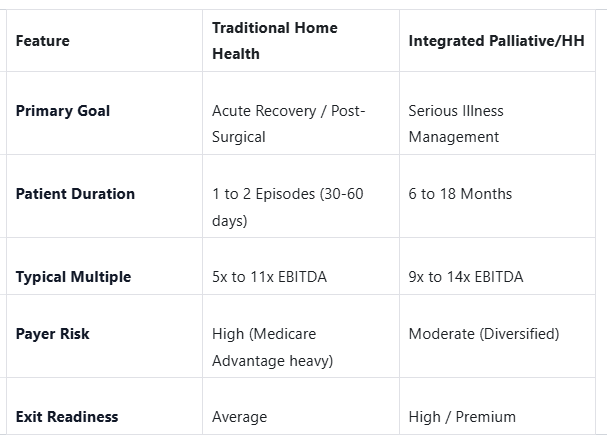
When we evaluate an acquisition, we look at the stability and diversity of cash flow. A traditional home health agency in the lower-middle market might trade at a multiple of 7x to 9x EBITDA. However, an agency that has successfully integrated palliative care begins to look more like a hospice platform, which can fetch multiples of 10x to 14x.
Consider an agency with $1M in Adjusted EBITDA:
Scenario A (Traditional HH): 100% Medicare Home Health. Potential multiple: 8x. Valuation: $8,000,000.
Scenario B (Integrated HH/Palliative): 70% Home Health / 30% Palliative. This diversification reduces risk and demonstrates a stronger referral network. Potential multiple: 10.5x. Valuation: $10,500,000.
By shifting the clinical model, the owner in Scenario B has added $2.5M in value without necessarily increasing their total patient census. This is the power of "multiple expansion" driven by clinical strategy.
Identifying Your Agency's Position
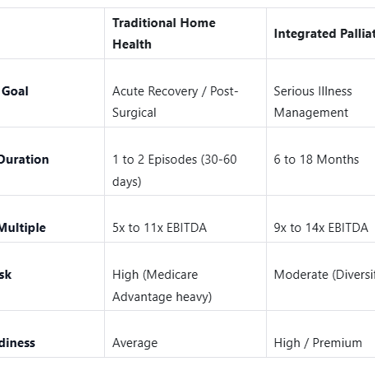
The table below helps owners understand how their current model aligns with buyer underwriting priorities in the 2026 and 2027 market.


Medicare Advantage and the Palliative Bridge
Medicare Advantage (MA) plans are increasingly interested in palliative care because it reduces high-cost hospitalizations. For owners, the 2027 proposed rule provides the regulatory framework to go to these MA payers with a standardized, billable product. When an agency can prove it saves the payer money by keeping serious-illness patients out of the ER, that agency becomes a "must-have" partner. From our perspective as a buyer, an agency with strong MA palliative contracts is a highly attractive asset because it represents "moated" revenue that is difficult for competitors to replicate.
Plain-Language Glossary
EBITDA: Earnings Before Interest, Taxes, Depreciation, and Amortization. This is a common measure of a company's healthy cash flow.
Multiple: The number multiplied by your EBITDA to determine the total sale price. Higher risk usually means a lower multiple.
Bona Fide Reason: A legitimate, recognized clinical justification that satisfies Medicare's requirements for payment.
PDGM: Patient-Driven Groupings Model. The current payment system for home health that relies on 30-day periods.
Recoupment: When Medicare takes back money it previously paid out, often due to perceived overpayments or audits.
Exit Timing: Why the 2027 Rule Creates an Opportunity
The lag between a proposed rule and its full impact on the market is the "sweet spot" for sellers. If you start building your palliative clinical protocols today, you will have a year of data to show buyers by the time the rule is fully active in 2027. We are looking for agencies that are proactive rather than reactive. Owners who wait until the rule is "old news" will find themselves competing with a flooded market of similar sellers.


So what should you do now?
Review your clinical mix: Determine what percentage of your current "maintenance" patients could be better served and billed under the new palliative definitions.
Audit your referral sources: Talk to your hospital and physician partners about their "gap" patients who are too sick for standard HH but not yet ready for hospice.
Normalize your EBITDA: Work with your accountant to strip out one-time costs so your valuation is based on your true operational strength.
Contact a strategic partner: Reach out to us to discuss how your agency fits into our current acquisition criteria.
We are actively evaluating acquisitions in the home health and hospice sectors. Our goal is to partner with owners who have built strong foundations and are ready to see their legacy grow as part of a national brand. If you are considering a sale or want to explore how a partnership with us could reduce your operational risk, let's start a confidential conversation.
Unlock Your 30-Minute Agency Succession Review
Maybe you're ready to expand your reach, or perhaps it's time to consider your legacy and the future of your business. Either way, it all begins with a conversation. Schedule a confidential, no-obligation call to explore what the future might hold for you and your business.
Complete the form, and we'll reach out for a chat...


© 2025 SENATE HEALTHCARE LLC.
ALL RIGHTS RESERVED