
Mike Macdonald's 'Year One' Blueprint: Why Succession Planning and Team Culture are the Winning Plays for Home Health Owners in 2026
Mike Macdonald took over a legendary franchise and won a Super Bowl in Year One by honoring the culture Pete Carroll built while upgrading what needed fixing. Home health and hospice owners facing succession can learn from the same playbook: you don't have to gut your team to get a strong exit. This post breaks down how Senate Healthcare approaches acquisitions with the same culture-first, continuity-driven model that just delivered a Lombardi Trophy, and why the 2026 M&A window is your chance to protect your legacy while maximizing valuation.
2/9/20268 min read


The Seattle Seahawks just proved something every home health or hospice owner should care about: smart succession planning doesn't destroy culture. It protects it. When Mike Macdonald took over from legendary coach Pete Carroll before the 2025 season, skeptics predicted chaos. Instead, the Seahawks just won Super Bowl LX with a dominant 29-13 victory over the Patriots, validating Macdonald's culture-first approach in his very first year at the helm.
For agency owners staring down their own succession cliff, the parallel is impossible to ignore. You've spent decades building not just a revenue stream, but a team, a reputation, and a mission. The idea of handing it off to a buyer who'll gut your staff, rebrand your logo, and treat your people like interchangeable widgets keeps you up at night. We get it. That's exactly why Senate Healthcare approaches acquisitions the way Macdonald approached his first season: culture and continuity first, operational improvements second.
Quick-Scan Summary
Who this is for: Home health or hospice owners in the $2M to $10M revenue range who want to exit but fear losing their team and legacy in the process.
Key takeaways:
Macdonald's Super Bowl win proves that strong succession planning preserves winning culture, not destroys it
Your biggest asset isn't your census. It's your field staff and their trust in leadership
Senate Healthcare's acquisition model prioritizes team retention and cultural alignment over rapid operational overhaul
Owners don't need a "perfect" team to sell. We work with agencies that have cultural strength even if processes need polish
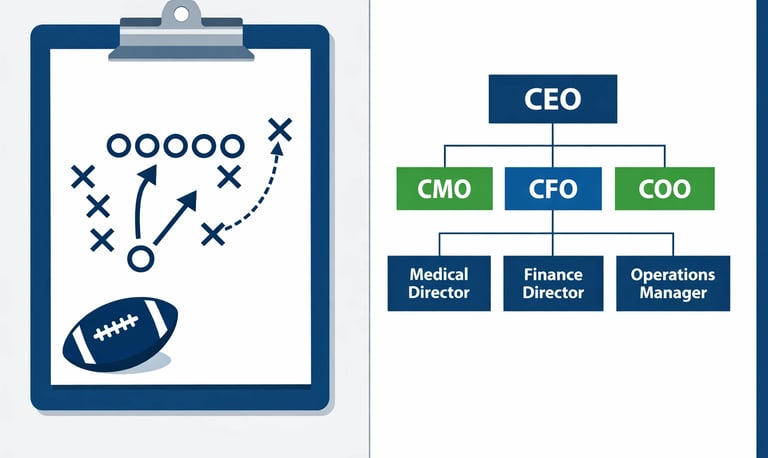
The Macdonald Model: What Happened in Seattle
When the Seahawks hired Mike Macdonald in January 2025, the stakes were massive. Pete Carroll had been the face of the franchise for 14 years, delivering a Super Bowl championship and building one of the NFL's most consistent winning cultures. Replacing that kind of legacy could have meant roster upheaval, scheme chaos, and a lost season.
Instead, Macdonald did something counterintuitive. He kept most of Carroll's defensive staff. He honored the "Legion of Boom" identity even while installing his own Baltimore-inspired schemes. He didn't blow up the roster. He leaned into the culture Carroll had built and tweaked the edges. The result? A 14-3 regular season, a playoff run, and a Lombardi Trophy hoisted in New Orleans on February 9, 2026.
According to the Seahawks' official site, Macdonald's coaching philosophy centers on "alignment, accountability, and respect for what came before." That's not corporate-speak. It's the actual blueprint he ran. And it's the same blueprint we use when acquiring home health or hospice agencies.
Why Culture Matters More Than Your P&L in a Sale
Here's the uncomfortable truth: most buyers don't care about your culture. They care about your EBITDA, your payer mix, and how fast they can squeeze margin improvement. If your best nurse quits two weeks post-close because the new owner installed a robot scheduler and eliminated her autonomy, that's a "retention issue" on a spreadsheet. For you, it's a betrayal of the mission you built.
We see this constantly. Agencies with strong financials but high cultural trust outperform agencies with pristine compliance and zero loyalty. Why? Because in home health or hospice, your product is people. When a caregiver walks into a patient's home, they're not delivering a widget. They're representing your brand, your values, and the trust you've built in the community over decades.
If the buyer treats that as disposable, your valuation multiple doesn't matter. The agency you sold isn't the agency you built. It's a shell with your name on it.


David's Story: The Owner Who Almost Walked Away
David ran a $4.2M home health agency in suburban Virginia for 19 years. By early 2025, he was exhausted. His ops director had retired, his clinical manager was eyeing a competitor's offer, and Medicare Advantage's prior-auth requirements were eating 15 hours of his week. He wanted out.
He got three offers. Two were from private equity roll-ups. Both promised "operational synergies" and "platform integration." Translation: fire half the staff, rebrand everything, and centralize scheduling to a call center three states away. The valuations were decent (5.2x and 5.5x EBITDA), but the terms made him nauseous. One PE group wanted him gone within 90 days. The other wanted a two-year earnout tied to metrics his team had zero control over.
David almost took the 5.5x offer. Then he talked to us.
We didn't promise the highest multiple. What we did promise was a Macdonald-style transition: keep the core team, maintain the brand identity for the first 18 months, and let David stay involved in an advisory role if he wanted (he did). We focused on the two things David cared about most: protecting his clinical manager's autonomy and ensuring his field staff didn't wake up one morning reporting to strangers.
Three months post-close, David's clinical manager is still there. So is 92% of his field staff. And the agency's patient satisfaction scores actually improved because we invested in the scheduling software David never had budget for. That's not charity. It's smart acquisition strategy. Retaining the people who built the reputation protects the enterprise value we just paid for.
The Senate Healthcare Succession Playbook (Borrowed from Seattle)
Here's how we approach agency acquisitions, using the same principles that got Macdonald a ring in Year One:
1. Honor what came before. We don't rebrand on Day One. We don't fire your leadership team to "clean house." We spend the first 90 days learning why your agency works, not replacing it with a cookie-cutter model.
2. Keep the core, improve the edges. Just like Macdonald kept Seattle's defensive identity but upgraded schemes, we keep your clinical team and patient relationships while investing in the back-office infrastructure you probably couldn't afford (better EMR, compliance automation, payor contracting support).
3. Align on values, not just valuations. If your mission is "dignified end-of-life care" and a buyer's mission is "maximize billable visits per clinician," that's a culture mismatch that no earnout structure will fix. We only pursue acquisitions where the cultural fit is real.
4. Plan the transition like a playoff run. Macdonald didn't wait until Week 17 to figure out his identity. He built it in training camp. Same with acquisitions: we map out leadership transitions, staff communication plans, and patient continuity protocols before the deal closes, not after.


What This Means for Your Exit Timeline
If you're an owner in the $2M to $10M range and you've been delaying a sale because you're terrified of what happens to your team, this is your permission structure: you don't have to choose between a good exit and protecting your people.
The 2026 M&A window is still open (see our recent post on why this quarter is peak exit timing), but it won't stay that way forever. CMS stability and rate clarity create buyer confidence. That confidence translates to better multiples and more flexible deal terms. But if you wait until 2027, you're betting that the macro environment stays favorable and that your key staff doesn't leave while you're stuck in limbo.
Macdonald didn't wait for "the perfect roster" to implement his vision. He worked with what he had and made it better. You can do the same.
Your Team Doesn't Have to Be "Super Bowl Ready" Yet
One fear we hear constantly: "My team is great, but we're not buttoned-up enough to sell. Our compliance documentation has gaps. Our scheduling process is manual. Our EHR is held together with duct tape."
Good news: we're not looking for perfection. We're looking for cultural strength and operational upside. If your field staff is loyal, your patient outcomes are solid, and your community reputation is strong, those are the assets that matter most. The process gaps? Those are fixable with capital and systems, which is exactly what we bring to the table.
Macdonald inherited a roster with talent but also holes. He didn't wait for a flawless lineup. He built around the core and filled the gaps. That's our model too.


So What Should You Do Now?
If you're an owner who's been sitting on the fence about an exit because you're worried about your team, here's your next play:
Audit your key-person risk. If your clinical manager, ops director, or top three caregivers left tomorrow, could the agency survive? If the answer is "barely," that's a red flag for any buyer. Start documenting processes and cross-training now.
Talk to your leadership team. You don't need to announce a sale, but you should understand what would make them stay post-transition. Autonomy? Compensation? Title? Those answers shape deal structure.
Get a confidential valuation. You can't make an informed decision without knowing what your agency is worth. We offer no-obligation consultations where we walk through real-world multiples based on your financials and market position. Book a consultation here.
Don't wait for 2027. Market timing matters. The longer you delay, the more risk you're taking on (regulatory changes, staff attrition, competitor moves, rate cuts). The 2026 window is still open. Use it.
The Bottom Line
Mike Macdonald just proved that you can honor a legacy and win a championship in the same season. For home health or hospice owners, that's not a sports metaphor. It's a roadmap. You don't have to sacrifice your team on the altar of a good exit multiple. You just need a buyer who understands that the people are the product.
Senate Healthcare is that buyer. We're actively acquiring home health or hospice agencies in the $2M to $10M range, and we prioritize cultural fit and team retention as core deal criteria. We're not a broker or advisor. We're the acquirer. And we structure transitions the way Macdonald structured his first season: respect what came before, improve what matters, and protect the culture that built the wins in the first place.
If you're ready to explore what a Macdonald-style exit looks like for your agency, let's talk. No pressure, no pitch. Just a conversation about how to protect what you built while getting the exit you deserve.
Plain-Language Glossary
EBITDA: Earnings Before Interest, Taxes, Depreciation, and Amortization. It's the metric buyers use to measure your agency's profitability and calculate what they'll pay (your "multiple").
Multiple: The number a buyer multiplies your EBITDA by to determine purchase price. For example, if your EBITDA is $800K and the multiple is 5.5x, the purchase price is $4.4M.
Earnout: A deal structure where part of the purchase price is paid later, based on hitting post-sale performance targets. Often used to shift risk onto the seller.
Key-person risk: The risk that your agency's value is too dependent on one or two people (usually the owner or a critical manager). Buyers discount valuations when this risk is high.
Sources:
CBS Sports Super Bowl LX Coverage: https://www.cbssports.com/nfl/superbowl/
Wikipedia Super Bowl LX Game Details: https://en.wikipedia.org/wiki/Super_Bowl_LX
Seattle Seahawks Mike Macdonald Profile: https://www.seahawks.com/team/coaches-roster/mike-macdonald
Senate Healthcare Partnership Consultation: https://senatehealthcare.com/healthcare-partnership-consultation
Senate Healthcare Golden Window Post: https://senatehealthcare.com/the-2026-golden-window-why-the-recent-interest-rate-drop-and-cms-stability-make-this-quarter-the-peak-time-to-sell
Unlock Your 30-Minute Agency Succession Review
Maybe you're ready to expand your reach, or perhaps it's time to consider your legacy and the future of your business. Either way, it all begins with a conversation. Schedule a confidential, no-obligation call to explore what the future might hold for you and your business.
Complete the form, and we'll reach out for a chat...


© 2025 SENATE HEALTHCARE LLC.
ALL RIGHTS RESERVED