
Mastering OASIS-E2: A Guide to Protecting Your Home Health Revenue in 2026
Mastering the new OASIS-E2 requirements is essential for any home health owner looking to protect their agency's valuation in 2026. This guide breaks down the critical changes to Resumption of Care (ROC) assessments and demographic coding that now impact 40 percent of your HHVBP score. Learn how to avoid "valuation haircuts" and ensure your agency remains an attractive target for acquisition.
4/27/20266 min read


This guide explores the critical transition to OASIS-E2 and its direct impact on agency valuation and clinical operations for home health owners. We break down the technical changes and provide a roadmap for maintaining high performance in the eyes of potential buyers.
Quick-Scan Summary
Who this is for: Home health or hospice agency owners with $2M to $10M in annual revenue who are concerned about compliance risk, clinical burnout, or preparing for an eventual exit.
Key Takeaways:
OASIS-E2 became effective April 1, 2026, introducing major changes to demographic coding and assessment timing.
Accuracy in these new items now accounts for roughly 40 percent of your Home Health Value-Based Purchasing (HHVBP) score.
Poor data collection creates a direct "valuation haircut" by increasing audit risk and lowering reimbursement during buyer due diligence.
The transition from iQIES front-end entry to clinician-finalized coding requires a fundamental shift in staff training.
The New Landscape of Home Health Compliance
We have officially moved past the implementation date for OASIS-E2. As of April 1, 2026, the data collection standards for home health agencies have shifted significantly. For an owner-operator, this is not just another regulatory hurdle. It is a financial pivot point. If your agency is currently struggling to get clinicians to document accurately on day one, your revenue is at risk.
At Senate Healthcare LLC, we look at these transitions through the lens of a buyer. When we evaluate an agency for a potential acquisition, one of the first things we scrutinize is the clinical documentation integrity. OASIS-E2 is the new benchmark. If your team has not mastered the shift from gender-based coding to the new sex-at-birth requirements, or if they are missing the updated Resumption of Care (ROC) assessments, it signals a deeper operational risk that can drive down your sale price.
Technical Deep Dive: What Actually Changed?
The move to OASIS-E2 was designed to align home health data more closely with other post-acute care settings. While some items were removed, the new requirements demand more precision from your field staff.
1. Sex and Demographics (A0810)
The transition from M0069 (Gender) to A0810 (Sex) is more than a label change. It aligns with standardized data categories used across Medicare. This data is used for risk adjustment, and if your team is still using old forms or outdated logic, your patient profiles will not accurately reflect the care being provided.
2. Transportation and Social Determinants (A1255)
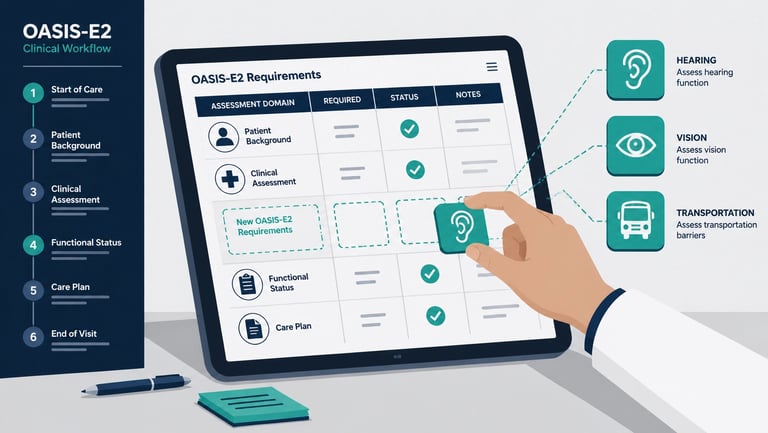
The updated A1255 item for transportation is much more refined than the previous A1250. It asks specifically about the barriers patients face in accessing care. For an owner, this is vital data. If your patients are missing appointments due to transportation, and your OASIS data does not reflect that barrier, your agency looks like it has poor outcomes when, in reality, it has a social barrier that could have been documented to justify the clinical course.
3. New Requirements for Resumption of Care (ROC)
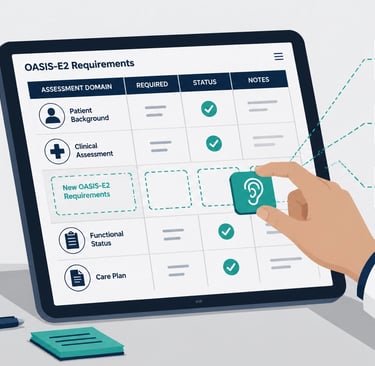
Perhaps the biggest clinical shift is the addition of Language (A1110), Vision (B0200), and Hearing (B1000) assessments at the ROC time point. Previously, these were often only required at start of care. Now, every time a patient returns from the hospital, your staff must re-assess these functional items. Failing to do so creates a non-compliant assessment, which can lead to payment delays or denials.
The 40 Percent Rule: Why HHVBP Matters for Your Exit
In 2026, the Home Health Value-Based Purchasing (HHVBP) model is the primary driver of performance. Approximately 40 percent of your total HHVBP score is derived directly from OASIS data. This means that nearly half of your potential bonus or penalty is decided by the quality of the initial and discharge assessments.
When a buyer like Senate Healthcare LLC reviews your financials, we look at your Total Performance Score (TPS). If your agency is trending toward a penalty because your clinicians are rushing through OASIS-E2 assessments, it directly affects your EBITDA.
The Valuation Math: A Realistic Scenario
Consider an agency with $5M in annual revenue and a 12 percent EBITDA margin ($600,000).
If the agency is performing well under HHVBP, a buyer might offer a 6.0x multiple, resulting in a $3.6 million valuation.
However, if the agency has poor OASIS-E2 accuracy leading to a 3 percent HHVBP penalty and a higher audit risk profile, a buyer might drop the multiple to 4.5x. Not only does the revenue drop to $4.85M, but the lower multiple results in a $2.6 million valuation.
That is a $1 million difference caused by documentation errors and compliance gaps. For many owners, that represents years of hard work lost due to preventable administrative issues.


The iQIES Shift: No More Safety Nets
One of the most disruptive changes in 2026 is the discontinuation of certain iQIES front-end entry features. In the past, some agencies relied on office-based "OASIS coordinators" to fix mistakes before the data hit the CMS system. Under the new guidelines, there is a push for clinicians to finalize codes themselves at the point of care.
This places a massive burden on your field nurses and therapists. If they are not properly trained on the OASIS-E2 guidance manual, the errors will flow directly into your quality reports. This is why we prioritize agencies that have invested in strong clinical education and robust Electronic Medical Record (EMR) integrations that guide the clinician through the assessment.
Owner Vignette: The Cost of Waiting
We recently spoke with an owner of a mid-sized home health agency in the Midwest. She was exhausted and ready to transition out of the business to spend time with her grandchildren. However, she had delayed her OASIS-E2 training because her staff was already burnt out.
When she finally decided to explore a sale, the due diligence process revealed a high error rate in the new ROC assessments. The potential buyers saw this as a massive liability for future Medicare audits. Instead of receiving a competitive offer, she was faced with "contingent" offers where a large portion of the sale price was held back for two years to cover potential clawbacks. She realized too late that being "too busy" for compliance was costing her the retirement she had envisioned.
Identifying Your Agency's Position
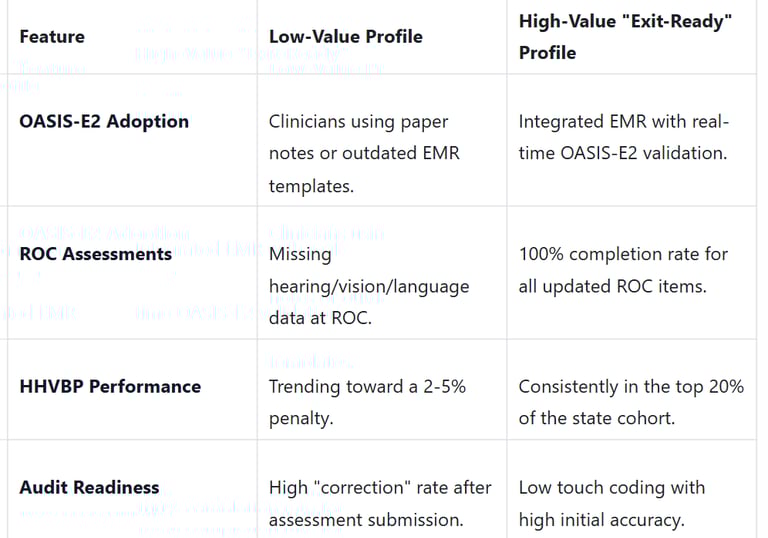
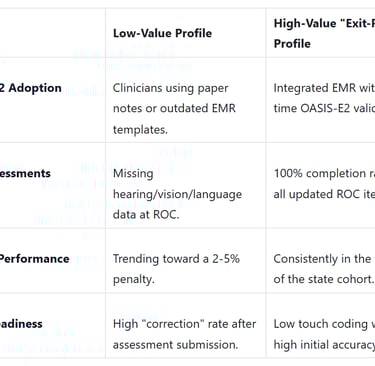
Not every agency is at the same stage of readiness. Use the table below to see where you might stand in the eyes of a strategic partner like Senate Healthcare LLC.
Plain-Language Glossary
HHVBP: A Medicare program where agencies are paid more (or less) based on the quality of care they provide rather than just the volume of visits.
ROC (Resumption of Care): The assessment required when a patient returns to home health after being in the hospital for more than 24 hours.
EBITDA Multiple: A number used to determine the value of a business (EBITDA x Multiple = Sale Price).
Risk Adjustment: A process that adjusts your performance scores based on how sick or complex your patients are.
So what should you do now?
Audit your last 30 days of ROC assessments: Specifically check for the inclusion of the new hearing, vision, and language requirements that went live on April 1.
Empower your clinicians: Ensure your field staff has access to the CMS OASIS-E2 Guidance Manual or a simplified cheat sheet for the new A0810 and A1255 items.
Check your EMR settings: Confirm that your software has disabled the old COVID-19 vaccination tracking (O0350) and updated the skip logic for 2026.
Evaluate your exit timeline: If you are planning to sell within the next 12 to 24 months, your OASIS accuracy today will determine your valuation tomorrow.
Partnering with Senate Healthcare LLC
At Senate Healthcare LLC, we aren't here to give you a list of consulting tasks to complete. We are an acquiring entity looking for home health or hospice agencies to join our growing portfolio. We understand the pressure that OASIS-E2 and HHVBP place on independent owners.
If you find that the constant cycle of regulatory changes is taking the joy out of patient care, it might be time to consider a partnership. We acquire agencies from owners who want to secure their legacy and ensure their staff and patients are taken care of by a professional, strategic partner. We value the hard work you have put into your agency, and we have the resources to navigate the complexities of 2026 and beyond.
Unlock Your 30-Minute Agency Succession Review
Maybe you're ready to expand your reach, or perhaps it's time to consider your legacy and the future of your business. Either way, it all begins with a conversation. Schedule a confidential, no-obligation call to explore what the future might hold for you and your business.
Complete the form, and we'll reach out for a chat...


© 2025 SENATE HEALTHCARE LLC.
ALL RIGHTS RESERVED