
Hospice SSVI Matters: Why CMS’s New “Risk Score” is Your Biggest Valuation Threat in 2026
CMS has introduced the Service and Spending Variation Index (SSVI), a public 16-point risk scorecard that directly affects how hospice agencies are valued. This post breaks down the four key metrics CMS uses to flag providers and explains how a high score can lead to a multi-million dollar "haircut" on your sale price. Learn the practical steps every owner must take to manage their SSVI score and protect their agency’s multiplier before entering the M&A market.
4/6/20266 min read


Breaking Down the 16-Point Scorecard
The SSVI is not a mystery. It is a mathematical calculation based on four specific claims-based metrics. Each metric is worth up to 4 points, totaling a maximum "risk" score of 16. If you want to protect your agency’s value, you must understand exactly what CMS is counting.
1. Non-Hospice Spending
CMS looks at how much Medicare is paying for services outside of your hospice benefit for your enrolled patients. If your patients are frequently visiting the emergency room for issues related to their terminal diagnosis, or if they are getting expensive medications covered under Part D that should be under your per diem, your score will rise. High non-hospice spending suggests the hospice is not taking full responsibility for the patient's care.
2. Length of Stay Exceeding 180 Days
While some patients legitimately outlive their initial prognosis, a high percentage of patients staying on service for more than six months is a red flag for CMS. They view this as potential "cherry-picking" of stable patients to maintain census.
3. Average Minutes of Care per Day
CMS is tracking the actual "boots on the ground" time your staff spends with patients. If your agency consistently bills for Routine Home Care (RHC) but provides minimal minutes of direct nursing or aide care, your SSVI score will climb.
4. Live Discharges Within Seven Days
This is perhaps the most sensitive metric. If patients are admitted and then discharged alive within a week at high rates, CMS suspects the agency is either admitting patients who do not qualify or "churning" patients for quick billing cycles.
The Valuation Trap: How High Scores Kill Deals
When we look at a home health or hospice agency for a potential acquisition, we look at the EBITDA (Earnings Before Interest, Taxes, Depreciation, and Amortization). However, the "multiple" we apply to that EBITDA depends on the risk profile of the business.
Consider an agency with $1 million in EBITDA. In a stable environment, a clean, low-risk agency might command a 6x multiple, resulting in a $6 million valuation.
If that same agency has an SSVI score of 12 out of 16, the math changes instantly. We have to account for the possibility of future CMS audits, clawbacks, or even the revocation of the provider number. To hedge against that risk, a buyer might only offer a 4x multiple.
That is a $2 million penalty for a high risk score.
Beyond the price, a high SSVI score can trigger the "Care Compare Scarlet Letter." CMS is now adding icons to the Care Compare tool for agencies that fail quality reporting. You can read more about how quality reporting impacts your reputation in our analysis of CMS finalizes FY 2026 hospice payment rule.
Anonymized Case Study: The Cost of Overlooking the Index
We recently spoke with an owner of a mid-sized hospice in the Southwest. They had a strong census and healthy margins. They were ready to retire and expected a top-tier valuation. However, during our initial review, we found their SSVI score was in the top 10 percent of the state, primarily due to long lengths of stay and high non-hospice spending.
The owner was shocked. They thought they were doing a great job by keeping patients longer and "saving" on medication costs by having patients use their Part D benefits. In reality, they were building a massive compliance liability.
Because the SSVI scores are now public, they couldn't hide it. We had to explain that while we were still interested in the acquisition, the purchase price would have to reflect the high probability of a CMS audit. The owner decided to stay in the business for another year to try to lower the score, but they lost the "Golden Window" for selling at the peak of the market. You can learn more about why timing matters in our guide on the 2026 golden window.


How to Protect Your Agency's Multiplier
If you are an owner-operator in the $2M to $10M revenue band, you are likely the primary person responsible for the strategic direction of your agency. You cannot afford to ignore your SSVI data. To maintain your exit value, you need to treat this index as a key performance indicator.
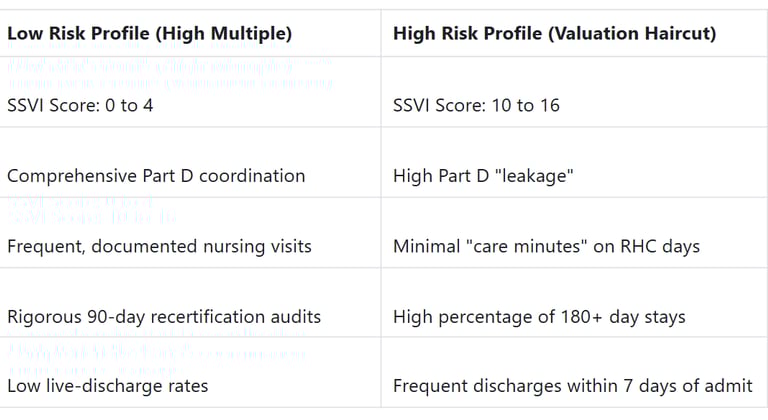
To stay ahead, you must also keep a pulse on regional trends. For instance, CMS has expanded oversight in states like Georgia and Ohio due to high fraud rates. This regional pressure often ripples out to the rest of the country. For more context on how state-level actions impact the industry, see our post on Nevada's action against hospice fraud.
Documentation is the Best Defense
In the event of an audit triggered by a high SSVI score, your clinical documentation is your only shield. Buyers will look at your charts to see if the "long-stay" patients truly meet the criteria for hospice. If your documentation is thin, the buyer will assume the worst and lower their offer.
Investing in staff retention and training is often the best way to ensure documentation stays sharp. We have found that agencies with high retention rates almost always have better compliance scores. For more on this, read why your retention rate is our number one valuation multiplier.
So what should you do now?
If you are concerned about your agency's SSVI score or how it might affect your future exit, here are three immediate steps:
Pull your PEPPER reports and check the Hospice Center webpage. Know your score before a buyer does.
Audit your "Long LOS" patients. Ensure every patient over 180 days has ironclad documentation of decline.
Review your medication spend. If your non-hospice spending is high, you need to bring those costs under your per diem to show CMS you are managing the terminal illness.
Request a confidential valuation review. At Senate Healthcare, we can help you understand how your specific risk profile compares to the agencies we are currently acquiring.
Partnering with Senate Healthcare
Senate Healthcare is an acquiring entity. We are actively looking to partner with and purchase home health or hospice agencies that are looking for a transition. We understand that no agency is perfect, and we are willing to work with owners to navigate the complexities of the new SSVI landscape.
Our goal is to provide a smooth exit for owners while ensuring the legacy of care they have built continues. If you are curious about what your agency is worth in the age of the SSVI, we should talk. We focus on direct acquisitions, not brokerage, which means a faster and more confidential process for you.
To discuss your agency’s future, visit our healthcare partnership consultation page.
This post explores the newly introduced CMS Service and Spending Variation Index (SSVI) and its direct impact on hospice agency market value. We provide actionable steps for owners to manage these risk scores before they become a permanent hurdle in a potential sale or partnership.
Quick-Scan Summary
Who this is for
Hospice agency owners with annual revenues between $2M and $10M.
Operators planning for a transition or sale within the next 12 to 24 months.
Clinical directors focused on maintaining compliance standards under new CMS oversight.
Key takeaways
The SSVI is a new 16-point "risk scorecard" that CMS uses to flag agencies for audits and oversight.
High SSVI scores are now public, meaning potential buyers will see your risk profile before they even sign an NDA.
A high risk score can result in significant valuation "haircuts," potentially stripping millions from an agency’s exit price.
Proactive management of non-hospice spending and live discharge patterns is the only way to protect your multiplier.
Plain-Language Glossary
SSVI (Service and Spending Variation Index): A scoring system used by CMS to measure how much a hospice's billing and care patterns differ from national averages.
EBITDA Multiple: A number (e.g., 5x or 6x) multiplied by your annual earnings to determine the total purchase price of your business.
Non-Hospice Spending: Costs for drugs or services that Medicare pays for outside of the hospice per diem while a patient is under your care.
Live Discharge: When a patient is removed from hospice care while still alive, often scrutinized by CMS if it happens frequently or very shortly after admission.
The New Reality of Hospice Transparency
For years, hospice owners operated in a world where internal data stayed internal until a buyer started their deep-dive due diligence. Those days are over. With the introduction of the Service and Spending Variation Index (SSVI), CMS is moving toward a model of radical transparency.
This is not just another internal report. CMS has begun posting provider-level SSVI scores on the Hospice Center webpage. This means your agency’s perceived risk is now a matter of public record. In the current market, where we are actively evaluating acquisitions, a public risk score is often the first thing a buyer looks at. If your score is high, it signals potential "program integrity" issues, which translates to risk. And in the world of M&A, higher risk always leads to lower valuations.
Unlock Your 30-Minute Agency Succession Review
Maybe you're ready to expand your reach, or perhaps it's time to consider your legacy and the future of your business. Either way, it all begins with a conversation. Schedule a confidential, no-obligation call to explore what the future might hold for you and your business.
Complete the form, and we'll reach out for a chat...


© 2025 SENATE HEALTHCARE LLC.
ALL RIGHTS RESERVED