
Does Your Payer Mix Really Matter in 2026?
Is your large patient census actually hurting your agency's value? As we navigate 2026, the 38 percent gap between Medicare Advantage and traditional Medicare reimbursement has changed the rules of the game. Discover how payer selectivity and margin management can increase your sale price by millions. We explore the data every home health or hospice owner needs to see before planning their exit.
7/6/20266 min read


Payer mix has evolved from a back-office accounting metric into the single most important factor for agency valuation and long-term sustainability. This post explores why home health or hospice owners must look beyond total census and focus on the profitability of each patient to maximize their eventual sale price.
Quick-Scan Summary
Who this is for:
Owner-operators of home health or hospice agencies with $2 million to $10 million in annual revenue who are considering a sale or seeking a strategic partner to help manage increasing reimbursement pressure.
Key takeaways:
Medicare Advantage enrollment has surpassed 35 million members, creating a massive shift in how agencies are paid.
A 38 percent reimbursement delta exists between traditional Medicare and Medicare Advantage, making high-volume, low-margin models risky.
Buyers like Senate Healthcare now prioritize quality of revenue over total patient volume when underwriting new acquisitions.
Strategically limiting admissions from low-paying payers can actually increase your agency’s total valuation by improving EBITDA margins.
The New Reimbursement Reality
The landscape for home health or hospice providers has shifted significantly as we move through 2026. According to data from the Kaiser Family Foundation (KFF) reported by Trella Health, Medicare Advantage (MA) enrollment hit more than 35 million members as of February 2026. This is no longer a small segment of the market: it is the market. For many owners in the $2 million to $10 million revenue band, this shift has brought unexpected financial strain.
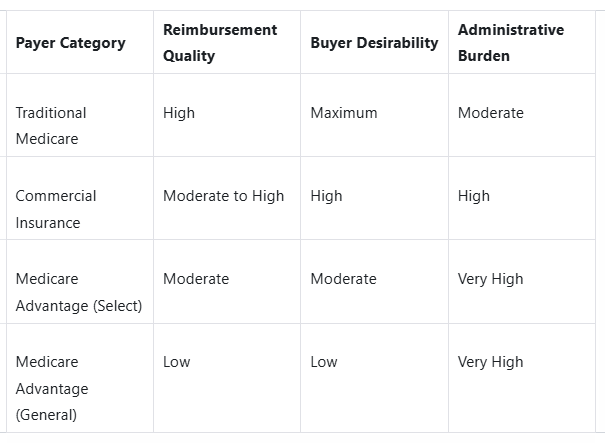
A recent Home Health Care News (HHCN) survey found that 56.2 percent of home-based care leaders identify Medicare Advantage as the primary source of financial pressure on their organizations. This pressure stems from a staggering 38 percent delta between traditional Medicare and Medicare Advantage reimbursement rates. When you are operating an agency with high overhead and staffing costs, losing nearly 40 percent of your potential revenue per patient is a recipe for burnout and eventual insolvency.
The Centers for Medicare and Medicaid Services (CMS) finalized a 1.3 percent aggregate decrease for 2026, which represents about $220 million in reduced funding. For the average operator, these cuts mean that every dollar of revenue must be scrutinized. We are seeing more own


Why Buyers Scrutinize Your Payer Mix
When we evaluate a potential acquisition at Senate Healthcare, we do not just look at your total revenue. We look at the quality of that revenue. An agency with $5 million in revenue derived primarily from traditional Medicare is worth significantly more than an agency with the same $5 million revenue coming from low-paying Medicare Advantage contracts.
Stoneridge Partners noted in their 2026 M&A Outlook that a balanced mix is the new sweet spot for buyers. This mix includes traditional Medicare, solid commercial contracts, and manageable Medicare Advantage exposure. Buyers are looking for agencies that have already figured out how to balance these sources without sacrificing clinical outcomes.
The logic is simple: high-margin revenue allows for better staffing, higher clinical quality, and lower administrative burden. Low-margin revenue requires more volume to cover fixed costs, which often leads to staff burnout and lower patient satisfaction scores. As an acquirer, we prefer to partner with agencies that have built a sustainable foundation.
Concrete Valuation Scenarios
To understand how payer mix impacts your exit price, consider two hypothetical home health agencies both generating $5 million in annual revenue.
Agency A: The Volume Chaser
Payer Mix: 80 percent Medicare Advantage, 20 percent Traditional Medicare.
EBITDA Margin: 5 percent (approx. $250,000).
Buyer Perception: High risk, high administrative burden, low clinical reinvestment.
Valuation Multiple: 3.0x EBITDA.
Sale Price: $750,000.
Agency B: The Margin Maximizer
Payer Mix: 70 percent Traditional Medicare, 20 percent Medicare Advantage, 10 percent Commercial.
EBITDA Margin: 15 percent (approx. $750,000).
Buyer Perception: Stable cash flow, sustainable staffing, high quality of earnings.
Valuation Multiple: 5.5x EBITDA.
Sale Price: $4,125,000.
Despite having the same top-line revenue, Agency B is worth over $3 million more because they managed their payer mix effectively. MedPAC projections suggest that freestanding home health agencies can maintain a 19 percent margin on traditional Medicare in 2026. If your margins are significantly lower than that, it is almost certainly a payer mix or operational efficiency issue that will impact your sale price.


Payer Selectivity: The 73 Percent Rule
One of the most interesting trends we have observed in 2026 is the rise of payer selectivity. According to HHCN data, 73 percent of providers have limited new admissions for certain payers over the past 12 months. Owners are finally saying no to contracts that do not cover the cost of care.
This strategy might seem counterintuitive to owners who were taught that growth is always good. However, in an environment with fixed labor costs and rising inflation, taking on a patient that pays less than your cost to provide the service is a guaranteed loss. We are seeing savvy operators use their data to identify which contracts are dragging down their overall valuation.
Owner Vignette: The Census Trap
Consider a home health agency owner we recently spoke with who was managing a census of 400 patients. While the agency was busy, the owner was exhausted and the business was losing money. The majority of their patients were under a low-reimbursement Medicare Advantage plan that required extensive prior authorizations and provided only a fraction of the traditional Medicare rate.
The agency had a -20 percent EBITDA margin. After a hard look at the numbers, the owner made the difficult decision to terminate the unprofitable contracts and shrink the census. Within six months, the census dropped from 400 to 120 patients. However, those 120 patients were mostly traditional Medicare or high-paying commercial cases.
The result was a shift from -20 percent EBITDA to a +8 percent EBITDA margin. The business became smaller in terms of patient count, but it became much more valuable to a buyer. The owner was no longer managing a crisis every day, and the agency was finally positioned for a successful partnership or sale.
Plain-Language Glossary
EBITDA: A measure of a company's overall financial performance, calculated as earnings before interest, taxes, depreciation, and amortization.
Payer Mix: The proportion of patients an agency serves, categorized by how their care is paid (e.g., Medicare, Medicare Advantage, Medicaid, or Private Pay).
Underwriting: The process a buyer like Senate Healthcare uses to assess the risk and potential value of an agency before making an offer.
Multiple: The factor by which a buyer multiplies an agency's EBITDA to determine the total purchase price.
Reimbursement Delta: The gap in payment rates between two different payer sources for the same clinical service.
So what should you do now?
Audit your profitability by payer: Use your 2026 data to calculate the exact EBITDA margin for each insurance contract you hold.
Review your admission criteria: Empower your clinical intake team to prioritize traditional Medicare and high-reimbursement cases.
Identify your exit timeline: If you plan to sell within the next 24 months, start shifting your payer mix now to show a history of margin improvement.
Consult with an acquirer: Reach out to a buyer like Senate Healthcare to understand how your current mix impacts your agency's market value.
Partner with Senate Healthcare
The transition from a volume-based business to a value-based one is difficult to navigate alone. At Senate Healthcare, we acquire and partner with home health or hospice agencies to help them overcome these reimbursement challenges. We are not brokers or advisors: we are the entity that buys and operates these businesses to build a national standard of care.
If you are an owner-operator in the $2 million to $10 million revenue band and you feel the weight of Medicare Advantage pressure, we should talk. We can help you evaluate your current standing and explore an acquisition that secures your legacy while ensuring your patients continue to receive high-quality care.
Visit us at www.senatehealthcare.com to learn more about how we partner with owners like you.


Unlock Your 30-Minute Agency Succession Review
Maybe you're ready to expand your reach, or perhaps it's time to consider your legacy and the future of your business. Either way, it all begins with a conversation. Schedule a confidential, no-obligation call to explore what the future might hold for you and your business.
Complete the form, and we'll reach out for a chat...


© 2025 SENATE HEALTHCARE LLC.
ALL RIGHTS RESERVED