
7 Mistakes You’re Making with Caregiver Retention (And How It’s Tanking Your Valuation)
Is your "revolving door" of staff costing you millions in your eventual sale? This article breaks down the seven most common caregiver retention mistakes that home health and hospice owners make and how they lead to massive valuation haircuts. Learn the specific math buyers use to price agencies and what you can do today to secure a premium exit.
5/14/20266 min read


This article explores why caregiver retention is the most critical metric for home health or hospice owners looking to maximize their sale price. We identify seven common operational mistakes that cause valuation haircuts and explain how buyers like Senate Healthcare LLC evaluate people risk during due diligence.
Quick-Scan Summary
Who this is for:
Home health or hospice owners with $2M to $10M in annual revenue.
Operators feeling burnt out by the constant "revolving door" of staffing.
Owners considering an exit within the next 12 to 24 months.
Key Takeaways:
Stability is now a primary driver of EBITDA multiples in the 2026 market.
A single turnover event costs an average of $4,200 in direct and indirect expenses.
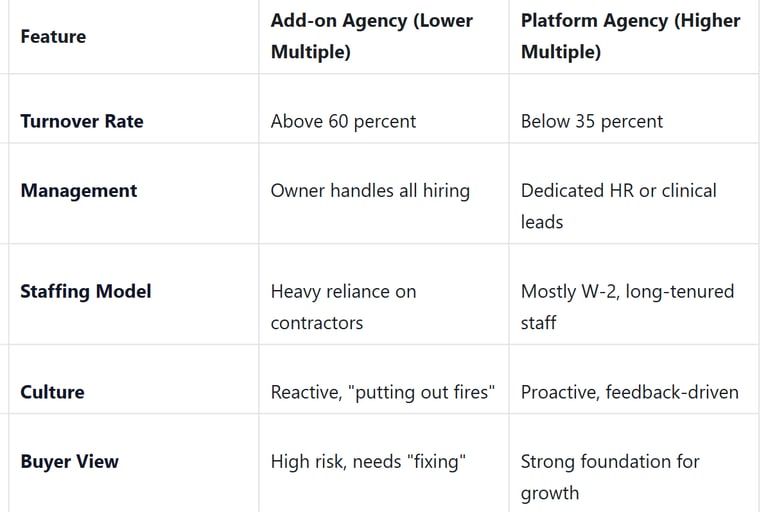
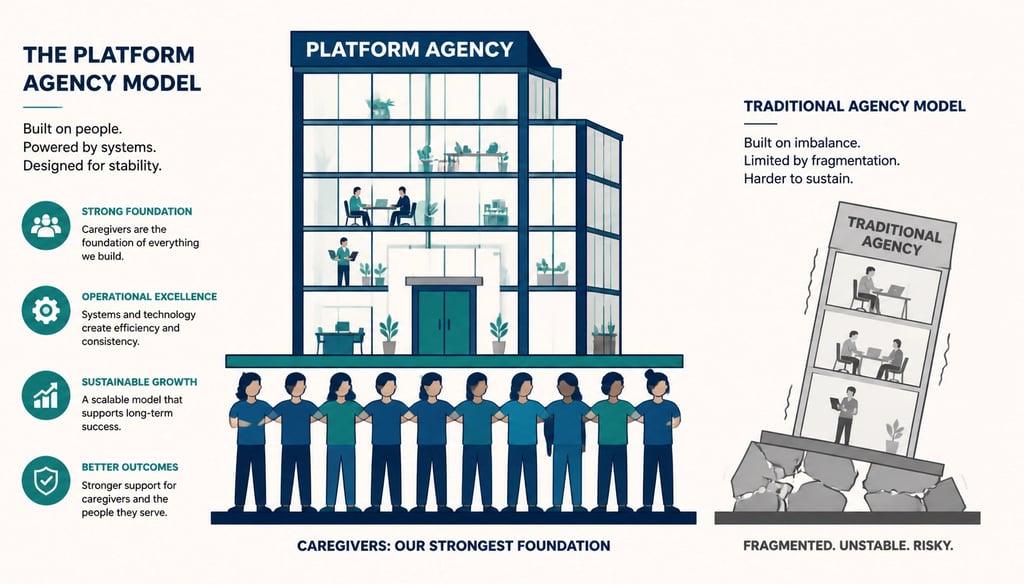
Agencies with high turnover are often viewed as "add-ons" rather than "platforms," leading to significantly lower offers.
Addressing culture and communication is a prerequisite for a premium exit.
The 2026 Market Context: Retention is the New Revenue
In the current M&A landscape, scale is no longer the only factor that determines what a buyer will pay for your agency. As of early 2026, sophisticated acquirers are shifting their focus toward workforce stability and key performance indicators related to staff satisfaction. According to Home Health Care News (HHCN), buyers now prioritize these human capital metrics because they are the strongest predictors of future clinical quality and financial performance.
For an owner-operator, this means that a high turnover rate is not just an HR headache. It is a direct drain on your final walk-away number. When Senate Healthcare evaluates a potential acquisition, we look past the top-line revenue to see if the engine of the business, the caregivers, is built to last.
The Owner’s Burden: Why Retention Feels Impossible
Many owners in the $2M to $10M revenue range find themselves trapped in a cycle of "hiring to fill holes." You spend your mornings recruiting and your afternoons dealing with call-outs. This creates a state of permanent "key-person dependence" where the owner is the only thing holding the culture together.
Consider the story of an anonymized owner we will call Robert. Robert ran a successful $6M hospice agency. On paper, his margins were healthy. However, his annual caregiver turnover was nearly 80 percent. He was exhausted and ready to retire, but when he looked for a buyer, he was shocked by the low offers. Buyers saw a business that would likely collapse the moment Robert stopped personally managing the schedule. His "people risk" was so high that it wiped millions off his potential valuation.
The Valuation Math: How Turnover Hits Your Bottom Line
To understand how retention affects your price, you have to look at the EBITDA (Earnings Before Interest, Taxes, Depreciation, and Amortization) multiples. Based on the Focus Bankers 2026 Report, small agencies under $5M in revenue typically trade between 3x and 6x EBITDA. Regional players might see 6x to 9x.
Let’s look at a concrete scenario:
Agency A: $1,000,000 EBITDA with a 75 percent turnover rate.
Because the risk of staff leaving after a sale is high, a buyer might only offer a 3.5x multiple.
Sale Price: $3.5 Million.
Agency B: $1,000,000 EBITDA with a 25 percent turnover rate.
This agency demonstrates a stable culture and repeatable systems. A buyer is willing to pay a 5.5x multiple for this stability.
Sale Price: $5.5 Million.
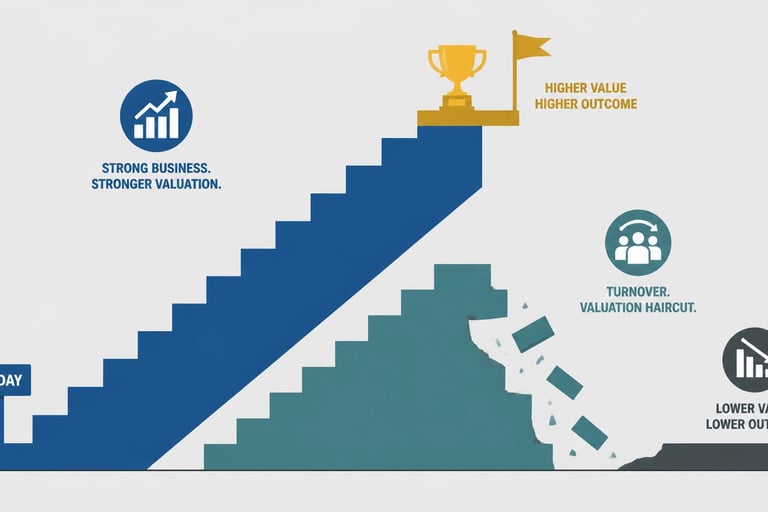
By failing to fix retention, Agency A loses $2 Million in value on the exact same earnings. Furthermore, research from the National Center for Biotechnology Information (PMC) shows that each turnover event costs providers roughly $4,200. If you lose 50 caregivers a year, that is $210,000 in lost profit before you even consider the impact on your multiple.
7 Mistakes That Are Tanking Your Valuation
1. Treating Onboarding as a Compliance Checkbox
Many agencies view onboarding as a day of signing forms and watching safety videos. This is a missed opportunity to build a connection. When a caregiver feels like a number from day one, they will leave for an extra fifty cents an hour elsewhere. Sophisticated buyers look for agencies that have a structured "first 90 days" program.
2. Persistent Payroll Errors
Nothing destroys trust faster than a late or incorrect paycheck. Data shows that even two payroll errors can cause nearly half of your staff to start looking for a new job. In due diligence, we look at your administrative systems. If payroll is messy, we assume clinical documentation and billing are likely messy too.
3. Communicating Only for Logistics
If the only time a caregiver hears from the office is to be told they need to pick up a shift or that they forgot a signature, they feel like a tool rather than a team member. This isolation is a major driver of turnover in home health or hospice care.
4. The "Commodity" Mindset
If you believe that caregivers are easily replaceable, your staff will feel it. This mindset prevents you from investing in the leadership training your middle managers need to actually support frontline workers. Acquirers want to see a management layer that knows how to lead, not just manage schedules.
5. Ignoring Feedback and Exit Interviews
If you are not surveying your staff and, more importantly, acting on that feedback, you are flying blind. When we see an agency that has no process for listening to its workers, we see a business with hidden "people risk" that could explode after the acquisition.
47 percent of failed deals in the home based care sector are linked to inadequate people risk planning. Workforce stability is no longer a soft metric; it defines deal outcomes in 2026.
6. Lack of Clear Career Pathways
Caregivers want to know where they are going. If there is no difference between a first-year employee and a five-year veteran in terms of title, responsibility, or pay, you will lose your best people to hospitals or larger competitors who offer growth.
7. Top-Down Recognition Only
Recognition that only comes from the "big boss" often feels hollow. Successful agencies foster a culture where peers recognize each other. This builds a community that caregivers are hesitant to leave, even for higher pay elsewhere.
Platform vs. Add-on: Where Do You Fit?
How a buyer categorizes your agency determines the multiple they apply. Retention is often the deciding factor.
Plain-Language Glossary
EBITDA: A measure of a company's overall financial performance, used as a proxy for cash flow.
Multiple: The number that a buyer multiplies your EBITDA by to determine the purchase price.
Due Diligence: The "home inspection" phase of a business sale where the buyer verifies all financial and operational data.
People Risk: The likelihood that a business will lose value because key employees or large groups of staff leave.
Acquirer: The entity (like Senate Healthcare) that is buying the business.
Exit Timing: Why You Should Act Now
If you are planning to sell your home health or hospice agency in the next year, you cannot wait until the "For Sale" sign is up to fix your culture. Buyers look at 12 to 24 months of historical data. If we see a sudden drop in turnover right before a sale, we might view it as an anomaly. We want to see sustained stability.
At Senate Healthcare, we look for agencies that have the "bones" of a great culture, even if they aren't perfect yet. We partner with owners to stabilize operations and provide a clear path to succession that protects both the staff and the owner's legacy.
So what should you do now?
Audit your turnover costs: Calculate exactly how much you spent on recruiting, background checks, and orientation over the last 12 months to see the "hidden" profit you are losing.
Implement a 90-day touchpoint: Schedule formal check-ins at day 30, 60, and 90 for every new hire to catch issues before they quit.
Clean up administrative friction: Ensure your payroll and scheduling software are working for your caregivers, not against them.
Evaluate your exit readiness: Reach out to a potential acquirer like Senate Healthcare to understand how your current retention metrics would impact a valuation today.
Partner With Senate Healthcare LLC
If you are a home health or hospice owner in the $2M to $10M revenue range and you are tired of the staffing grind, we are here to talk. We are not brokers or advisors; we are a dedicated buyer looking to acquire and grow high-quality agencies. Our goal is to reduce your operational risk and provide a fair, transparent exit strategy that values the hard work you have put into your team.
Contact us today to discuss how we can work together to ensure your agency’s future.
Unlock Your 30-Minute Agency Succession Review
Maybe you're ready to expand your reach, or perhaps it's time to consider your legacy and the future of your business. Either way, it all begins with a conversation. Schedule a confidential, no-obligation call to explore what the future might hold for you and your business.
Complete the form, and we'll reach out for a chat...


© 2025 SENATE HEALTHCARE LLC.
ALL RIGHTS RESERVED