
2026 Home Care M&A Secrets: What Agency Owners Need to Know Now
Wondering what your home care or hospice agency is worth in today's market? This guide breaks down the "secrets" of 2026 M&A, including how Medicare Advantage is impacting valuations and why compliance is your biggest leverage point. Learn the difference between platform and add-on acquisitions and see how to calculate your potential exit price.
5/28/20266 min read


This article explores the shifting landscape of home health or hospice acquisitions in 2026 and identifies the specific factors driving valuation today. We break down what owners in the $2M to $10M revenue range must prioritize to maximize their exit value and ensure a smooth transition.
Quick-Scan Summary
Who this is for:
Owners of home health or hospice agencies with $2M to $10M in annual revenue.
Healthcare entrepreneurs weighing the pros and cons of selling to an acquirer versus pursuing a full exit.
Operators feeling the pressure of reimbursement changes and staffing shortages.
Key Takeaways:
Valuations are highly bifurcated, with premium multiples reserved for agencies with a clean Medicare mix.
Compliance and clinical documentation are no longer just checkboxes; they are primary deal drivers.
Medicare Advantage penetration is the single biggest factor influencing buyer underwriting and price adjustments.
Senate Healthcare is actively evaluating acquisitions to expand our portfolio of quality-focused agencies.
The 2026 Market Context: Disciplined But Active
The home health or hospice market in 2026 is characterized by a "return to fundamentals." While the post-pandemic years saw a frenzy of activity and inflated multiples, the current environment is more disciplined. Buyers are looking for sustainable growth and operational excellence rather than just rapid expansion.
Recent data suggests that deal volume has stabilized after a period of volatility. For example, in the first quarter of 2026, home health transactions reached their highest point in over a year. This uptick is partly due to the CY 2026 Home Health Final Rule, which provided more favorable rate changes than initially feared. This regulatory clarity has given buyers the confidence to move forward with acquisitions, knowing that the reimbursement floor is relatively secure.
According to the Mertz Taggart Q1 2026 Home-Based Care M&A Report, hospice remains a particularly active subsector. The demand for high-quality hospice assets continues to outpace supply, creating a competitive environment for agencies that can demonstrate strong clinical outcomes and clean compliance records.
Owner Pain Points: Why Now?
Many agency owners are finding themselves at a crossroads. The challenges of running a home health or hospice business have grown more complex. We frequently hear from owners about several recurring pain points:
Succession Risk: Many founders are ready to step back but do not have a clear internal successor. This "key-person dependence" can lead to a valuation haircut if the business cannot function without the owner’s daily involvement.
The Reimbursement Squeeze: While rates have stabilized, the overhead required to manage multiple payer sources and regulatory requirements continues to climb. Smaller agencies often lack the scale to absorb these costs efficiently.
Audit Anxiety: With increased scrutiny from the OIG and Medicare contractors, the risk of a retrospective audit is a constant source of stress.
Staffing Burnout: The perpetual battle for nurses and therapists has made scaling difficult for independent operators.
At Senate Healthcare, we acquire agencies to solve these specific problems. By selling to or partnering directly with us as the acquirer, owners can secure their legacy while ensuring their patients and employees are transitioned into a larger, more resource-rich organization.


The Valuation Math: Quantifying Your Upside
Understanding how your agency is valued is critical before entering any discussions. In 2026, most buyers use a multiple of EBITDA (Earnings Before Interest, Taxes, Depreciation, and Amortization) to determine the purchase price. However, the specific multiple applied to your EBITDA depends on your size, quality, and payer mix.
For a hospice agency generating $1M in EBITDA, the valuation range can be wide:
A smaller agency with thin margins and high staff turnover might see a multiple of 4.5x to 6.5x, resulting in a valuation of $4.5M to $6.5M.
A mid-sized, high-quality agency with a diversified referral base and clean audits can command 7.0x to 9.0x, pushing the value to $7M to $9M.
A platform-quality asset with strong technology and a wide geographic footprint can even exceed a 9x multiple.
Consider a real-world scenario. An agency owner with $8M in revenue and $1.2M in EBITDA might be offered a 6x multiple ($7.2M) because their documentation is disorganized. By spending six months improving compliance and stabilizing their clinical team, they could potentially move that multiple to 8x, increasing their sale price by $2.4M. This is why "exit readiness" is so valuable.
Platform vs. Add-on: Where Do You Fit?
When we evaluate a potential acquisition at Senate Healthcare, we look at whether an agency will serve as a "platform" or an "add-on."
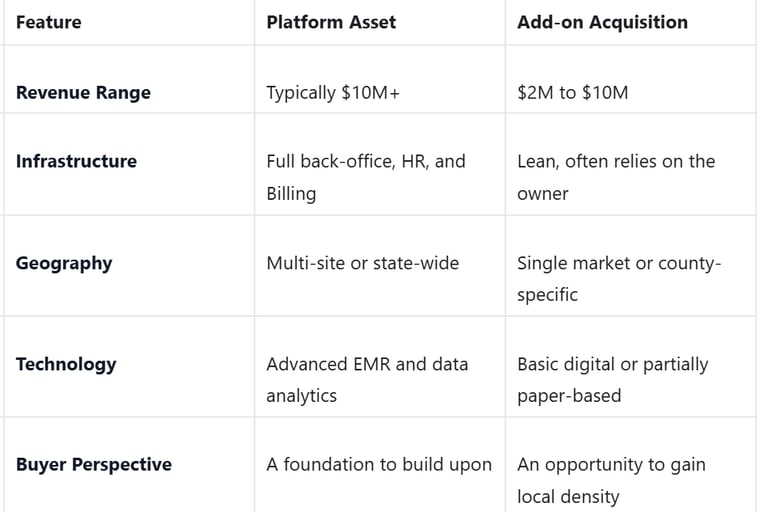
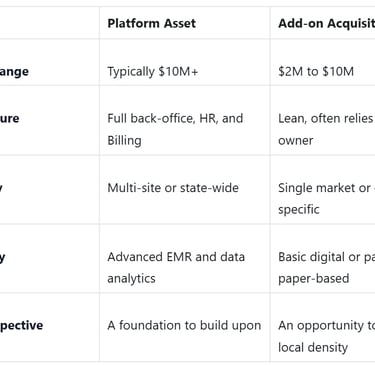
Most owners in the $2M to $10M range are considered add-on acquisitions. This is a strong position to be in because larger strategic buyers like Senate Healthcare are always looking for ways to increase their "density" in a specific market to improve staffing efficiencies and referral relationships.


The Medicare Advantage Factor
You cannot talk about M&A in 2026 without discussing Medicare Advantage (MA). As traditional Medicare enrollment shifts toward MA, the way buyers underwrite deals has changed. Medicare Fee-For-Service remains the "gold standard" because of its predictable rates and lower administrative burden.
Agencies with a high concentration of low-paying Medicare Advantage contracts are seeing their valuations compressed. Buyers look closely at the "realized margin" for each payer. If 50% of your patients are under an MA plan that pays 20% less than traditional Medicare, your EBITDA is not only lower, but it is also perceived as higher risk.
To protect your valuation, it is essential to demonstrate that you can manage MA patients profitably. This includes having strong utilization management and data that shows low readmission rates. As noted by Stoneridge Partners in their 2026 Outlook, payer-level profitability is now a standard requirement in due diligence.
Timing Your Exit in 2026
Why is 2026 a pivotal year for home health or hospice owners? The "window" is currently open due to the stability of interest rates and the clarity on reimbursement. Waiting too long could expose you to the next cycle of regulatory changes or a potential economic downturn that might tighten buyer budgets.
Furthermore, the new TEAM (Transforming Episode Accountability Model) launched in January 2026. This model makes hospitals more accountable for the total cost of a patient's care. If your agency is a high-performer that helps hospitals achieve these goals, your strategic value to a buyer like Senate Healthcare has never been higher.


Plain-Language Glossary
EBITDA: A measure of a company's overall financial performance, used as a proxy for cash flow. It stands for Earnings Before Interest, Taxes, Depreciation, and Amortization.
Multiple: The number that EBITDA is multiplied by to determine the enterprise value of a business.
Payer Mix: The percentage of your revenue that comes from different sources like Medicare, Medicare Advantage, Medicaid, or Private Pay.
Due Diligence: The period during an acquisition where the buyer deeply inspects your financials, clinical records, and legal contracts.
LUPA: Low Utilization Payment Adjustment. This occurs in home health when there are too few visits in an episode, resulting in a lower payment.
So what should you do now?
Audit Your Own Records: Conduct a "mock audit" of your clinical documentation. Fixing errors now prevents a buyer from finding them later and dropping the price.
Analyze Your Payer Mix: Break down your profitability by payer. If a specific Medicare Advantage contract is losing you money, consider if the volume is worth the margin hit.
Clean Up Your Financials: Ensure your personal expenses are not co-mingled with business expenses. Clean books lead to faster closings.
Reach Out for a Confidential Consultation: You do not have to be "ready to sell today" to start a conversation.
Partner with Senate Healthcare
At Senate Healthcare, we are not brokers or advisors looking for a commission. We are the buyer and acquirer. Our goal is to transform home care and hospice services into a trusted national brand by acquiring high-quality local agencies and partnering directly with owners. If you are an owner-operator considering your next chapter, we would like to talk. Our process is streamlined and designed to maintain the quality of care you have worked so hard to build.
Visit www.senatehealthcare.com to learn more about our acquisition criteria or to schedule a confidential discussion with our team.


Unlock Your 30-Minute Agency Succession Review
Maybe you're ready to expand your reach, or perhaps it's time to consider your legacy and the future of your business. Either way, it all begins with a conversation. Schedule a confidential, no-obligation call to explore what the future might hold for you and your business.
Complete the form, and we'll reach out for a chat...


© 2025 SENATE HEALTHCARE LLC.
ALL RIGHTS RESERVED