
10 Reasons Your Agency’s Valuation Isn't What You Expected (And How to Fix It)
Wondering why your home health or hospice agency valuation isn't hitting the numbers you expected? This guide breaks down the 10 critical factors currently driving M&A multiples in 2026, from compliance risks to owner dependency. We provide concrete examples of how small changes in your operations can lead to millions of dollars in additional value at the closing table. Learn how to move your agency from a low-multiple "add-on" to a high-value strategic asset.
5/18/20266 min read


This article explores the specific factors currently driving home health and hospice valuations in 2026 and provides a roadmap for owners to maximize their sale price. We examine the common pitfalls that lead to lower-than-expected offers and how you can position your agency to attract premium multiples from acquirers like Senate Healthcare.
Quick-Scan Summary
Who this is for: Home health or hospice owners with $2 million to $10 million in annual revenue considering an exit or partnership.
Key takeaways: Valuation is a reflection of risk and quality rather than just size. Improving compliance, diversifying payer mixes, and reducing owner dependency are the fastest ways to move from a 3x multiple to a 7x multiple.
The 2026 M&A landscape for home health and hospice has shifted away from the volume-heavy strategies of the early 2020s. Today, buyers are disciplined, data-driven, and highly sensitive to regulatory headwinds. If you are an owner looking at the market, you might hear about record-breaking multiples and wonder why the initial feedback on your own agency feels conservative.
At Senate Healthcare, we evaluate many agencies for potential acquisition. We often see a disconnect between an owner’s perceived value and the reality of a buyer’s underwriting process. The gap usually comes down to "investment readiness." While you see a decade of hard work and community service, a buyer sees a series of risks that must be priced into the deal. Understanding these risks is the first step toward fixing them.
The Current Market Context
As we move through the second quarter of 2026, the market is characterized by a bifurcation of value. According to the FOCUS Bankers 2026 Report, multiples for smaller agencies with less than $5 million in revenue typically trade between 3x and 6x EBITDA, while larger regional players can command 6x to 10x.
However, size is not the only factor. Recent insights from Home Health Care News indicate that even single-state providers can reach the 7x to 10x range if they possess strategic value, such as a highly diversified payer mix or specialized clinical programs. Conversely, generalist agencies that have not adapted to 2026 regulatory standards face commoditization risk and lower offers.
10 Reasons for a Valuation Haircut (and the Fixes)
1. High Compliance and Audit Risk
The number one value killer in 2026 is a "dirty" clinical record. With increased regulatory scrutiny noted by the Braff Group, buyers will discount your price if they suspect future "clawbacks" from Medicare.
The Fix: Conduct a mock ADR (Additional Documentation Request) audit now. If your error rate is above 10 percent, hire a third-party consultant to clean up your documentation processes before you engage with a buyer.
2. Over-Reliance on a Single Payer
If 90 percent of your revenue comes from a single Medicare Advantage contract that is currently being squeezed, your agency is viewed as high-risk. Payer volatility is a major headwind for unprepared sellers.
The Fix: Aim for a balanced mix. Ideally, no single payer should represent more than 30 percent of your total census. Senate Healthcare looks for agencies that have successfully navigated the shift toward diversified payer models.
3. Owner-Centric Operations
Does every major clinical or financial decision go through your desk? If you are the primary relationship holder for your referral sources, the business cannot thrive without you. This forces a buyer to demand a longer "earn-out" or a lower purchase price.
The Fix: Promote a clinical director or a general manager to handle daily operations. Step back from the front-line referral relationships and introduce your management team to your key hospital partners.


4. High Staff Turnover and Contract Labor
In 2026, clinical labor is the most valuable currency. If your margins are built on the backs of expensive 1099 contractors or agency staff, your EBITDA is considered "low quality."
The Fix: Focus on retention programs and full-time hiring. A buyer will pay a premium for a stable, loyal W-2 workforce because it ensures continuity of care and lower long-term costs.
5. Stagnant or Declining Census
Buyers pay for the future, not the past. If your census has been flat for three years, you are selling a "lifestyle business" rather than a growth asset.
The Fix: Reinvigorate your sales team with a focus on high-acuity referrals. Show a clear "upward tick" in the six months leading up to a sale to prove your agency still has momentum.
6. Low Quality Scores and Star Ratings
Quality is no longer a "nice to have" feature. In a value-based care environment, low Star ratings or poor HCAHPS scores directly impact your reimbursement potential and your valuation.
The Fix: Implement a rigorous Quality Assurance and Performance Improvement (QAPI) program. Improving your Star rating by even half a point can significantly increase your EBITDA multiple.
7. Poor Financial Visibility and "Messy" Books
If your P&L statement includes personal expenses, family cell phone plans, or non-business travel, it creates work for the buyer's accountants. Messy books lead to "deal fatigue" and lower trust.
The Fix: Work with a healthcare-specific bookkeeper to "normalize" your EBITDA. Remove personal expenses at least 12 months before an exit so the financial records are transparent and easy to audit.
8. Lack of Technology Integration
Agencies still relying on paper charts or outdated EMR systems are viewed as inefficient. In 2026, data is key to proving outcomes to payers.
The Fix: Invest in a modern, scalable EMR. Being able to export real-time data on patient outcomes makes your agency much more attractive to strategic acquirers.
9. Concentration of Referral Sources
If half of your referrals come from one single physician group or one hospital discharge planner, you are one retirement or policy change away from losing half your business.
The Fix: Diversify your referral network. No single source should provide more than 20 percent of your admissions.
10. Geography and "Add-on" Status
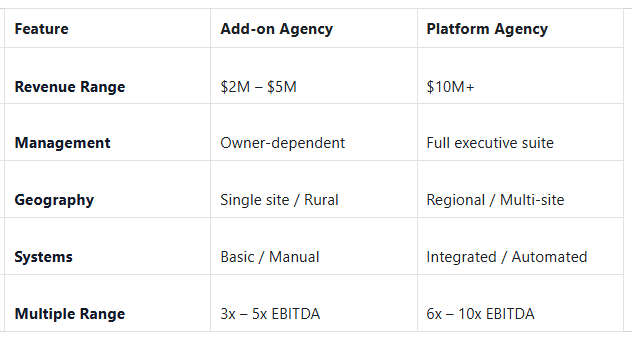
If your agency is in a rural area with limited growth potential, it may be viewed as an "add-on" rather than a "platform." Add-ons typically trade at lower multiples because they require more oversight from the parent company.
The Fix: If you are in a smaller market, focus on becoming the undisputed leader in that niche. High market share in a small area can still command a premium if the operations are flawless.
Valuation Math: The $3 Million Difference
To illustrate the impact of these factors, let’s look at two hypothetical hospice agencies, both generating $1 million in EBITDA.
Agency A (High Risk):
Owner-operated (no second-in-command).
70% Medicare Advantage concentration.
3-Star rating.
Messy financials.
Valuation Multiple: 3.5x
Purchase Price: $3,500,000
Agency B (Optimized):
Full management team in place.
Diversified payer mix (Medicare, MA, and Private Pay).
4.5-Star rating.
Clean, audited financials.
Valuation Multiple: 6.5x
Purchase Price: $6,500,000
By addressing the ten points listed above, the owner of Agency B effectively "found" $3 million in additional value without increasing their bottom-line profit.
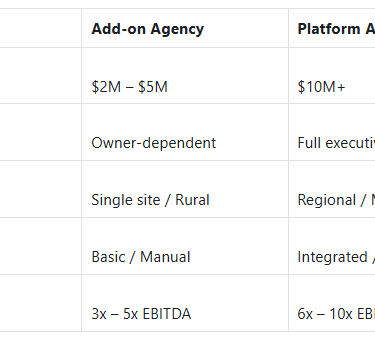
Platform vs. Add-on: How Buyers Classify You
Understanding how Senate Healthcare or other acquirers categorize your business helps you set realistic expectations.
The Importance of Exit Timing
Many owners wait until they are burnt out to sell. Unfortunately, burnout often leads to declining quality and stagnant growth, which are exactly when your valuation is at its lowest. The best time to partner with an acquirer like Senate Healthcare is when your agency is performing well but requires more capital or infrastructure to reach the next level.
Stoneridge Partners emphasizes that buyers in 2026 favor quality and compliance over pure size. If you sell while your metrics are peaking, you retain the most leverage in negotiations.
Plain-Language Glossary
EBITDA: Earnings Before Interest, Taxes, Depreciation, and Amortization. This is the standard measure of a company's operating performance.
Multiple: The number used to multiply your EBITDA to determine the purchase price (e.g., $1M EBITDA x 5 multiple = $5M valuation).
Normalization: The process of adjusting your financial statements to remove one-time expenses or personal costs that a new owner wouldn't have.
Due Diligence: The "investigation" phase where a buyer verifies your clinical, financial, and legal records.
Payer Mix: The breakdown of where your revenue comes from (e.g., Medicare, Medicaid, Private Insurance).
So what should you do now?
If you are considering a sale in the next 12 to 24 months, start these operator-focused steps today:
Audit Your Clinical Files: Hire an external firm to review 20 to 30 random charts to identify and fix recurring documentation gaps.
Step Back From Daily Operations: Delegate one major responsibility to a staff member this month to begin reducing owner-dependency.
Clean Your Financials: Stop running non-essential personal expenses through the business to ensure a "clean" EBITDA calculation for 2026.
Review Your Payer Contracts: Identify your least profitable contracts and either renegotiate them or focus your sales efforts on higher-margin payers.
Partner with Senate Healthcare
Senate Healthcare is not a broker or an advisor; we are an active buyer looking for high-quality home health or hospice agencies to join our portfolio. We understand the challenges of running an agency in today's regulatory environment because we are operators at heart.
Whether you are looking for an immediate exit or a strategic partner to help you navigate the complexities of 2026, we are interested in hearing your story. We value transparency, clinical excellence, and the legacy you have built in your community. Let's discuss how we can reduce your operational risk and help you achieve the valuation your hard work deserves.
Unlock Your 30-Minute Agency Succession Review
Maybe you're ready to expand your reach, or perhaps it's time to consider your legacy and the future of your business. Either way, it all begins with a conversation. Schedule a confidential, no-obligation call to explore what the future might hold for you and your business.
Complete the form, and we'll reach out for a chat...


© 2025 SENATE HEALTHCARE LLC.
ALL RIGHTS RESERVED